

A thread for Democrats Only
POSTED BY: THGRRI
UPDATED: Monday, September 14, 2026 11:03
VIEWED: 756680
PAGE 73 of 73

Quote:
Originally posted by second:Quote:6ix, you are completely fucked up in the head.
Originally posted by 6ixStringJack:
The only problem with that story is that you've had plenty of opportunity to reverse it, but it always gets worse when you guys run the show too.
Go fuck yourself, Paul.
Nobody trusts the likes of you either.
--------------------------------------------------
Be Evil. Be a dick.
I know you are, but what am I?
Go fuck yourself, retard.
The Democratic Party is dead. Finished. You lose everything.
Move out of my country. Everybody hates you.
--------------------------------------------------
Be Nice. Don't be a dick.

NOTIFY: Y | REPLY | REPLY WITH QUOTE | PERMALINK | TOP | HOME

Quote:Above is an example of 6ix's Nihilism.
Originally posted by 6ixStringJack:Quote:
Originally posted by second:Quote:6ix, you are completely fucked up in the head.
Originally posted by 6ixStringJack:
The only problem with that story is that you've had plenty of opportunity to reverse it, but it always gets worse when you guys run the show too.
Go fuck yourself, Paul.
Nobody trusts the likes of you either.
--------------------------------------------------
Be Evil. Be a dick.
I know you are, but what am I?
Go fuck yourself, retard.
The Democratic Party is dead. Finished. You lose everything.
Move out of my country. Everybody hates you.
--------------------------------------------------
Be Evil. Be a dick.
Below is an example of Trump’s Nihilism.
Trump, after getting a private talking-to from Xi, now wants to know why any of this is a big deal.
Trump was asked about concerns that China was inserting code in crucial systems that control various parts of American infrastructure, such as energy, communications, and water. “You don’t know that,” he answered. “I’d like to see it, but it’s very possible that they do. And we’re doing things to them. I told them, ‘We do a lot of stuff to you that you don’t know about, and you are doing stuff to us that we probably do know about.’ We do plenty. It’s a double-edged sword.”
Instead of saying that these cyberattacks were real threats and that the country’s national-security professionals were working to stop them, the president of the United States gave an answer that just as easily could have come from a Chinese official: Secret code in your power grid? You don’t know that. We’d like to see the proof. But you Americans do plenty of things to us that we probably don’t even know about.
The Joss Whedon script for Serenity, where Wash lives, is Serenity-190pages.pdf at https://www.mediafire.com/two
NOTIFY: Y | REPLY | REPLY WITH QUOTE | PERMALINK | TOP | HOME
Trump’s deportations are costing Americans jobs
May 19, 2026
https://attentiontotheunseen.com/2026/05/19/trumps-deportations-are-co
sting-americans-jobs/
The New York Times reports:
The Trump administration has long claimed that mass deportations would deliver more jobs and higher wages to American-born workers. But a new study casts doubt on that assertion, undermining a central tenet of the president’s immigration policy.
Recent surges in deportations have led to job losses for both immigrant and American-born workers, while wages have stayed flat, according to the study, published by the National Bureau of Economic Research, a nonpartisan research organization. Construction, which depends heavily on immigrant labor, was impacted more than any other industry studied, with American-born workers losing more jobs as a result of the deportations than the undocumented workers who remained. https://www.nber.org/papers/w35129?utm_campaign=ntwh&utm_medium=em
ail&utm_source=ntwg5
The study offers the first national analysis of the effects of the Trump administration’s aggressive deportation operations on the labor market, comparing communities that experienced surges in deportations between January 2025 and October 2025 with those that did not.
Analyzing federal labor data, researchers focused on four industries that rely heavily on undocumented immigrant workers: agriculture, construction, manufacturing and wholesale. Deportations had a chilling effect on each of those industries, disproportionately affecting men, who accounted for more than 90 percent of the immigration arrests. Taken together, the affected industries saw a 5 percent drop in employment for male undocumented workers and a 1.3 percent drop for male American-born workers without a college degree.
The researchers found no evidence that employers increased wages to attract American workers. Instead, work slowed.
In construction — where the researchers estimated 15 percent of the workforce is undocumented — American-born workers have paid a price for the deportations, the study found: Employment dropped by 3 percent for male American-born workers without a college degree, and 7.5 percent for undocumented workers. For each arrest, six American-born workers lost a job, and four undocumented workers lost one.
“Construction companies view it as easier to reduce production, reduce the construction of new homes and new buildings in general, rather than try to increase wages for U.S.-born workers,” said Chloe East, an author of the study and an economics professor at the University of Colorado, Boulder.
Previous research has also shown that increased immigration enforcement slows housing construction, drives up home prices and leads to job losses for American-born workers.
The Joss Whedon script for Serenity, where Wash lives, is Serenity-190pages.pdf at https://www.mediafire.com/two
NOTIFY: Y | REPLY | REPLY WITH QUOTE | PERMALINK | TOP | HOME
Barney Frank, now in hospice care, has an urgent message for Democrats hoping to bounce back from Trump
Democrats have a chance to defeat President Donald Trump's brand of right-wing populism, but only if the party embraces core economic issues instead of polarizing culture fights.
By Anthony Brooks
May 14, 2026
https://www.wbur.org/news/2026/05/14/barney-frank-hospice-congress-dem
ocrats-trump
Brooks: Let me start with a very general question. You've been talking to CNN, Politico and other journalists, including me. What is it you want to say about this moment?
Frank: "That it is essential for the values that have driven me into politics to defeat right-wing populism, and that the major obstacle to doing that is the insistence by part of the left wing of pushing everybody to adopt politically unacceptable views. I'm not telling people I don't want them to advocate for those things — I filed a bill to legalize marijuana in 1972 and I didn't think it was going to go anywhere. My problem is that instead of treating some of these reforms as issues which are currently unpopular — for which you have to build support — they instantly make them litmus tests for everybody and therefore make it harder for us to win."
Brooks: What specific examples of litmus tests are you talking about?
Frank: "Open borders is one. Defunding the police would be another, along with insistence on political correctness and transgender participation in girls' sports. And environmental issues like the Green New Deal — they just go too far."
Brooks: Your book is entitled "The Hard Path to Unity: Why We Must Reform the Left to Rescue Democracy." [Publication date September 15, 2026] What other ways does the left have to reform itself?
Frank: "Beginning in the '80s there's a sharp divergence between economic growth and the extent to which that's shared. After the financial crisis, there's anger about inequality and I was one of those trying to get Democrats to move on this. And finally, after the emergence of Bernie Sanders and Donald Trump and people like like Marine Le Pen [in France], there was movement on the economic issue. At that point I had hoped, 'OK, now we're all for fighting inequality and we'll diminish the anger.' But the problem was that those on the left, who had been right on the economic issue, decided that they could do even more changes. They said, 'Good, let's do the economics, but let's get rid of all these cultural and social evils.' And they went way too far. Like a lot of ideologues, they convinced themselves that the public agreed with them far more than it did."
Brooks: I want to ask you about the last 10 years, which have been dominated by Donald Trump. Is the dream of furthering liberal democracy gone for good, or do you think it will come back?
Frank: "It's not gone for good but there's been a lot of harm done. That's why I have a sense of urgency and why I'm taking advantage of this situation to talk about it. If liberal Democrats, not just here in America but elsewhere, do not repudiate the extremism that drives away a lot of voters, we're going to have this kind of [right-wing] populism for the long-term. And as to Trump, I have developed my theory about him: It's not just that he's bad on all these values, but he is an idiot savant. He has just one talent: an ability to exploit anger that got him into power. But having gotten into power, he's got nothing left, and that's why now he's just floundering."
Brooks: You've said that you think he's "imploding."
Frank: "Yes. I cannot think of an issue on which he's popular. The Iran war, the fight with the Pope, the economy, even immigration, where the left was dead wrong in its excessive openness, he's managed to make himself more unpopular. His anger, his narcissism, all of the negative parts of his personality have asserted themselves, and he rea
NOTIFY: Y | REPLY | REPLY WITH QUOTE | PERMALINK | TOP | HOME
Final Five and U.S. Competitiveness
by Jerry Cayford | Posted on Thursday, May 21, 2026 5:00AM
https://3quarksdaily.com/3quarksdaily/author/jerrycayford
https://3quarksdaily.com/3quarksdaily/2026/05/final-five-and-u-s-compe
titiveness.html
California’s primary is in about two weeks, and it’s a mess. The panic is slightly subsiding, though, since Democrats have started polling in one of the top two spots in the race for governor. For months, Republicans were polling first and second, with eight Democrats trailing because they split the vote. The California Democratic Party chair even urged low-polling candidates to drop out so as not to be spoilers.
This can all look like an amusing soap opera. Will the Democrats shoot themselves in the foot, again? But studying it led me to literature I hadn’t found before, coming from a quarter I hadn’t expected: the Harvard Business School (HBS). An HBS study of American economic competitiveness shows that a surprisingly short path leads from an amusing soap opera to the gravest of questions: why is American society failing?
The Harvard Business School’s U.S. Competitiveness Project was a large-scale, eight-year investigation of the causes of America’s poor recovery from the Great Recession. Its final report, A Recovery Squandered: The State of U.S. Competitiveness 2019, looks at many factors that combine to determine the health of a society and its economy. https://www.hbs.edu/competitiveness/Documents/a-recovery-squandered.pd
f
The finding that connects their project to California’s primary is this: “the most important reason the United States has made so little progress during the long expansion [is]: deep dysfunction in our political system” (17).
California’s nonpartisan top-two primary system is a reform-that-is-really-half-a-reform of American states’ usual dysfunctional system. In top-two voting, all candidates compete in a single, nonpartisan primary, and only the top two qualify for the general election. This half-reform avoids giving voters a realistic choice outside the top two parties and, as we will see in the HBS report, thereby preserves the dysfunction of our politics. The full reform needed is “nonpartisan top-five primaries and ranked choice voting in general elections” (26), in which the top five candidates advance from the nonpartisan primary, and voters then choose among them in the general election by ranked choice (aka instant runoff voting). One of the HBS report’s authors, Katherine Gehl, expands on this reform in a 2023 article, “The Case for the Five in Final Five Voting.”
The Wider Crisis
Harvard Business School comes to electoral reform inadvertently, not as a choice but as a discovery in its survey of the business community. The U.S. Competitiveness Project, co-chaired by Michael Porter and Jan Rivkin, surveyed American business leaders working in a wide range of industries, almost 6,000 HBS alumni (along with some current MBA students and a cross-section of the public). They repeated this survey six times between 2011 and 2019. You can get a quick snapshot of the Competitiveness Project—and of America—from Figure 7 in the introductory chapter of A Recovery Squandered. It shows nineteen “elements of the national business environment” graphed by how America is doing compared to other countries (X-axis) and whether America is improving or deteriorating (Y-axis). (The scale of both axes is the net percentage of respondent positive/negative views.) Notice the dot in the lower left corner: “Political System” ranks worst for on-going deterioration, and only “Health Care” ranks worse compared to other countries.
Three points from the report’s big picture deserve mention before we focus on the political system. First is the report’s thesis statement on our recovery from the Great Recession: “despite a decade of steady economic growth, the United States has done remarkably little to address underlying structural weaknesses in our economy and our society. The nation has squandered the recovery” (3). Second, the report points out that Fi
NOTIFY: Y | REPLY | REPLY WITH QUOTE | PERMALINK | TOP | HOME
Are you tired of the Trump era yet?
Every few weeks there's a new disaster that would have sunk any other president.
By Noah Smith
May 25, 2026
https://www.noahpinion.blog/p/are-you-tired-of-the-trump-era-yet
I get a lot of flak from progressives for being a “both sides” kind of commentator. I spend a fair amount of time criticizing leftist ideology and expounding on the very real failures of progressive governance, both of which have gotten much worse over the last decade. Yes, I support the Democrats, but that support is contingent — if their ideology and competence deteriorate to the point where the Republicans are less bad, I’ll switch to supporting the GOP. So it’s worth it to fight to halt and reverse the deterioration; in the long term, the cost of ignoring extremists and policy failures in order to have “no enemies on the left” is very high.
And yet right now, despite all of the negative trends on the left, the choice of which party Americans should support has never been clearer. The second Trump administration has unleashed a dizzying array of measures seemingly tailor-made to weaken the United States of America — sometimes at the behest of rightist extremists, sometimes due to Trump’s own mercurial whims, and sometimes in order to enrich Trump and his clique.
Sometimes it’s hard to keep track of everything Trump is doing to tear down the America I grew up in. In his first term, it was often said that he avoided criticism using a “DDOS” strategy — rhetorically attacking so many opponents at such blinding speed that they couldn’t focus on any one outrage for long. In his second term, the DDOS is actual policy; Trump inflicts real damage on such a broad array of U.S. institutions, with such incredible speed, that the news can’t keep track of them all.
To illustrate this, I decided to write a post about three mostly unrelated pieces of Trumpian insanity:
• The assault on international tech industry employees and founders
• The disastrous Iran War
• Trump’s unprecedented corruption
Either the second or the third of these would have been a presidency-ending disaster for Barack Obama, George W. Bush, or Bill Clinton, while the first would have alienated broad swaths of the business community. But for Trump, it’s just business as usual. The stories crowd each other out of the headlines, and everyone just sort of gets overloaded and starts tuning out the news. Trump’s approval ratings drift slowly downward, but nothing else really happens. Hardcore MAGA supporters just keep screaming that everyone has “TDS”, while Trump’s wavering allies eventually manage to convince themselves that Democrats would be even worse.
But anyway, if you were paying attention, here’s the latest round of Trumpian disasters.
Much more at https://www.noahpinion.blog/p/are-you-tired-of-the-trump-era-yet
The Joss Whedon script for Serenity, where Wash lives, is Serenity-190pages.pdf at https://www.mediafire.com/two
NOTIFY: Y | REPLY | REPLY WITH QUOTE | PERMALINK | TOP | HOME
There’s One Thing All Democrats Must Agree On, or They’re Dead in 2028
The DNC’s 2024 autopsy is a waste of your time. The answer to the party’s woes lies deep in a New York Times poll released the same day.
Michael Tomasky / May 22, 2026 / 10:26 a.m. ET
https://newrepublic.com/post/210843/democrats-autopsy-2024-electoral-s
trategy-2028
I started reading the Democratic autopsy of their 2024 loss that was belatedly released Thursday, but I stopped on page eight, when I got to this sentence: “In 1989, after losing three straight presidential campaigns, our party refocused the conversation around policy and purpose to reclaim the vital center of American discourse.” The second I saw that indefensible sentence, I clicked away.
Why? I’ve written this a few times, but I’ll write it again: There is no comparison whatsoever to be made between the Democrats’ situation after the 1988 election and their situation now, post-2024. In 1989, the Democrats had been absolutely pasted in three elections in a row. In 1980, Jimmy Carter lost to Ronald Reagan by nearly 10 points and 440 electoral votes; in 1984, Walter Mondale lost to Reagan by 18 points and 512 electoral votes; in 1988, Michael Dukakis lost to George H.W. Bush by 8 points and 315 electoral votes.
Meanwhile, the last three presidential elections have been decided by razor-thin margins. Hillary Clinton lost narrowly, though she won the popular vote by a fairly substantial margin (2.8 million); Joe Biden won; and Kamala Harris lost by a combined 230,000 votes in three states. There is no parallel to 1989.
So why would someone write this? I can think of only two reasons. The first is a combination of historical ignorance and allowing emotion to push aside facts. Democrats were so crushed by 2024 that it kinda felt like 1988. But feeling that without looking at the actual numbers is either dumb or lazy.
The second reason someone might write that sentence is ideological. That is, they are firmly committed to the view that the Democratic Party needs to “move to the center” or even “to the right,” and so they invoke the anemic ghost of 1988 to help them make their case. And if they did happen to stop and look at the numbers from the 1980s and wrote the sentence anyway, well, that would make the writing of it a deeply cynical exercise as well, because the writer would know there’s no truth to the analogy.
That “someone,” by the way, was Democratic consultant Paul Rivera. The Democratic National Committee hired him on a pro bono, part-time basis to conduct the autopsy even though he hadn’t worked on a presidential campaign in more than two decades. Apparently, he never finished the job, as the document released on Thursday was shockingly incomplete. “For full transparency, I am releasing the report as we received it, in its entirety, unedited and unabridged,” DNC chair Ken Martin said. “It does not meet my standards, and it won’t meet your standards, but I am doing this because people need to be able to trust the Democratic Party and trust our word.”
No wonder I couldn’t read it any further. Lazy and inapt historical analogies, and indeed carrying on a detailed argument about why Harris lost, is irrelevant to what’s needed most in this moment: a discussion of how the Democrats can win in 2028. But before doing that, let me quickly offer three broad reasons why Harris lost:
1. Joe Biden didn’t exit the race in time.
2. Harris didn’t do an adequate job of reminding voters of Trump’s incompetence on a range of fronts in his first term (this is a point the autopsy apparently does make, in fairness).
3. Harris didn’t make a compelling or aggressive enough economic case.
Always in presidential campaigns, there are dozens of factors, but I would hope about 97 percent of us can agree that if Biden had exited in the spring and the Harris campaign had done a better job of 2 and 3, she’d likely have won those 230,000 votes in Michigan, Pennsylvania, and Wisconsin, and more. OK? And that’s all the autopsy that’s really needed. (There are separate question
NOTIFY: Y | REPLY | REPLY WITH QUOTE | PERMALINK | TOP | HOME
How many lynchings ended with a trial of the murderers followed by a conviction for something, anything, not just murder?
AI Overview
There is no exact total number for how many lynchings ended in a trial and conviction. However, historians and civil rights archives estimate it was exceedingly rare.
Because a lynching is defined as an extralegal, mob-driven execution without due process, the vast majority of perpetrators were never held legally accountable.
Why Convictions Were Rare:
• Complicity and Scale: Dozens or hundreds of individuals often took part in a lynching, and local law enforcement frequently turned a blind eye or actively participated.
• Acquittals: When mob members were actually arrested and put on trial, all-white juries in the Jim Crow-era South almost universally refused to convict anyone for the murder of an African American.
• Lesser Charges: If a trial did result in a conviction, it was almost exclusively for a minor, peripheral offense like rioting or arson rather than murder.
The Equal Justice Initiative and the NAACP both maintain extensive documentation regarding the thousands of documented racial terror lynchings that occurred in the U.S. during the 19th and 20th centuries. The Equal Justice Initiative (EJI) has documented nearly 6,500 racial terror lynchings of Black Americans in the United States between 1865 and 1950.
The Joss Whedon script for Serenity, where Wash lives, is Serenity-190pages.pdf at https://www.mediafire.com/two
NOTIFY: Y | REPLY | REPLY WITH QUOTE | PERMALINK | TOP | HOME
The Four Ideas That Explain America’s Democratic Crisis
By Brynn Tannehill | Jun 9, 2026
https://www.damemagazine.com/2026/06/09/four-ideas-explain-americas-de
mocratic-crisis/
Now that I’m an American living in Canada, something I hear all the time is some variation of, “What the hell is going on in the United States?” spoken with a tone of mixed bemusement and horror. The people I work with come from all over the world, and it’s the same message from everyone. The very short answer is “fascism”. However, people outside the U.S. can’t square the circle when it comes to understanding how the Americans they meet are generally friendly and helpful yet elected a government that revels in cruelty. The answer to why America is the way it is today lies in four central concepts: the “Chesterton’s fence” thought experiment, the Dunning-Krueger effect, Bonhoeffer’s theory of stupidity, and social dominance orientation (SDO).
The U.S. is diving deeper and deeper into a constitutional, political, economic, and military crisis, and it’s too much for most people to absorb. Understanding the root of these problems is critical to responding to them and the current regime, and hopefully, to finding a path toward future repair.
Chesterton’s Fence
This rule states that one should not remove any established system until you understand the purpose it serves. In 1929 novelist G.K. Chesterton wrote the following on politics and reform:
“In the matter of reforming things, as distinct from deforming them, there is one plain and simple principle; a principle which will probably be called a paradox. There exists in such a case a certain institution or law; let us say, for the sake of simplicity, a fence or gate erected across a road. The more modern type of reformer goes gaily up to it and says, “I don’t see the use of this; let us clear it away.” To which the more intelligent type of reformer will do well to answer: “If you don’t see the use of it, I certainly won’t let you clear it away. Go away and think. Then, when you can come back and tell me that you do see the use of it, I may allow you to destroy it.”
By understanding the “why” behind the “what,” we avoid situations where removing something leads to unexpected problems or negative outcomes. This is crucial for avoiding unintended consequences when making changes. Even if a system appears inefficient or outdated, there might be a hidden purpose or benefit that is not immediately obvious.
The modern MAGA and Trumpist movement refuse to do this. They make their decisions from the “gut” or on the fly, guided by common sense or Christian religious beliefs. If they don’t understand something, it needs to be eliminated; no further thought is required so long as the person regards themselves as intelligent or Christian.
For example, Elon Musk and his Department of Government Efficiency (DOGE) claimed massive fraud at the Social Security Administration (SSA). This belief was caused by their misunderstanding of the system’s data. They assumed that the system was wrong, never considering it was their comprehension that was flawed. It never occurred to them to dig deeper to understand why they were seeing what they were seeing. Instead, they chose to kick down Chesterton’s metaphorical fence.
Musk and Trump believe that their great wealth is a sign of their intelligence and infallibility, despite all evidence to the contrary. This belief in their superiority leads them to assume that their decisions to kick down fences are, naturally, correct because no one could possibly be smarter than them or better at deciding what needs to be destroyed. In reality, it is more reflective of their sociopathy and amoral ability to exploit the system for personal gain.
Which leads us to the next fundamental concept for understanding American fascism:
More at https://www.damemagazine.com/2026/06/09/four-ideas-explain-americas-de
mocratic-crisis/
The Joss Whedon script for Serenity, where Wash lives, is Serenity-190pages.pdf at https://www.mediafire.com/two
NOTIFY: Y | REPLY | REPLY WITH QUOTE | PERMALINK | TOP | HOME
Quote:
Originally posted by second:
So autopsy, schmautopsy. Stop arguing about 2024, Democrats. Talk about the future. And talk about the bad guys who are making working people’s lives harder. That’s where today’s “vital center” is—they’re sick and tired of getting screwed—and that way lies victory.
SPOILER ALERT: You ARE the bad guys.
--------------------------------------------------
Those who dance always seem crazy to those who can't hear the music.
NOTIFY: Y | REPLY | REPLY WITH QUOTE | PERMALINK | TOP | HOME
Quote:Trumptards are Confederates. They don't want Lincoln telling them that slavery is wrong, and they know that slaves deserve to work for free so that Confederates don't have to.
Originally posted by 6ixStringJack:
SPOILER ALERT: You ARE the bad guys.
The Joss Whedon script for Serenity, where Wash lives, is Serenity-190pages.pdf at https://www.mediafire.com/two
NOTIFY: Y | REPLY | REPLY WITH QUOTE | PERMALINK | TOP | HOME
The Voters Who Believe That Trump Defends Their Values
Why Calls to ‘Save Democracy’ Don’t Work
Katy Osborn, Scott Warren | June 13, 2026
https://www.theatlantic.com/ideas/2026/06/democracy-government-trump-m
aga/687535/
Given President Trump’s disregard for long-standing political norms and his efforts to overturn the 2020 election, many Americans fear that he is hostile to democracy. According to this view, the 49.8 percent of voters who supported him in 2024 must simply be unaware of the existential threat he poses to our republic. The logic, to Trump’s critics, is therefore simple: Once voters fully grasp that democracy is under threat from creeping authoritarianism, then surely they will turn against Trump.
Yet this strategy has largely fallen flat. Why? The consulting and pro-democracy organizations where we work have spent the past few months with conservative Trump voters across three counties in Wyoming, Michigan, and South Carolina. We learned that many do indeed revere America’s founding design, including the Constitution, free and fair elections, the Electoral College, and the rule of law. But these voters feel that government institutions have drifted from their founding values and priorities, which they classify as faith, or the belief that moral authority precedes political authority; family, the primary unit of social life and obligation; freedom, mainly from government overreach; and place, or the importance of local community over national abstraction. The people we spoke with explained that by forsaking these values, the country’s political institutions have lost touch with the moral ethos that they believe should guide public life, and that these institutions were designed to protect.
Our research involved conducting in-depth interviews with and observing the daily lives of dozens of people along with their friends, families, and neighbors to better understand how they think about American democracy right now. Our goal was not to persuade or judge, but to figure out why public trust in national institutions has plummeted to historic lows and what might be done to build it back up.
We learned that the central question for the conservatives we met is not “Should America be a democracy?” Instead it is: “Has American democracy remained faithful to what makes it legitimate?” Democratic institutions are legitimate, in the view of conservatives, when they honor and protect the faith, freedom, families, and communities of their constituents. When institutions and the politicians who inhabit them fail to appreciate the centrality of these core values, they become illegitimate.
One participant, Sarah, a 30-something mother of three in rural Wyoming, grew up poor, the daughter of a single teen mom. From the time she was 10, her local church fed her family, cared for her when her mother couldn’t be around, and surrounded her with people who treated her with dignity. In 2008, at age 18, she strongly considered voting for Barack Obama for president. She appreciated his care for struggling Americans and believed his promises of change. The parents of her boyfriend at the time didn’t argue with her. Instead, her future in-laws listened and then asked: Who brought you out of poverty? The answer, Sarah realized, was not the federal government, but her church community—a view that she believed put her closer to the priorities and policies of conservatives rather than Democrats.
Nearly 20 years later, Sarah told us that virtually every major institution she has encountered in her life, including public schools, hospitals, and various federal agencies, has squandered her trust and fallen short of what her church gave her. Having witnessed the shortcomings of the public-school system firsthand as a teacher, Sarah now home-schools her children. When neurologists dismissed her young son's recurring seizures, she turned to networks of mothers online to crowdsource a diagnosis and treatment plan, which largely entailed avoiding certain government-sanctioned products and chemicals. (When we met h
NOTIFY: Y | REPLY | REPLY WITH QUOTE | PERMALINK | TOP | HOME
Boomers actually do hold most of the wealth and power. So why do they call it ‘whiny’ to point that out?
By Nick Lichtenberg
June 14, 2026, 7:00 AM ET
https://fortune.com/2026/06/14/why-are-boomers-millennials-angry-at-ea
ch-other-wealth-inequality-psychology/
Over 2,000 years ago, Aristotle had some bars about the kids these days: “Young men have strong passions, and tend to gratify them indiscriminately,” the great philosopher wrote in Rhetoric. “They are changeable and fickle in their desires, which are violent while they last, but quickly over… They have exalted notions, because they have not yet been humbled by life or learnt its necessary limitations.”
Later in the same chapter, he had some words for their elders: “They are small-minded, because they have been humbled by life: their desires are set upon nothing more exalted or unusual than what will help them to keep alive.”
He could have been reading my email.
A striking number of my readers—older, almost uniformly—skipped past the data entirely and went straight to character: younger generations complain too much. They spend recklessly. They don’t sacrifice. They whine.
What was notable wasn’t the anger. It was the precision of the deflection. No one challenged the Federal Reserve data showing that Baby Boomers control roughly 52% of U.S. household wealth while representing about 20% of the population. No one argued that Millennials are, in fact, thriving. The response to a structural argument about wealth and power was, almost invariably, a moral argument about character.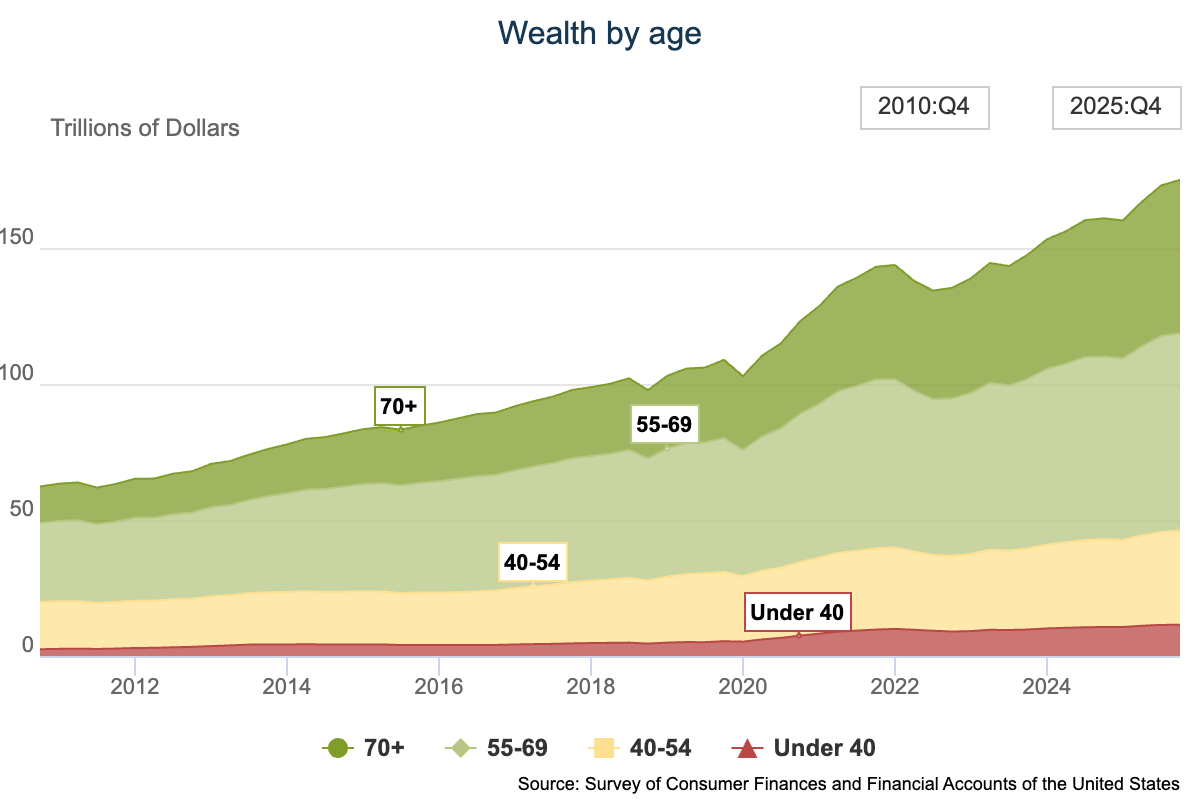
That pattern has a name in psychology. And understanding it—alongside what actually makes Boomers different from every dominant class that preceded them—tells you more about where America is stuck than any balance sheet. Is it whiny to try to understand this psychology, or is it a form of self-knowledge?
Two kinds of threats—and why they’re not symmetrical
In 2023, researchers Stéphane Francioli, Felix Danbold, and Michael North published a peer-reviewed study in Personality and Social Psychology Bulletin examining precisely what makes Boomers and Millennials hostile toward each other. The findings map almost perfectly onto the reader mail in this reporter’s inbox. https://pmc.ncbi.nlm.nih.gov/articles/PMC11490062/
Both generations express genuine animosity toward the other. But the nature of that animosity is fundamentally different, and the difference is not incidental.
Millennials’ hostility toward Boomers is driven primarily by what intergroup threat theorists call realistic threat—specifically, the fear that Boomers’ delayed transmission of power hampers their life prospects. The Federal Reserve data on housing, wealth, and debt give that fear its material texture. Millennials aren’t upset about Boomer values. They’re upset about Boomer advantages, and the structural conditions that have made those advantages self-perpetuating.
Boomers’ hostility toward Millennials runs in the opposite direction. Their animosity is driven primarily by symbolic threat—perceived conflict over culture, values, and worldview. Not economics or data. The feeling that a generation coming up behind them is challenging something essential about what America is, what hard work means, what success is supposed to look like.
This asymmetry is a predictable feature of dominant-group psychology, older even than Aristotle. When you hold the material advantages, you don’t feel materially threatened — because you aren’t. What you feel threatened by is the narrative that your advantages might not be entirely earned. That is a different kind of threat that produces a different kind of defense.
The meritocracy is the message
One word I used in a previous headline was particularly triggering: “hoarding,” as in, hoarding wealth, hoarding real estate, hoarding political power and opportunity. Seen through the lens of psychology, this verb begs the question of what Boomers a
NOTIFY: Y | REPLY | REPLY WITH QUOTE | PERMALINK | TOP | HOME
Quote:
Originally posted by second:Quote:Trumptards are Confederates. They don't want Lincoln telling them that slavery is wrong, and they know that slaves deserve to work for free so that Confederates don't have to.
Originally posted by 6ixStringJack:
SPOILER ALERT: You ARE the bad guys.
Confederates were Democrats.
And it's the Democrats today that want to let in millions every year to work for slave wages and keep the quality of life down for everyone who isn't rich.
YOU are the bad guys. You were always the bad guys.
--------------------------------------------------
Those who dance always seem crazy to those who can't hear the music.
NOTIFY: Y | REPLY | REPLY WITH QUOTE | PERMALINK | TOP | HOME
Quote:So, the Democrats of today's USA are the Democrats of the Confederacy in 1860? Then the Democrats of North Korea must be the Democrats of today's USA, too. The same name must mean they are the same.
Originally posted by 6ixStringJack:Quote:
Originally posted by second:Quote:Trumptards are Confederates. They don't want Lincoln telling them that slavery is wrong, and they know that slaves deserve to work for free so that Confederates don't have to.
Originally posted by 6ixStringJack:
SPOILER ALERT: You ARE the bad guys.
Confederates were Democrats.
And it's the Democrats today that want to let in millions every year to work for slave wages and keep the quality of life down for everyone who isn't rich.
YOU are the bad guys. You were always the bad guys.
--------------------------------------------------
Those who dance always seem crazy to those who can't hear the music.
• People's Democratic Republic of Algeria
• Democratic Republic of the Congo
• Democratic Republic of Timor-Leste
• Federal Democratic Republic of Ethiopia
• Lao People's Democratic Republic
• Democratic People's Republic of Korea
• Federal Democratic Republic of Nepal
• Democratic Socialist Republic of Sri Lanka
The Joss Whedon script for Serenity, where Wash lives, is Serenity-190pages.pdf at https://www.mediafire.com/two
NOTIFY: Y | REPLY | REPLY WITH QUOTE | PERMALINK | TOP | HOME
The End of Neoliberalism
The virtues it extolled—cosmopolitanism and competition—led to its demise.
June 15, 2026, 12:13 AM
By Branko Milanovic, a research professor at the CUNY Graduate Center.
https://foreignpolicy.com/2026/06/15/neoliberalism-globalization-compe
tition-cosmopolitanism-economics-reagan-thatcher/
If one were to define neoliberal globalization during the 40-year period from the early 1980s to around 2020, one could say it was driven by two ideas: cosmopolitanism and competition. One could also say these same features have now led to neoliberalism’s undoing.
Cosmopolitanism was an essential neoliberal idea going back to the meetings of the Walter Lippmann Colloquium in 1930s Paris and the early Mont Pèlerin Society. Cosmopolitanism meant that every individual in the world was to be thought of as equally important and equally capable of economic improvement if they faced optimal economic conditions—which implied security of private property, free trade, low taxes, and a “tolerable administration of justice.” Very little else, in the words of economist Adam Smith, was needed to fulfill the universal desire of all persons to “better their own condition” and for the world to attain unimagined levels of prosperity.
Cosmopolitanism was also the political idea underpinning a neoliberal world where national government as such would be out of sight and would leave individuals free to pursue their self-interest. This was, ideally, a world of small or almost invisible government. In the language of early advocates of neoliberalism, “imperium”—that is, flags, anthems, languages, and other paraphernalia of nationhood—would be left to politicians (and to voters, if citizens insisted on voting), and the more consequential world of “dominium” would consist of the movement of goods, capital, technology, and people.
For cosmopolitanism to create global wealth and prosperity, the world also had to be competitive. Not only would people be allowed to compete with (or against) one another regardless of national borders, but they also needed to be stimulated to compete by the display of all the goods that could be theirs and by the societal approval they would command if they won in that competition.
Competition produced global growth: Between 1980 and 2020-21, the average world GDP per capita more than doubled, jumping from $7,700 (in 2005 international dollars, adjusted for purchasing power parity) to almost $17,000. This makes the worldwide yearly average growth rate 2.1 percent per capita, an extraordinarily high rate for a period of 40 years. (And this despite the increase of the world population from 4.4 billion in 1980 to 8.3 billion now.) The more than doubling of per capita income combined with an almost doubling of the world population means that the total amount of goods and services produced in the world quadrupled during the era of neoliberal globalization.
But this “anonymous” growth rate, realized principally thanks to the high growth rates of Asian countries and notably China, did not help neoliberals’ case in rich countries. What was politically salient was not the 2.1 percent global rate but the fact that in the United States and in most rich Western countries, much of the population registered real (adjusted for inflation) growth rates of approximately 1 percent per year, while incomes of the rich grew two to three times faster.
Moreover, the neoliberal period (dated from Ronald Reagan’s presidency onward) was not only pro-rich, in the sense that incomes of the rich increased faster than those of the middle class and the poor. It also represented a slowdown in across-the-board growth compared with the preceding period. In fact, at every point of U.S. income distribution—except at the very top—growth was slower during the neoliberal era than during the previous decade and a half.
The world, at least for a while, seemed to become uniform, divided not by borders of nation-states, race, or ge
NOTIFY: Y | REPLY | REPLY WITH QUOTE | PERMALINK | TOP | HOME
Wall Street Journal BOOKSHELF | By Barton Swaim | June 15, 2026 4:05 pm ET
‘Communion’ Review: The Veep’s Progress
JD Vance recounts his conversion to Catholicism and explains what he calls a ‘Christian approach to economics.’
Harper, 304 pages, $35
https://www.wsj.com/arts-culture/books/communion-review-the-veeps-prog
ress-358f0ac2
JD Vance’s intellectual evolution continues apace. In “Hillbilly Elegy” (2016) he lamented the social pathologies he witnessed as a child in small-town Kentucky and Ohio—drug addiction, domestic violence, idleness and dependency—but concluded that “these problems were not created by governments or corporations or anyone else. We created them, and only we can fix them.” As a political figure, first as U.S. senator and currently as vice president, Mr. Vance now holds that governments and corporations did create them, namely by free trade and offshoring. As for the state’s role in welfare dependency, Mr. Vance no longer has much to say about it.
These changes of mind more or less tracked his altered views on Donald Trump, which went from scathing in 2016, when Mr. Vance had a book to sell, to laudatory in 2022, when he needed the former president’s endorsement in the Ohio Senate race.
Mr. Vance’s second memoir, “Communion,” chronicles the evolution of his religious views: from the Evangelical-Pentecostal faith of his early years, through the halfhearted atheism of his 20s, to his conversion to Roman Catholicism in 2019 at age 35. The book is part religious memoir, part campaign book. Roughly the latter half articulates Mr. Vance’s updated thoughts on foreign policy and economics, with Christianity making appearances at opportune moments; readers familiar with books by ambitious politicians will assume the author of this one has an eye on 2028.
Mr. Vance has no ill words for the unlearned fundamentalism in which his grandmother raised him. He credits the small-town nondenominational congregants of his early years with living out the kind of communitarian values the rest of the world professes to value but mostly doesn’t. You soon get the feeling, however, that the Bible-carrying countryfolk of Mr. Vance’s early years serve mainly as a foil for the educated elites he so detests. “From the professional pipeline I encountered in law school to the social media mob of the 2016 election,” he writes, “the intensity of social control was far greater among our elites than anything I’d seen in a Pentecostal or Southern Baptist church back home.”
More than once Mr. Vance scorns elite “strivers” and purports to feel shame that he once tried hard to gain admittance to their circles. “I wanted to win the race because other people wanted to win the race,” he recalls of his feverish attempt to attend an elite law school. “In a sense, I won that race and was admitted to Yale Law School.” But it all came at a price. “Without realizing it, I had become addicted to winning the competitions other people set for me.” On the next page, Mr. Vance uses the term “humblebrag,” but about other people, not himself.
You might have thought the esteem in which he holds working folk, together with his disdain for elites who presume to know what other people need, would have led Mr. Vance to appreciate laissez-faire economics, presuming as it does that ordinary people generally know how to use their own resources more wisely than faraway eggheads. And maybe he almost did plump for free markets at one time. Early in the book, in a passage I’m tempted to think he forgot to cut, he makes the point that religious questions often involve hidden complexities. Mr. Vance draws a comparison with minimum-wage laws, which, he notes, seem like a great idea but “could do more harm than good” by dissuading employers from hiring more workers. His lesson: “The complexity counsels some humility in the face of difficult questions.”
That bit appears in Chapter 2. By Chapter 11, “A Dismal Science,” Mr. Vance has cast humility aside. Straw men populate the book’s later chapters, particularly on economic questions. He e
NOTIFY: Y | REPLY | REPLY WITH QUOTE | PERMALINK | TOP | HOME
Why Wages Fall
Paul Krugman | Jun 20, 2026
https://paulkrugman.substack.com/p/arindrajit-dube-on-wages
. . . So the entire shareholder primacy revolution that happens in the ‘70s and ‘80s, turns out had a real impact on how wages were set. Research by Daron Acemoglu from M.I.T. and coauthors find a really interesting fact. Most businesses are not run by people with a business school degree. I actually didn’t know that. Even today, that’s actually the case. But the share that actually have a CEO with a business school degree has been rising quite, quite steadily. So what happened, for example, in the ‘80s or the ‘90s, when a company moved for the first time to a CEO with an MBA? Sometimes it’s because maybe someone retired or even died, you know? It sounds kind of grim, but actually it makes for a good natural experiment where, almost random, you introduce a CEO with an MBA for the first time. And what’s really interesting is that it leads to a very clear reduction in pay: about a 6% reduction in pay for workers overall, and about a 9% reduction for blue-collar workers. So the labor share falls by about five percentage points. That’s the amount of money going to workers versus owners. And of course, CEO pay rises. Now you may say, well, maybe that happens, and that’s just like the cost of running the business better, right? MBAs probably raise productivity. Wrong. It has no effect on productivity compared to comparable businesses. So it’s purely a rent transfer, as we say. Meaning, you’re taking money from one group and giving it to the other. In this case, the money is going towards owners of capital and high-income managers, and away from the workers, especially blue-collar workers.
Krugman: Wow. I always thought that the Harvard Business School was evil, but I didn’t realize it was quite that evil. So that’s pretty impressive. That’s really a significant impact on sort of the nature of our society that comes from almost an academic doctrine.
Dube: Absolutely. This is sort of like ideology. It’s ideology, not skills that is explaining this important change here. And, in fact, this turns out to have played a non-trivial role in the fall in the labor share in the United States, for example.
Krugman: That’s a really funny thing for me. Economists are supposed to be hard-headed, but in fact, if you really look at the data, and really do economic science, it says that ideology matters a lot.
The Wage Standard: What’s Wrong in the Labor Market and How to Fix It [2026]
Download the book from https://z-lib.sk/s/?q=The+Wage+Standard+What+Wrong+in+the+Labor+Market
+and+How+to+Fix+It
A sample from the book:
Quote:
If you’re like most working Americans, I have some good news: You probably deserve a raise!
Now, you very well may share this sentiment—after all, most of us believe we’re doing a decent job. But here’s the kicker: In this case, chances are, you’re right. You might wonder how I could possibly know that, since we’ve likely never met. I’ve never been to your workplace, and we’ve never shared a meal or even a coffee. So how can I be so sure?
Well, it has everything to do with my job. I study how people get paid, and why they earn what they earn. My work involves poring over mountains of data, analyzing how companies set wages, and examining the ripple effects of those decisions on employees, customers, and companies themselves. I’ve researched what happens when businesses compete to attract talent and what unfolds when governments step in to establish pay standards. A few years ago, I even advised the United Kingdom’s government on setting its minimum wage policy. These experiences have given me a unique perspective on how companies—your employer included—figure out what to pay.
Here’s the truth: Over the past half century, many working- and middle-class Americans have received paychecks smaller than they should be, even as our society has grown more prosperous. In this book, I aim to show you why—and, more importantly, how—we can change the labor market to work better for us all.
NOTIFY: Y | REPLY | REPLY WITH QUOTE | PERMALINK | TOP | HOME
Why America Is Spiritually Broken and How to Fix It
June 20, 2026
Senator Chris Murphy on his provocative new book about loneliness, disconnection, and what Democrats need to do to win back America’s soul.
Emily Bazelon interviews Senator Chris Murphy about his new book Crisis of the Common Good: The Fight for Meaning and Connection in a Broken America. Murphy argues that Trump is not the root cause of America’s political crisis—he’s a symptom. The real diagnosis: a country ravaged by loneliness, disconnection, and the collapse of community. From gun violence to Jan. 6, Murphy traces our troubles back to a spiritual unspooling, a loss of meaning and purpose. But his book offers solutions.
https://slate.com/podcasts/gabfestreads/2026/06/senator-chris-murphys-
crisis-of-the-common-good-argues-that-americas-political-crisis-stems-from-loneliness-and-disconnection
Download the free book from https://z-lib.sk/s/Crisis%20of%20the%20Common%20Good
Quote:
Introduction
Black Bear
Rider isn’t likely to play in the NHL. Don’t get me wrong— my fourteen-year-old son is a good, dedicated athlete, and he might be a little upset that the first line of his dad’s book sells short his professional hockey prospects. But despite competing in a serious, multistate league that requires me to occasionally miss votes in the Senate to travel up and down the East Coast every weekend over a grueling sixty-game, five-month season, he’s not interested in devoting his entire childhood to chasing a pro career as a hockey goalie. He still plays other sports—flag football, basketball, and golf—and he values the locker-room camaraderie just as much as the competition. That sounds about right for an eighth grader.
The problem is that the people who run the league he plays in see things differently. For the owners of the American Hockey Federation (AHF)—the youth hockey association that pulls together elite teams from Connecticut to Virginia—kids’ sports is a cutthroat business, a way to make a handful of people very, very rich. Black Bear Sports Group owns the AHF, several other youth hockey leagues, and many of the rinks in which the teams practice and play. Methodically and quietly, Black Bear—backed by private equity investment—is building a stranglehold over the youth hockey infrastructure in the eastern United States. While Rider sees hockey as character-building fun, Black Bear’s objective is far simpler: to make a grotesque amount of money off kids’ sports.
I first came face-to-face with this reality when I noticed a parent from our team sheepishly recording his son from a dark corner of the rink during one of our league games. . . .
The Joss Whedon script for Serenity, where Wash lives, is Serenity-190pages.pdf at https://www.mediafire.com/two
NOTIFY: Y | REPLY | REPLY WITH QUOTE | PERMALINK | TOP | HOME
Adam Bates
June 27 at 12:27?PM
I think one of the underdiscussed aspects of these young progressive/socialist firebrands is what their youth says about their perception of the Republican Party.
I've been trying to figure out why it bugged me so much to hear Chris Murphy say that "boldness" is the lesson he took from the socialist youth coup the other night, and I think this is it.
One of my frequent complaints about the current generation of Democrat leaders is that they regularly act like (and sometimes flat-out say) they think at some point this Trumpist trance is going to break and the GOP will revert to the party of Ronald Reagan and George Will that old guard Democrats remember from their formative years in politics.
32-year-old Darializa Avila Chevalier doesn't have that memory. 34-year-old Zohran Mamdani doesn't have that memory. For their entire adult lives, the GOP has been a party of inveterate, openly bigoted trolls who never participate in any discourse in good faith and can never be reasoned with.
It's not boldness for its own sake. It's boldness born of seeing this iteration of the Republican Party for what it is, of not lying to themselves that at some point everything is just going to snap back to "Republican" meaning open borders and skepticism of foreign interventions just because that's what Ronnie Reagan thought 40 years ago.
Their boldness is the natural, inevitable consequence of hearing "Republican" and reflexively thinking of Stephen Miller instead of George Will.
Chuck Schumer's and Joe Biden's ancient dalliances with their "colleagues across the aisle" must now be seen as grotesque failures to heed the warning signs rather than halcyon reveries to which we should aspire to return.
George Will ain't walkin through that door. The GOP is a nazi troll party now, and the only people in our entire political ecosystem who seem to actually understand that are the ones who are too young to remember anything else. They are being bold, but not because it appeals to voters. They're being bold because once you stop lying to yourself about what we're dealing with, there's no excuse to be anything else.
https://www.facebook.com/adam.bates.9216/posts/i-think-one-of-the-unde
rdiscussed-aspects-of-these-young-progressivesocialist-fi/10109266615535087/
The Joss Whedon script for Serenity, where Wash lives, is Serenity-190pages.pdf at https://www.mediafire.com/two
NOTIFY: Y | REPLY | REPLY WITH QUOTE | PERMALINK | TOP | HOME
What J. D. Vance Once Knew
Ten years ago, the vice president wrote that one day, voters would realize the truth about Donald Trump. That day has now arrived.
By Peter Wehner | Jul 4, 2026
https://www.theatlantic.com/ideas/2026/07/jd-vance-trump-independence-
day/687779/
TEN YEARS AGO TODAY, in the middle of the presidential campaign, an essay in The Atlantic set out to explain the appeal of Donald Trump. Its author traced that appeal to the social decline and cultural trauma he had known firsthand, in an impoverished childhood. https://www.theatlantic.com/politics/archive/2016/07/opioid-of-the-mas
ses/489911/
The author, J. D. Vance, had only days earlier published Hillbilly Elegy, which went on to sell roughly 3 million copies and made him, almost overnight, the country’s designated interpreter of working-class grievances. And he was quite good at it.
In the July 4, 2016, essay, Vance described the places from which the pain came—factories that downsized or ceased to exist, along with the jobs they had provided; the aesthetic decline in once beautiful and vibrant towns; families that were shattering or never forming in the first place; and anger and frustration with a government that had broken the trust with the people it was meant to serve. “During this election season,” Vance wrote, “it appears that many Americans have reached for a new pain reliever.” His name was Donald Trump.
In the midst of a social crisis, Vance observed, Trump offered “an easy escape from the pain. To every complex problem, he promises a simple solution.” But, he argued, such promises were a cheap high. “He never offers details for how these plans will work, because he can’t. Trump’s promises are the needle in America’s collective vein.”
“Trump is cultural heroin,” Vance wrote. “He makes some feel better for a bit. But he cannot fix what ails them, and one day they’ll realize it.”
“One day” is today.
THE TRUMP PRESIDENCY, while still quite dangerous, is also collapsing, cracking under the weight of its own choices. The main driver is the economy, which he sold as his strong point. We’re seeing tariff-driven price increases, gas prices that spiked from less than $3 to more than $4 a gallon during a 100-day war against Iran that America lost, wages failing to keep pace with the cost of living, and inflation ticking back up. Manufacturing jobs, which Trump promised to bring roaring back, are still being lost. Health care has gotten much more expensive on his watch, and millions have lost coverage.
At the top of the nation’s health agencies sits Robert F. Kennedy Jr., who in a single year moved to cut the list of recommended childhood vaccines nearly in half, fired the government’s vaccine advisers and replaced them with skeptics, and presided over the worst measles outbreak in 30 years. The National Institutes of Health, the crown jewel of American biomedical science, has seen billions in research cut, clinical trials canceled, and labs closed, resulting in a “brain drain” that rival nations are racing to exploit. And the dismantling of USAID, along with the gutting of PEPFAR—the President’s Emergency Plan for AIDS Relief, the bipartisan AIDS-relief program credited with saving more than 25 million lives—has, by credible estimates, already cost the lives of hundreds of thousands, most of them children, with projections of as many as 14 million more by 2030 if the cuts hold.
Americans are deeply divided and intensely polarized, with pessimism at or near a multidecade high. Faith in nearly every major institution—government, the press, universities, religious leaders—sits at or near the bottom of the modern record.
It’s no surprise, then, that Trump’s approval rating is anemic. (In one recent poll, it’s down to 30 percent.) His remaining support is soft, while the unhappiness with him is intense. Republican members of Congress are beginning to break with him. His MAGA base is fracturing. Former stalwart supporters, such as Tucker Carlson, are openly mocking the president. (“Shut up, bitch! I don’t take you seriou
NOTIFY: Y | REPLY | REPLY WITH QUOTE | PERMALINK | TOP | HOME
The Judeo-Bolshevist Target
Popular memory in the West tends to separate the Holocaust from the German war against the Soviet Union, but for the Nazi regime they were two faces of the same undertaking.
By Omer Bartov | July 23, 2026 issue
https://www.nybooks.com/articles/2026/07/23/the-judeo-bolshevist-targe
t-jochen-hellbeck/
Reviewed:
World Enemy No. 1: Nazi Germany, Soviet Russia, and the Fate of the Jews
by Jochen Hellbeck
Penguin Press, 536 pp., $35.00
Free download of Jochen Hellbeck's books from https://z-lib.sk/s/Jochen%20Hellbeck
Sometime in early 1983, toward the end of my time as a graduate student at Oxford University, I met with the military historian Michael Howard, who had served as an officer during World War II and fought in the Italian campaign. As I followed this distinguished, rather reserved scholar toward the entrance of All Souls College, where he was a fellow, he sensed my unease at walking across the immaculate lawn. Grinning discreetly, he muttered, “They’d shoot you were you to do this on your own.”
By then Howard had already read much of my Ph.D. thesis on the war crimes committed by the Wehrmacht (the German armed forces) against Red Army troops and Soviet civilians, for which I had used German army documents to demonstrate that regular combat units—influenced by a combination of intense indoctrination, orders from the high command, brutal discipline, and fierce fighting at the front—had killed civilians and prisoners of war on an unprecedented scale. The number of crimes I described, he told me, had astonished him.
Howard explained that for much of the Italian campaign his battalion had fought against the same German unit. When they captured one of the German officers, they invited him to the mess and shared a glass of cognac before sending him to a POW camp. They expected the same treatment from the Germans.
I was taken aback that Howard, one of the preeminent military historians of his time, was surprised to learn of the atrocities on the Eastern Front. But at that point few scholars in the United Kingdom or the United States seemed to understand that in Europe World War II had been conducted as two very different wars. In Western Europe the fighting was quite conventional, despite its frequent ferocity. The war in Eastern Europe, by contrast, was precisely what Adolf Hitler ordered his generals to carry out: a Vernichtungskrieg, or war of annihilation, against subhuman enemies to be exterminated or enslaved.
During the war Americans and Europeans paid close attention to the daily news that documented the fighting on the Eastern Front—and for good reason. For much of the war, most of the German military was fighting in the East, which is also where it sustained its greatest defeats and most of its casualties. It is hard to imagine that the Western Allies could have freed Europe from Hitler and his collaborators without the Red Army’s relentless drive to Berlin, which came at great cost: the Soviet military lost as many as 11 million men and women.
But no sooner had the fighting come to an end than competing national memories of the Eastern Front started to take shape. In the Soviet Union the war became a foundational event binding together a vast and complex society. The collective memory of the war continues to play this role to this day: official commemoration emphasized the sacrifice and heroism of everyday Soviet citizens for freedom around the world. As the cold war began, however, the British and the Americans came to see the Soviet Union as essentially the equivalent of Nazi Germany—one totalitarian regime that replaced another. By the early 1950s the war was increasingly recalled as a struggle against tyranny by the forces of democracy, and America’s “unholy alliance” with the USSR—now a bitter adversary—as a necessary evil.
Most popular accounts of the war in America fixated on those fronts where the US Army had been engaged; the war in the East, where the bulk of the Wehrmacht was destroyed, drew relatively little attention. The titles
NOTIFY: Y | REPLY | REPLY WITH QUOTE | PERMALINK | TOP | HOME
Liberals Don't Understand Conservatives & It's Why They Can't Fight Back
Conservatives aren't hypocrites, you just don't understand their views.
Ben Wheeler
Jun 25, 2026
https://benwheeler.substack.com/p/liberals-dont-understand-conservativ
es
A lot can be said of the past year and a half of Trump’s second term, but one thing that seems to be ringing off the inside of my skull as of late is the degree to which American Liberals completely misunderstand their conservative peers.
A lot has happened that should have triggered a crisis of conscience on the political right such as masked men grabbing people off the street, attempts by the government to strip LGBTQ+ Americans of their guns, widespread domestic surveillance of liberals, and the mass pardoning of the January 6th insurrectionists. The liberal response has been to call conservatives hypocrites and blind sheep, and while I don’t inherently disagree with that characterization, I do think it comes from a place of complete misunderstanding.
There is, from the outside looking in, an inherent contradiction in American conservative ideology, and it’s most obvious with their two most popular slogans being “Don’t Tread On Me” and “Back the Blue”. It is true that police are members of our communities and families, but they are also agents of the state. The police enforce the laws and orders of the government, and they are - more than any other part of government - the most likely to tread on you. So how can it be that conservatives can believe both of these and not feel embarrassed by the contradiction? How can conservatives believe in law and order while also supporting a President who is objectively the biggest crook to ever reach the White House?
In short, there is no contradiction to be embarrassed by, because these principles were never symmetric to them. Frank Wilhoit wrote that the backbone of conservatism is that “there must be in-groups the law protects but does not bind, and out-groups the law binds but does not protect”. Why must there be in-groups and out-groups in the conservative view though? Conservatism at its core is about believing in a strict hierarchical society. Corey Robin wrote in The Reactionary Mind that conservatism across two centuries is fundamentally the defense of established hierarchy against threats from below. Rather than a philosophy of liberty or tradition, the right is actually a reactionary movement defending power, privilege, and inequality.
This can be best understood by looking at our own history. The loyalists, the enslavers, and the segregationists in American history were conservatives. The loyalists would have maintained their power and status had the colonists not revolted against the crown. The enslavers and then later the segregationists were defending their power and privilege by continuing the subjugation of an entire race for 200 years. The same political sect that supports ICE grabbing random people off the street, also supported slave catchers. The law bound Black Americans while offering them no protection whatsoever. The law also protected White Americans but did not bind them when they waged violence on Black Americans. . . .
. . . The police do not exist to enforce abstract, neutral statutes; they exist to maintain the boundary line between the protected rulers and the bound subjects. Therefore, a conservative feels no shame when the state targets marginalized groups, liberals, or immigrants, because the law is performing its proper, asymmetrical function: binding the out-group while offering them no protection. This also explains why Trump’s overt criminality does not alienate his base, but rather reinforces his appeal as the ultimate patriarch. The ruler is completely above human law and answerable only to God or the preservation of the hierarchy itself. To his followers, Trump is not a crook breaking the law; he is an absolute sovereign exercising his natural prerogative to protect the in-group and punish the out-group. He is the modern embodiment of the monarch who
NOTIFY: Y | REPLY | REPLY WITH QUOTE | PERMALINK | TOP | HOME
Wow dude.
You managed to find an even bigger faggot than Kevin Drum.
Congrats.
ETA:
Whattya know though...
Not unlike Kevin Drum was, Ben here is also a fat sack of shit.
Was expecting black plastic frame glasses too though. Disappointed.
Hey, Ben.
Democrats ARE hypocrites, on every single issue under the sun.
Until you figure that out and/or admit it, your party is dead.
--------------------------------------------------
Those who dance always seem crazy to those who can't hear the music.
NOTIFY: Y | REPLY | REPLY WITH QUOTE | PERMALINK | TOP | HOME
Quote:The Founding Fathers didn't like what they saw when their revolution was taken over by evil men like Trump, who was voted into office by complete assholes like 6ixStringJoker and the Trumptards, the kind of people who cannot tell the difference between good and evil, the kind who would be #RootinForPutin.
Originally posted by 6ixStringJack:
Hey, Ben.
Democrats ARE hypocrites, on every single issue under the sun.
Until you figure that out and/or admit it, your party is dead.
--------------------------------------------------
Those who dance always seem crazy to those who can't hear the music.
A Natural Aristocracy Among Men
Posted on Monday, Jul 13, 2026 6:00AM by Michael Liss
https://3quarksdaily.com/3quarksdaily/2026/07/a-natural-aristocracy-am
ong-men.html
In the end, they were, like so many other citizens of this exasperating if often great and good land, men of impulse, of passion, of ambition and of regrets. Washington himself, a demigod in his lifetime, still left office soured by the partisan sniping, some of which was directed at him. Franklin, the twinkle-eyed inventor, patriot, diplomat, and elder statesman, one of the great figures of the 18th century, felt aggrieved over some attitude of Congress that he felt did not appreciate his point of view. John Adams, unceremoniously shown the door by the electorate in 1800, remained an outsider for the rest of his long life, periodically railing at the uncouth, the undemocratic, the unmeritocratic, and the uneducated. James Madison watched the beautiful Swiss-watch-like mechanism of his Constitution challenged by the reality of it being used by men who very often had little more than personal and tribal advancement in mind. And, of course, there’s Jefferson.
In Gordon S. Wood’s telling in his Pulitzer Prize-winning 1993 book, The Radicalism Of the American Revolution, this result was entirely rational. “A new generation of democratic Americans was no longer interested in the revolutionaries’ dream of building a classical republic of elitist virtue out of the inherited materials of the old world.”
Download the book for free at https://annas-archive.gl/search?q=The+Radicalism+Of+the+American+Revol
ution
or
https://z-lib.gl/s/The%20Radicalism%20Of%20the%20American%20Revolution
The Joss Whedon script for Serenity, where Wash lives, is Serenity-190pages.pdf at https://www.mediafire.com/two
NOTIFY: Y | REPLY | REPLY WITH QUOTE | PERMALINK | TOP | HOME
Wow dude.
You managed to find an even bigger faggot than Kevin Drum.
Congrats.
ETA:
Whattya know though...
Not unlike Kevin Drum was, Ben here is also a fat sack of shit.
Was expecting black plastic frame glasses too though. Disappointed.
Hey, Ben.
Democrats ARE hypocrites, on every single issue under the sun.
Until you figure that out and/or admit it, your party is dead.
--------------------------------------------------
Those who dance always seem crazy to those who can't hear the music.
NOTIFY: Y | REPLY | REPLY WITH QUOTE | PERMALINK | TOP | HOME

Thanks for the bump jack
T

NOTIFY: Y | REPLY | REPLY WITH QUOTE | PERMALINK | TOP | HOME
Quote:
Originally posted by THG:
Thanks for the bump jack
T
Oh. I missed this one.
You haven't been a part of this conversation since April, retard.
Go bounce, faggot.
--------------------------------------------------
Those who dance always seem crazy to those who can't hear the music.
NOTIFY: Y | REPLY | REPLY WITH QUOTE | PERMALINK | TOP | HOME
US at 'turning point' in Trump’s imperial project: top historian
Opinion by Nick Hilden
Jul 20
https://www.msn.com/en-us/news/opinion/us-at-turning-point-in-trump-s-
imperial-project-top-historian/ar-AA28jETt
A leading historian says the United States has reached a “turning point” due to President Donald Trump’s authoritarian project, and that it could determine the future integrity of the country, both in terms of its reputation and its existence as a state.
This is according to renowned historian Timothy Snyder, whose scholarly work has focused on authoritarian regimes in Russia and Germany. While appearing on the podcast of researcher Robinson Erhardt, Snyder discussed how democracies collapse and historical parallels to the U.S. under Trump. His assessment was not optimistic.
“The fact that the U.S. exists and is celebrating 250 years doesn't mean that it'll exist in 5 years or 10 years or 15 years — states have a beginning and they have an end,” he said. “I think that the Trump people are much more likely to wreck the U.S. as an entity than they are to succeed in generating some kind of homogeneous tyranny from the Pacific to the Atlantic.”
While he ultimately thinks it will fail to materialize, Snyder said one corollary came to mind in terms of the type of state the U.S. is moving toward under Trump, explaining, “Many of the things that have happened in the United States happened first in Russia. And many of the clues of what post-modern tyranny or fascism will look like, you can get first from observing Russia.” He provided several examples of these “clues,” from Russia’s reliance on hydrocarbons for fuel and economic generation, the centralization of media and the destruction of local reporting, and how social media can be wielded to promote “authoritarian politics” — all trends he suggests are being repeated in the U.S.
Rather than transforming into a stable autocracy, however, Snyder thinks the U.S. is headed toward outright decline.
“As far as general historical moments,” he said, “I think we're at an imperial turning point.” He nodded to past examples when people took the existing “imperial order for granted,” saying, “The question is, how do you react when it breaks up? How do we deal with it when we no longer exercise the same kind of power that we used to? Are we able to exercise power in new ways? Or do we choose to fall upon one another?”
Snyder suggests that the future of the country may be less a matter of resisting tyranny than a “rebuilding paradigm” in which the country must recover from the damage done by Trump, both domestically and in terms of its international relations as well. As the U.S. deals with the negative aspects of its heritage, Snyder questions, “Do we choose to focus on how we were always right…and thereby lose any sort of possibility for building a post-imperial kind of state? Or do we instead continue a conversation inside the United States which allows us to present ourselves as a credible power outside the United States?”
Related Articles:
• Watch: Trump Acts More Like a Russian than an American, Says Yale Historian on Maher Show
https://www.alternet.org/2017/03/watch-trump-acts-more-russian-america
n-says-yale-historian-maher-show/
• Top historian says Trump is committing 'superpower suicide'
https://www.alternet.org/superpower-trump/
• Trump joins the ranks of authoritarian 'superlosers:' top historian
https://www.alternet.org/msn-uk/trump-loser-2676932023/
The Joss Whedon script for Serenity, where Wash lives, is Serenity-190pages.pdf at https://www.mediafire.com/two
NOTIFY: Y | REPLY | REPLY WITH QUOTE | PERMALINK | TOP | HOME
Look at you faggots freak out.
Your entire world fell apart.
So sad.
Everybody hates you. All of you.
--------------------------------------------------
Those who dance always seem crazy to those who can't hear the music.
NOTIFY: Y | REPLY | REPLY WITH QUOTE | PERMALINK | TOP | HOME
This sheer terror is driving Trump's 2 a.m. rage tweeting
By Thom Hartmann | July 21, 2026 5:30AM ET
https://www.rawstory.com/raw-investigates/trump-prison/
Last week, Donald Trump essentially told us exactly what he will do this November. When reports start coming in that the Democrats are winning, he will send in the troops.
He’ll point back to last week's national address and tell the nation:
“I told you so. I warned you. They rigged the election for the Democrats and now I have to stop it.”
He’ll mobilize ICE and the National Guard’s “Rapid Reaction Force” that he’s assembled over the past six months to seize ballot boxes and crush the inevitable “insurrection” — protests in the streets against his seizing ballot boxes — by “left-wing communist radical domestic terrorists.”
He’ll declare a state of emergency, invoke his NSPM-7, and blame it on a foreign country and/or “Antifa.” He’ll declare protesting a crime, and tear gas will fill our streets.
This is easy for me to imagine: I was there in 1967 when Lyndon Johnson did nearly the same thing, although for an entirely different purpose, and I’ve worked in several countries where this very scenario had already played out.
And those same white supremacists Trump has already pardoned can also easily imagine how it should play out when he calls them out to attack protesters; they’ve been terrorizing minority communities for centuries and are very good at it.
This includes his tens of thousands of well-armed loyalist cult members who’re salivating at the idea of splitting that $1.776 billion they believe they’ll get when he seizes absolute control of the country.
As Senator Amy Klobuchar said on MSNOW:
“This is a man desperate to hold onto his power and he will do anything to keep that power.”
Would he actually be so audacious as to try that? Could he actually pull it off?
He could, he will, because he’s already tried it once.
The difference is that six years ago — the last time he tried to overturn an election he lost — his Attorney General, FBI Director, Director of National Intelligence, Chairman of the Joint Chiefs, DHS Secretary, and Chief of the National Guard would all have refused such an order, so he called on thousands of violent thugs to attack the Capitol, stop the election certification, and murder the vice president.
This time, in a classically Putin-esque move, he’s replaced all of those people with lickspittles like Blanche and true believer fanatics like Miller and Homan who’ll do exactly what he tells them to.
Many of them sat in the room with him, in the front row in front of the teleprompter, watching and nodding along with his lies. They know that if Democrats win and the election is certified this fall many of them, too, will end up on the wrong end of civil and criminal investigations.
Trump has recently declared, officially, that Democrats are traitors, communists, potential terrorists, and should be deported. The only thing he hasn’t demanded is for Democrats to be arrested for our politics, and that may well come in just a few months.
After all, he can’t afford to allow the House or Senate to fall into Democratic hands, because then he’ll be investigated with the power of law and subpoena for the many crimes he is currently committing.
He wouldn’t survive that politically, and he believes the Senate this time will actually convict him: they know that once he’s convicted and has thus lost his power, there’s no way he can regain it and he’ll no longer represent a threat to their political careers.
This is all why he’ll say or do anything to hang onto his power, because he knows if he loses that power his entire house of cards collapses.
He and his children go to prison or are forced into exile. His wife gets to reinvent her life the way she wants. What’s left of his properties gets sold off at auction like his casinos were the last time he went bankrupt.
This is what he’s imagining at 2 o’clock in the morning when he’s rage-tweeting. He’s also remembering the terri
NOTIFY: Y | REPLY | REPLY WITH QUOTE | PERMALINK | TOP | HOME
Look at you faggots freak out.
Your entire world fell apart.
So sad.
Everybody hates you. All of you.
--------------------------------------------------
Those who dance always seem crazy to those who can't hear the music.
NOTIFY: Y | REPLY | REPLY WITH QUOTE | PERMALINK | TOP | HOME
Wealth Concentration and Oligarchy
By Paul Krugman | Jul 25, 2026
https://paulkrugman.substack.com/p/talking-again-with-gabriel-zucman
There’s a fundamental tension in democratic societies between extreme wealth and the very possibility of a well-functioning democracy. And it’s not a new idea. All the thinkers of democracy have written about this, all the way back to Aristotle.
Most people have very little wealth. Wealth is highly concentrated, and what most people have is income. But the very top has wealth, and in some sense, the wealth-to-income ratio is telling you how many minions they can buy, how much influence they can buy in the economy and in politics.
Expressing their wealth relative to total income gives a sense of the influence they have, how much they can spend on buying media companies, on funding electoral campaigns. Billionaires accounted for nineteen percent of total political spending during the 2024 federal election cycle.
What’s your take on why total wealth has grown faster than income?
Zucman: There are different stories, and I think the one that makes most sense to me and that seems most consistent with the data is that there’s been a number of policy changes since the 1980s that have favored wealth and capital, broadly speaking. So, for instance, you used to have rent controls for housing in many countries; when you lift rent controls, the value of housing wealth tends to go up. Many countries used to have pretty high corporate income tax rates, of almost fifty percent on average at the world level in the 1980s. Well, when the government takes half of the profits of companies, it capitalizes into stock prices; it reduces the market value of companies. But then when governments slash the corporate tax—and it has declined from about 45–50% to about 20–25% today at the global level—well, that again capitalizes into stock prices, and now it boosts the market value of companies, of equities.
And you’ve had deregulation in many sectors that has boosted the profitability of corporations. You’ve had a significant change in the division of value added between labor and capital—the rise of the capital share, the decline in the labor share. That means more profits, more income for shareholders; again, it boosts the value of corporate equity. So all of these changes, they don’t happen like that out of nowhere. They are, of course, heavily influenced by policy.
So, for instance, changes in factor shares—labor and capital shares—have been partly affected by the decline in union power. When unions are stronger, you tend to get a bigger labor share. When unions are weaker, you get a bigger capital share. Also in the way that we organize international economic relations, globalization. When we organize things without any kind of international tax coordination, or to put it differently, if we organize global economic integration by allowing total tax competition—no minimum taxes, no minimum tax rates—then capital owners can threaten to outsource production or to shift profits to low-tax places, and again, it reinforces the power of capital, hence the value of wealth.
Much more at https://paulkrugman.substack.com/p/talking-again-with-gabriel-zucman
The Joss Whedon script for Serenity, where Wash lives, is Serenity-190pages.pdf at https://www.mediafire.com/two
NOTIFY: Y | REPLY | REPLY WITH QUOTE | PERMALINK | TOP | HOME
I see your idiot asshole doesn't want to talk about how many Trillionaires were made during YOUR Covid, or how much money Jeff Bezos made during that time.
Fuck Paul Krugman and Fuck You, Shit Golem.
--------------------------------------------------
Those who dance always seem crazy to those who can't hear the music.
NOTIFY: Y | REPLY | REPLY WITH QUOTE | PERMALINK | TOP | HOME
The ongoing show trial of Fauci motivated this post
Reality is a Communist Plot
Of MAGA and the totalitarian mindset
By Paul Krugman | Jul 30, 2026
https://paulkrugman.substack.com/p/reality-is-a-communist-plot
The Covid vaccine didn’t work, and vaccines cause autism. But hydroxychloroquine worked, and so did ivermectin. Anthony Fauci killed millions of people.
Climate change is a hoax. Wind power caused a massive TV blackout during the Trump-Biden debate. Solar power is useless because the sun doesn’t shine at night, and batteries don’t exist. Smoke blanketed North America, not because of climate change, but because Canada didn’t rake its 2 million square miles of boreal forest.
We’ve destroyed Iran’s military, and the Iranian regime is begging for a deal. Also, the U.S. isn’t running out of precision weapons as a result of the Iran war, and furthermore the shortage is Joe Biden’s fault.
The economy is in a “golden age.” Prices are down. And Trump has a 59 percent approval rating.
Trump won the 2020 election.
Communism is the greatest threat facing America.
The modern American right is very good at hating. MAGA hates immigrants (unless they’re white South Africans); it hates liberals; it hates scientists.
What the ongoing show trial of Fauci — which motivated this post — has really driven home, however, is that what Trump and his supporters hate most of all is reality. They know what they want to believe. They fly into paroxysms of rage whenever someone points out that the world isn’t what they want it to be. And they always want to shoot the messenger.
Of course, motivated reasoning isn’t confined to the right. Some people on the left insist that zoning restrictions have no role in causing high housing prices, that it’s all about Wall Street greed. Many centrists insist that being in the middle on a left-right scale — which isn’t even how most voters think about politics — is the secret to electoral victory. And so on.
I’m not immune to the temptation to believe what I want to be true. I try to fight it, but don’t always succeed. Still, I try to acknowledge and admit it when I have let wishful thinking warp my judgement.
But what we’re seeing now isn’t run-of-the-mill motivated reasoning. It’s something far more extreme.
If believing something suits MAGA’s prejudices and interests, they don’t hesitate: they simply insist that it’s true. They routinely dismiss scientific and statistical evidence, but they don’t stop there. They’re perfectly willing to deny reality even if the truth is staring them in the face.
Thus, Trump urged Americans to remember that 2024 TV blackout, which nobody remembers because it didn’t happen. He insists that California has “blackouts and brownouts every weekend,” when the state’s 39 million residents can tell you it doesn’t. He says that you must show ID to buy groceries, which everyone who buys their own food knows isn’t so.
Do Trump and his followers actually believe these things? As I see it, that’s a category error, starting from the presumption that they even accept that objective facts exist. All the evidence (Hah! “Evidence!”) says that they don’t.
George Orwell, whose work seems more relevant by the day, knew all about this mindset. In his essay “Looking back on the Spanish war” he wrote about how the rise of totalitarianism had changed the rules:
In the past people deliberately lied, or they unconsciously coloured what they wrote, or they struggled after the truth, well knowing that they must make many mistakes; but in each case they believed that ‘the facts’ existed and were more or less discoverable. And in practice there was always a considerable body of fact which would have been agreed to by almost everyone.
Totalitarians, however, denied that objective facts existed. Furthermore, reality is mutable, changing with the leader’s whims:
If the Leader says of such and such an event, ‘It never happened’ – well, it never happened. If he says that two and two are five – well, t
NOTIFY: Y | REPLY | REPLY WITH QUOTE | PERMALINK | TOP | HOME
Conservatives Perfected the Ideal Legal Tactic. It’s Time for Liberals to Use It.
By Mark Joseph Stern
Aug 03, 2026
https://slate.com/news-and-politics/2026/08/supreme-court-analysis-lib
eral-antonin-scalia-guns.html
In 1991, former Chief Justice Warren Burger renounced the then-nascent push to reinterpret the Second Amendment as an individual right to bear arms. Appearing on PBS NewsHour, the conservative jurist condemned this campaign as “one of the greatest pieces of fraud, I repeat the word fraud, on the American people by special interest groups that I have ever seen in my lifetime.” Burger, a Richard Nixon appointee, was no outlier: Across the partisan spectrum, leading constitutional lawyers agreed that the Constitution did not create a personal right to possess guns. A year earlier, Erwin Griswold, solicitor general for Presidents Lyndon B. Johnson and Richard Nixon, said that the pro-gun argument “exceeds the limits of principled advocacy.” Shortly before that, the far-right Judge Robert Bork—formerly Nixon’s solicitor general and attorney general—said that the Second Amendment protects state militias, not individuals. Bork, whose own nomination for the Supreme Court was famously defeated over his extreme right-wing views, deemed all state gun restrictions “probably constitutional.”
Less than 20 years later, the Supreme Court announced in D.C. v. Heller that Burger, Bork, and their contemporaries had it all wrong: The Second Amendment had guaranteed an individual right to bear arms the whole time. Of course, the constitutional text remained the same. What changed was the nation’s understanding of it. Over decades, gun rights activists transformed a position dismissed by Burger and Bork into a cornerstone of conservative constitutional identity. They built a political movement around their ahistorical, atextual interpretation. Buoyed by lavish funding from the industries that stood to benefit, these activists elected lawmakers who embraced their view, then elevated judges who would translate it into law. By the time Heller reached the Supreme Court, the individual-right theory did not appear radical to the conservative majority. It looked inevitable.
Second Amendment advocates like to frame Heller as a triumph of originalism, and SCOTUS certainly sold it that way. But in truth, it is popular constitutionalism all the way down. Yale Law professor Reva Siegel laid out this fact in a renowned law review article months after the decision came down, and her observation has only grown more prescient with time. The Republican-appointed supermajority has spent the past four years steadily expanding the right it created in 2008, to the point that it now deems all restrictions on “armed self-defense” to be “presumptively unconstitutional.” Under Heller and its progeny, courts have struck down state laws that ban guns from zoos, libraries, and museums; that prohibit the removal of serial numbers from weapons; and that outlaw machine guns. SCOTUS has struggled to keep pace with the revolution that it unleashed and has sometimes seemed embarrassed by the consequences of its own rulings.
The modern Second Amendment has thus become both a paragon of popular constitutionalism and its own dark mirror. Gun rights advocates followed much of the popcon playbook, but never truly built majority support for their broader aims: Many of their legal demands today—like unlicensed public carry and easy access to assault weapons—are unpopular with the broader public. It seems fair to say that the average American who wants to keep a handgun at home did not sign up for unpermitted open carry of an AR-15 at the zoo. Heller is not just a case study in popular constitutionalism; it is also a warning that industry-backed interest groups can mimic a mass movement, then leverage it to create a constitutional right that extends far beyond anything the citizenry ever demanded.
Siegel’s early account of the Second Amendment’s rise remains unimpeachable as a straightforward chronicle of how moneyed interests can manufacture constitut
NOTIFY: Y | REPLY | REPLY WITH QUOTE | PERMALINK | TOP | HOME
More crybabism from you faggots.
I'll bet you're really fucking happy that the Democrats weren't able to get rid of the filibuster now, aren't you Shit Golem?
Oh, how you villainized Sinema and Manchin at the time.
Do you know how fucked you'd be right now if that happened?
You are a fucking idiot.
--------------------------------------------------
Those who dance always seem crazy to those who can't hear the music.
NOTIFY: Y | REPLY | REPLY WITH QUOTE | PERMALINK | TOP | HOME
The Oligarchs are Doubling Down on Republicans
And Democrats should make the most of it
By Paul Krugman | Aug 04, 2026
https://paulkrugman.substack.com/p/the-oligarchs-are-doubling-down-on
Inauguration Day 2025 looked and felt like a coronation, as Donald Trump was installed in a position of immense, unprecedented power. Since he had returned to office despite the Jan. 6 insurrection, it was obvious that time-honored checks and balances on presidential authority wouldn’t apply to him. And the megabillionaires who had spent vast sums to assure Trump’s victory had no qualms about appearing as the new MAGA oligarchy. Through their political and monetary fealty to Trump, they had positioned themselves to dictate policy, free from petty democratic constraints and concern for public welfare. They evidently expected that they would spend years effectively ruling the nation in their interests, along with the president they had bought.
Now, a year and a half later, the oligarchs’ victory celebrations look premature. Newly elected presidents usually experience a few months of positive net approval, but Trump’s “honeymoon” barely lasted a month. He is now plumbing new depths of public disapproval:
Furthermore, Trump’s plunge is like a vortex pulling the entire Republican Party down with him. G. Elliott Morris’s model gives Democrats an 85 percent chance of taking the House despite extreme GOP gerrymandering. He also gives the Democrats a 55 percent chance of taking the Senate, despite its overrepresentation of small, rural states that strongly tilts its composition towards the Republicans.
And you know what has an even worse approval rating than Donald Trump? AI data centers:
There are substantive reasons to oppose these centers, but beyond concerns over rising electricity bills, pollution, water depletion and noise, the controversy over data centers has become a proxy for public backlash against the power of the broligarchs and their disregard for the welfare of ordinary Americans.
According to historical experience, this kind of massive shift in public sentiment should have induced hedging on the part of the big money. That is, based on past patterns we would have expected billionaires to give more money to Democrats during the midterm elections compared to the 2024 election as a way to maintain influence if the balance of power in Washington shifts.
But that’s not what is happening this time: instead, oligarchs are doubling down on MAGA. An analysis by the Washington Post finds that megadonors have already spent more than $1.6 billion on the November midterms. Here’s how that spending breaks down:
What’s the rationale here? Why are the billionaires doubling down in support of a hugely unpopular president and his hugely unpopular agenda?
This partly reflects a change in the nature of billionaires’ relationship with the extreme right. Twenty years ago American conservatism was dominated by a “What’s the Matter With Kansas?” strategy in which corporations and the wealthy used racism and bigotry to advance their goals — tax cuts and deregulation — without necessarily being racists and bigots themselves. Today Elon Musk isn’t putting on a show of being a neo-Nazi, because that’s who he really is.
Beyond that, Trump’s second presidency is so pervasively corrupt, abusive and destructive that it will be virtually impossible for anyone who supported him to move on and rehabilitate themselves. Outside of MAGA, who will ever be willing to trust Larry Ellison, Mark Zuckerberg or Jeff Bezos again? Frankly, what political hopeful would be stupid or venal enough to associate with them?
Indeed, I believe and hope that if Democrats regain power, they won’t repeat past mistakes by trying to “move on” from the corruption and scandals of the previous regime. It’s now clear that Biden’s Attorney General, Merrick Garland, enabled Trump’s return to power by slow-walking the investigation of January 6th. Earlier, Barack Obama let Republicans off the hook by not pursuing the lies that led to the Iraq war. Let’s
NOTIFY: Y | REPLY | REPLY WITH QUOTE | PERMALINK | TOP | HOME
Biden’s sad cancer news explains uncomfortable realities for Democrats
Jim Geraghty | August 11, 2026
https://www.washingtonpost.com/opinions/2026/08/11/biden-debacle-is-st
ill-hurting-democrats/
If Biden, his family and his most ardent supporters had gotten their way, and he had somehow managed to get reelected for another term in 2024, he almost certainly would have had to resign the presidency over these debilitating health issues by now.
As of February 2024, an astounding 86 percent of Americans believed that Joe Biden was too old to serve another term. (Try getting 86 percent of any group to agree on anything.)
But throughout the first half of the most recent presidential election year, Biden, his family and most of the Democratic Party establishment refused to acknowledge any possibility that another nominee might be a better option, or that there was any reason to discuss it. And then on June 27, 2024, Biden turned in his terrible debate performance. (Hunter told the BBC he believes his father’s bad showing that night may have been affected by the undetected cancer within him.)
Biden’s delayed withdrawal, taking another three weeks to announce a decision that felt inevitable, damaged the party. Biden later insisted that if he had stayed in the race, he would have beaten Donald Trump. (The polling strongly indicated otherwise.)
Why are today’s Democratic grassroots up in arms against the establishment and embracing far-left and socialist candidates? In theory, establishment candidates and incumbents are supposed to have all the advantages — name ID, fundraising, long-established close ties to interest groups.
But if you’re a Democrat, nothing that happened in 2024 reassured you about your party’s establishment. Almost everyone in the country thought the octogenarian Biden was too old to serve another four years; the party establishment insisted it would be fine. Then Biden flubbed the debate, and Democrats were told that there was no time and no need for a primary and that Vice President Kamala Harris was the only appropriate substitute. (Would a ticket of any two Democrats who had been elected statewide from any two swing states have done better?)
Had Harris won, the party establishment could argue it knew what it was doing. Harris enjoyed the convention she wanted, won her debate with Trump, and her campaign raised and spent $1.5 billion in 15 weeks.
But not only did she lose, including the popular vote, but she also went 0 for 7 in the key swing states.
One last painful wrinkle was the country learning that the president had prostate cancer and had probably had it for several years and not known it because his doctors had stopped running PSA tests on his blood in 2014. Most Americans figured that doctors were watching an elderly president’s health like hawks; even Barack Obama’s White House physician, Jeffrey Kuhlman, said Biden should have been given a cognitive test during his final year as president.
After the multilayered debacle of 2024, the Democratic Party rank and file have every reason to ask the establishment, “Why should we trust you? In every key decision, you’ve gotten it wrong.”
You know who didn’t have anything to do with the Democratic Party’s bad decisions in the 2024 cycle? Sen. Bernie Sanders (I-Vermont), along with Rep. Alexandria Ocasio-Cortez (D-New York) and other left-wing voices in the party.
And now we see left-wing and Democratic Socialists of America-aligned candidates like Abdul El-Sayed winning key Democratic primaries in the midterms.
Joe Biden left the stage in January 2025, but the fallout from the way he exited, and the consequent mistrust and loss of confidence in his party’s leaders, is lingering far longer.
Full Debate: Biden and Trump in the First 2024 Presidential Debate | WSJ
The Joss Whedon script for Serenity, where Wash lives, is Serenity-190pages.pdf at https://www.mediafire.com/two
NOTIFY: Y | REPLY | REPLY WITH QUOTE | PERMALINK | TOP | HOME
Enter the political strategists who said, ‘Oh wow…this country has a gigantic pool of angry, insecure underachievers who will believe absolutely anything that absolves them of responsibility. If we just tell them they’re right and everyone else is wrong, they’ll worship us.’
Agent Self FBI @RetroAgent12 wrote
• MAGA isn’t drawn to Trump because he’s smart or competent. They’re drawn to him because he tells uneducated, insecure, angry people that their stupidity and ignorance is actually strength.
• He gives them a script where nothing is ever their fault. Blame immigrants. Blame “elites.” Blame Democrats, blame anyone except the person in the mirror.
• He turns racism and sexism into a political identity. He makes being uninformed feel heroic.
• And MAGA eats it up because it saves them from having to grow, learn, or change.
• They don’t want leadership. They want validation for being ignorant. And Trump gives it to them every single day.
https://www.facebook.com/groups/Speakupboldly/posts/4196834140646990
The Joss Whedon script for Serenity, where Wash lives, is Serenity-190pages.pdf at https://www.mediafire.com/two
NOTIFY: Y | REPLY | REPLY WITH QUOTE | PERMALINK | TOP | HOME
Trump’s Constitutional Dictatorship
Maggie Haberman and Jonathan Swan’s inside account of the Trump administration portrays a president with a vast appetite for power but who repeatedly backs down when the costs of his actions become too high.
By Mark Danner | August 20, 2026 issue
https://www.nybooks.com/articles/2026/08/20/trumps-constitutional-dict
atorship-regime-change-haberman-swan/
Reviewed:
Regime Change: Inside the Imperial Presidency of Donald Trump
by Maggie Haberman and Jonathan Swan
Simon and Schuster, 464 pp., $34.00
Download from https://annas-archive.gl/search?q=Maggie+Haberman+Jonathan+Swan&ch
eck=1
or from https://z-lib.gl/s/Maggie%20Haberman%20Jonathan%20Swan
Amid the tumult and the bluster and the noise, what exactly makes our singular president tick? After revisiting in minute detail the innumerable outrages and atrocities of Donald Trump’s second term we come upon, in the epilogue to Regime Change, the purported answer. The New York Times reporters Maggie Haberman and Jonathan Swan, having mostly completed their epic chronicle, arrive at the now-gilded Oval Office for their “fact-checking” interview. The president, in an expansive mood, greets them and guides them to their seats in front of the Resolute Desk. “No other president,” he had recently declared with his customary eloquence, “could do some of the shit I’m doing.”
Exactly what shit might he have had in mind? Sending masked ICE agents to seize and deport hundreds of thousands of largely law-abiding people and imprison 60,000 more? Overturning the eighty-year-old world trade system by imposing arbitrary tariffs? Launching a war of choice against Iran with nary a word to Congress or the American people? Firing hundreds of thousands of government workers and gutting USAID, PBS, and the Kennedy Center? Attacking law firms and universities and television networks?
One could go on, but the president wishes to make a broader point. A loyal-unto-death aide, Natalie Harp—known to her colleagues as “the human printer”—is dispatched to fetch a document, and the president begins to read from it,
reciting the names of some of history’s most powerful figures, explaining how each fell short of his own power as US President. Alexander the Great, the Caesars, William the Conqueror—“They didn’t have airplanes, right? You couldn’t travel around.” Genghis Khan. Attila the Hun. Tamerlane. “Napoleon,” he said with relish. “Hitler. Mao. Stalin.”
These leaders “maintained power through fear,” he said. “Who would ever do a thing like that? Right?”
Trump lingered on the document’s central argument: that each leader, however fearsome in his day, had no global reach. Their power was local. But his was not.
“I never thought of it in terms of that,” Trump said. “It’s very interesting, the power.” Then he added: “But when I read it, I said, ‘He’s right.’”
And the “he” in question? The “historian” whose name had slipped the president’s mind, Harp later texts them, was actually the golfer Gary Player’s longtime caddy. No matter. “What was revealing,” they write,
was not really that Trump agreed with the thesis but the way he inhabited it: the evident pleasure he took in the company of Mao, Hitler, and Stalin, masters of state control through murder, torture, and detention, and Napoleon—and the untroubled ease with which he accepted a place among men who had reshaped the world through conquest and fear. He drew no distinction between those who built and those who destroyed.
The scene is irresistible: the president of the United States sitting at the Resolute Desk and comparing himself blithely to Mao, Hitler, and Stalin. Still, what does it tell us? That a tireless and amoral will to power is deeply embedded in Donald Trump’s narcissism and vanity is not exactly a revelation: anyone who has watched him perform a ninety-minute stand-up routine before a crowd of supporters—drinking in, with almost erotic delight, the fervent worship of thousands—cannot have failed to notice. And after the undermining of
NOTIFY: Y | REPLY | REPLY WITH QUOTE | PERMALINK | TOP | HOME
There is a new book on Trump.
Regime Change: Inside the Imperial Presidency of Donald Trump
By Maggie Haberman and Jonathan Swan | Jun 23, 2026
Simon and Schuster, 464 pp., $34.00
Download for free from https://annas-archive.gl/search?q=Maggie+Haberman+Jonathan+Swan&ch
eck=1
or from https://z-lib.gl/s/Maggie%20Haberman%20Jonathan%20Swan
From the Introduction
History is full of ironies. For Democrats, there could be no irony more painful than the realization it was their own success in removing Donald Trump from the White House in the 2020 election—and their subsequent determination to ensure he would never return—that has made him the most consequential and feared President of our lifetimes.
Had Trump eked out a victory over Joe Biden in that election, he would have begun his second term in a sorry state. The pandemic was still raging in early 2021, still killing Americans by the thousands, warping the economy, and disrupting global trade. Inflation would soon arrive, as it did across major economies worldwide, dragging down the approval ratings of incumbent leaders in nearly every liberal democracy and fueling the rise of right-wing populists. There is no reason to think Trump would have been the exception. He has insisted that inflation would never have happened on his watch, but that claim, while impossible to disprove, was equally impossible to take seriously. That spring, Trump was set to withdraw American forces from Afghanistan. He had wanted to move much faster than that, and it had required a concerted effort by his military leaders and national security advisor to stop him from initiating a wildly precipitous withdrawal of all U.S. troops from the Middle East and Africa before he left office on January 20, 2021. Who knows whether Trump’s withdrawal from Afghanistan would have been smoother, more competent, than Biden’s disastrous exit, but the withdrawal was never going to be easy and would have added yet another burden to a consecutive term.
Where Trump envisaged success in a second term, it is not hard to instead imagine him hobbling through those four years, reacting to the pressures that would soon pile up, throwing him off balance and preventing him from ever taking full command of the presidency. Trump had felt stymied for much of his first term, starting with the investigation into Russian meddling in the 2016 election, then impeachment, and then Covid. By the end of Trump’s first term he was deeply unpopular, with his approval rating in the thirties. And given the trajectory he was on, it was certainly feasible that he might have finished a consecutive term with an even lower approval—which would have made him an historically unpopular President. Had that happened, Trump’s MAGA movement would have been greatly weakened. And the old-line Republican establishment would have had a fighting chance to yank the party away from the populism that Trump had channeled and fueled so masterfully.
All those what-ifs.
Instead, Joe Biden won the 2020 election—a fact Trump would never concede. When, in early 2021, Trump’s aides sent out a press release from the office of the “former” President, he made sure it never happened again. For months, he inhabited a fantasy world where, encouraged by oddballs and diehards, he would insist that what he portrayed as the greatest crime in American history—the supposed theft of the 2020 election—would soon decisively be proved and he would return to office as early as August of 2021. To admit he had lost—not to mention that he had lost to an aging politician who struggled on the stairs—would have been psychologically impossible for this New York developer and reality TV star who had spent his life trying to avoid humiliation, trying to brand himself as the world’s greatest “winner.”
Another irony: Some Trump aides eventually would concede, though only privately, that it was precisely because of Trump’s unique pathologies—especially a delusional capacity that they thought at the time was entirely self-destructive—that he pulled off the improbable fe
NOTIFY: Y | REPLY | REPLY WITH QUOTE | PERMALINK | TOP | HOME
Universal Health Coverage Could Save $1 Trillion and 114,000 Lives Every Year, Yale Study Projects
By Matt Kristoffersen | August 13, 2026
https://ysph.yale.edu/news-article/universal-health-coverage-could-sav
e-one-trillion-dollars-and-114000-lives-every-year/
A single-payer universal health care system could cover every American, save more than 100,000 lives a year, and still cost $1 trillion less than the system it would replace, according to a new preprint study led by researchers at the Yale School of Public Health.
For the study, which has not yet been peer reviewed, the researchers modeled what would happen if the United States adopted a national public insurance program like the one proposed in the Medicare for All Act. Using 2024 spending, insurance coverage, and mortality data, they estimate that the universal coverage would reduce annual health expenditures by $1.04 trillion, or nearly 20% — even after accounting for the additional care that uninsured and underinsured people would receive. https://doi.org/10.64898/2026.07.22.26358689
The Joss Whedon script for Serenity, where Wash lives, is Serenity-190pages.pdf at https://www.mediafire.com/two
NOTIFY: Y | REPLY | REPLY WITH QUOTE | PERMALINK | TOP | HOME
Hidden Cuts to Health Care
By Heather Cox Richardson | Aug 21, 2026
https://heathercoxrichardson.substack.com/p/hidden-cuts-to-health-care
Richardson reads aloud the following article to you:
***************
August 20, 2026
Heather Cox Richardson | Aug 21, 2026
https://heathercoxrichardson.substack.com/p/august-20-2026
On Saturday, August 15, the New York Times editorial board published an op-ed noting that the Republicans are trying to hide the cuts they have made to health care in the U.S.
The editorial board called the expansion of affordable health care to millions of Americans one of the great achievements of the federal government in this century. Before the Democrats passed the Affordable Care Act (ACA) in 2010 without a single Republican vote, about 18% of Americans under 65 had no health insurance. With the passage and later expansion of the ACA, also known as Obamacare, the number of uninsured had fallen below 10%.
But now, the journalists note, Trump and the Republicans are working to uproot that achievement. While they extended Trump’s 2017 tax cuts for the wealthy and corporations in their July 2025 budget reconciliation bill—the one they call the “One Big Beautiful Bill Act,” passed without a single Democratic vote—they refused to extend subsidies that enabled people to afford healthcare insurance in the ACA marketplaces.
The Democrats shut down the government last fall to try to force Republicans to restore those cuts, foreseeing that higher prices for premiums would drive healthier people out of the markets and out of healthcare insurance, while the loss of those healthier people from risk pools would drive up premiums for those remaining.
They were unsuccessful, and as they warned, without the subsidies, people dropped their health insurance. A report from the Department of Health and Human Services in late June 2026 showed that at least 5 million people lost health insurance in the first six months of the year, a drop of about 13%. For those remaining, premiums have spiked: the editorial board notes that a middle-income, middle-aged couple with two children could pay an additional $3,500 a year, more than doubling their premium from before the cuts. Deductibles also jumped this year by about $1,000 a person as people chose cheaper policies that offered less coverage.
Democrats shut down the government also because they wanted to restore the cuts of about $1 trillion over the next ten years Republicans had made in funding for Medicaid. In their budget reconciliation bill, Republicans placed what they called a “work requirement” on enrollees, requiring them to prove they have a job or a valid exemption.
But, as the editorial board notes, the “work requirement” is really a “paperwork requirement” that will throw people eligible for the program off it because they have not filed the right paperwork. As the board reports, Elizabeth Zhang and Gideon Lukens of the Center on Budget and Policy Priorities estimated that about two of the three people who will lose Medicaid because of the new requirement are legally entitled to it.
They estimated that up to 15 million people are at risk of losing Medicaid coverage. That, in turn, will force hospitals, especially rural hospitals, to cut back services or close. Although still legally required to provide services to everyone, they will not be reimbursed for the cost of such care and will drop labor and delivery services, for example. Those closures will not just mean poorer health care, they will mean lost jobs.
As the New York Times editorial board noted, Republicans deliberately put off the implementation of most of the Medicaid cuts until after the 2026 midterms.
New York Times reader KAM from Marin County, California, noted in a comment on the story that Treasury Secretary Scott Bessent defines onerous paperwork differently than Republicans in Congress. Bessent recently announced the Treasury will no longer require shell companies to disclose even the name, address, and identification of people who own an interest
NOTIFY: Y | REPLY | REPLY WITH QUOTE | PERMALINK | TOP | HOME
Red states are getting hit the hardest. Let's hope they wakeup in time.
T
NOTIFY: Y | REPLY | REPLY WITH QUOTE | PERMALINK | TOP | HOME
Rebellion - How Antiliberalism Is Tearing America Apart—Again [2024]
By Robert Kagan
Download the free book from https://z-lib.gl/s/Robert%20Kagan%20Rebellion
Introduction
Virtue will slumber. The wicked will be continually watching: Consequently you will be undone.
—Patrick Henry, Virginia Ratifying Convention, June 9, 1788
The institutions that America’s founders created to safeguard liberal democratic government cannot survive when half the country does not believe in the core principles that undergird the American system of government. The presidential election of 2024, therefore, will not be the usual contest between Republicans and Democrats. It is a referendum on whether the liberal democracy born out of the Revolution should continue. Today, tens of millions of Americans have risen in rebellion against that system. They have embraced Donald Trump as their leader because they believe he can deliver them from what they regard as the liberal oppression of American politics and society. If he wins, they will support whatever he does, including violating the Constitution to go after his enemies and political opponents, which he has promised to do. If he loses, they will reject the results and refuse to acknowledge the legitimacy of the federal government, just as the South did in 1860. Either way, the American liberal political and social order will fracture, perhaps irrecoverably.
Although this crisis seems unprecedented, the struggle that is tearing the nation apart today is as old as the republic. The American Revolution did not just produce a new system of government dedicated to the protection of the rights of all individuals against government and community, the first of its kind in history. It also produced a reaction against those very liberal principles, by slaveholders and their white supporters, by religious movements, by those many Americans who have sought to preserve ancient, traditional hierarchies of peoples and beliefs against the leveling force of liberalism. This struggle between liberalism and antiliberalism has shaped international politics for the last two centuries and dominates the international scene today. But the same struggle has also been fought within the American system since the time of the Revolution.
The idea that all Americans share a commitment to the nation’s founding principles has always been a pleasing myth, or perhaps a noble lie. We prefer to believe we all share the same fundamental goals and only disagree on the means of achieving them. But, in fact, large numbers of Americans have always rejected the founders’ claim that all men are created equal, with “unalienable” rights to life, liberty, and the pursuit of happiness, and they have persistently struggled against the imposition of those liberal values on their lives. Great numbers of Americans, from the time of the Revolution onward, have wished to see America in ethnoreligious terms, as fundamentally a white, Protestant nation whose character is an outgrowth of white, Christian, European civilization. Their goal has been to preserve a white, Christian supremacy, contrary to the founders’ vision, and they have tolerated the founders’ liberalism, and the workings of the democratic system, only when it has not undermined that cause. When it has, they have repeatedly rebelled against it.
A straight line runs from the slaveholding South in the early to mid-nineteenth century to the post-Reconstruction South of the late nineteenth and early twentieth centuries, to the second Ku Klux Klan of the 1920s, to the Dixiecrats of the 1940s and ’50s, to Joseph McCarthy and the John Birch Society of the 1950s and ’60s, to the burgeoning Christian nationalist movement of recent decades, to the New Right of the Reagan Era, to the Republican Party of today. The issues change—from fluoridated water in the 1960s to vaccines today, from allegedly communist-inspired Girl Scout handbooks in the 1950s to elementary-school curricula today. The circumstances have varied—these movements ha
NOTIFY: Y | REPLY | REPLY WITH QUOTE | PERMALINK | TOP | HOME
lol
I didn't miss ANY of this bullshit while I was gone.
You're a couple of fucking worthless losers.
--------------------------------------------------
Those who dance always seem crazy to those who can't hear the music.
NOTIFY: Y | REPLY | REPLY WITH QUOTE | PERMALINK | TOP | HOME
What the Third Reich Can Teach Us About America Today
In “53 Days,” the historian Timothy W. Ryback shows how the Nazis used democratic means to destroy German democracy.
By Sam Adler-Bell
Sam Adler-Bell is a co-host of the podcast “Know Your Enemy.” He is at work on a history of Jewish New York.
Sept. 1, 2026
https://www.nytimes.com/2026/09/01/books/review/53-days-timothy-ryback
.html
Review of 53 DAYS: How Hitler Dismantled a Democracy, by Timothy W. Ryback
Download Ryback’s books from https://z-lib.gl/s/?q=Timothy+W.+Ryback
We tend to remember fascism in its flourishing, at the height of its power: societies marked by dictatorship, a total war machine and the absence of individual rights. But it is an irreducible feature of fascism that it begins as a democratic phenomenon.
“The big joke on democracy,” the Nazi propaganda minister Joseph Goebbels wrote in May 1928, “is that it provides its mortal enemies the means to its own destruction.” The Harvard historian Peter E. Gordon agrees. Fascism’s “trademark,” he recently observed, is to deploy “democratic procedure even as it seeks to destroy the substantive values of democracy from within.”
In the 21st century, as liberal societies teeter, journalists and scholars have taken an interest in earlier moments of democratic sabotage. Two years ago, the historian Timothy W. Ryback published “Takeover: Hitler’s Final Rise to Power,” an account — in minute and often thrilling detail — of the six months leading up to Adolf Hitler’s appointment to the chancellorship of Germany in January 1933.
His book focused especially on the hubris of two of Hitler’s enablers: Gen. Kurt von Schleicher, the former chancellor and conservative institutionalist who hoped Hitler’s brownshirts would crush the left on his behalf; and Alfred Hugenberg, the media magnate who published Hitler’s propaganda and eventually joined his cabinet. Both men hoped to contain and usurp Hitler’s movement, assuming it would be them and their patrician ilk, not a common thug like Hitler, who would reap the rewards of the Nazi assault on democracy.
These themes and characters return in Ryback’s “53 Days: How Hitler Dismantled a Democracy.” The new book serves as something of a coda to “Takeover,” extending the timeline to Hitler’s first seven weeks in office — providing, as Ryback writes, “a step-by-step account of how Hitler disabled and then dismantled his country’s democratic structures and processes in less than two months’ time.”
In “53 Days,” we see Hitler’s war on the press, his purging of the civil service, his elimination of civil liberties and his crushing of resistance by the federated German states. It all culminates on March 23, 1933, with the Reichstag’s approval of the aptly named “Enabling Act,” which suspended the Weimar Constitution and handed Hitler unfettered power. As a pat New York Times headline reported the next day: “Quick Action in the Reichstag: Vote Dictatorship for Hitler Regime.”
To a remarkable degree, Ryback’s brisk narrative titrates the exact proportion of detail and context to enliven these moments and never dawdles over any single standoff; the book, which is a short 244 pages, really moves. While Ryback’s prose is mostly taut and interesting, he does sometimes indulge in needless adverbs: Hitler is “fiercely anti-democratic, belligerently nationalistic and viciously racist”; Goebbels, “fiercely, possessively, viciously loyal”; and the Nazi Party, “belligerently” nationalistic and “assertively” socialist.
These occasional tics are less distracting, however, than Ryback’s frequent, at times gratuitous, winks at the Trumpian present. To be clear, Ryback rarely if ever compares Donald Trump and Adolf Hitler explicitly. Instead, he summons and summarizes details from the Nazi past that unmistakably rhyme with the present, leaving it to his discerning readers to make the connection.
Between “Takeover” and “53 Days,” Ryback has made something of a hobby out of these allusions in articles he’s written for The Atlantic, the first
NOTIFY: Y | REPLY | REPLY WITH QUOTE | PERMALINK | TOP | HOME
Jimmy Kimmel’s Interview with James Talarico That the FCC Doesn’t Want You To See
Sep 10, 2026 #Kimmel
Jimmy’s interview with Democratic Senate candidate from Texas James Talarico was not televised because of threats from the FCC so we're hosting their discussion here on YouTube. James talks about Republicans being scared of him winning, Jesus being co-opted by MAGA, the RNC Convention being held in Texas, not taking money from corporate PACs, Trump calling him a “freaky guy” and having second thoughts about endorsing his opponent Ken Paxton, and the GOP making it harder for people to vote.
The Joss Whedon script for Serenity, where Wash lives, is Serenity-190pages.pdf at https://www.mediafire.com/two
NOTIFY: Y | REPLY | REPLY WITH QUOTE | PERMALINK | TOP | HOME
The leaders of the American right have embraced the false idea that the United States is at war with Islam
By Jonathan Chait | September 10, 2026, 4:48 PM ET
https://www.theatlantic.com/ideas/2026/09/bush-trump-mamdani-giuliani-
islam/688582/
The current New York City mayor, Zohran Mamdani, has affronted one of his predecessors, Rudy Giuliani, by taking the inflammatory step of deciding to attend the city’s 9/11 commemoration. “It offends me,” Giuliani proclaimed earlier this week on Newsmax.
One might suspect that the nature of Mamdani’s offense lay in his being a politician who is associating himself with a day that Giuliani prefers to associate with Giuliani. But the former mayor proceeded to lay out a much darker rationale. “They’re taking over certain parts of America and certain parts of Europe. They have every desire to take us over. This is not ‘they want to be just another religion,’” he said of Muslims. “Mamdani is a clear, a clear supporter of that. All of the Muslims he supports are murderers!”
Like many of Giuliani’s utterances, this one has no connection to reality. Yet his assertion that Mamdani harbors some secret desire to conquer the United States in the name of Islam, that his religion is the skeleton key to a web of sinister motivations, is now treated on the right as almost banal. A quarter century after 9/11, delirious anti-Muslim bigotry is almost routine in the political rhetoric of many conservatives.
The conventional account of Donald Trump’s political career explains his rise to power as a populist revolt against Republican orthodoxy. The GOP elite had lost touch with their base by endorsing immigration reform, free trade, or forever wars in the Middle East, which created an opening that Trump exploited.
That story is largely true, but it misses an important issue. The President George W. Bush–era Republican Party after 9/11 insisted that the United States was at war not with a religion but with an idea. America opposed radical Islamism, not Islam. We stood for freedom as a universal human principle.
Not all voters on the right accepted this formulation. Some believed that the United States was at war with Islam itself. By 2007, conservative Republicans viewed Islam negatively by a margin of more than 30 points; Democrats, independents, and moderate Republicans all held net-favorable views. Ten years later, nearly 80 percent of Republicans believed that the values of Islam were at odds with American values. One of the most important and ominous notions that Trump has seized upon and legitimized is that Muslims are inherently un-American.
Anti-Muslim sentiment sprang up organically in the immediate aftermath of the 9/11 attacks, but Bush’s forceful defense of pluralism confined it to the rantings of Ann Coulter, Michael Savage, and other fringe reactionaries. After Coulter called on the United States in 2001 to “invade their countries, kill their leaders and convert them to Christianity,” National Review dropped her column. As Bush passed from the scene and was replaced by Barack Obama, some right-wing-outrage entrepreneurs recognized an opportunity to redefine the War on Terror as a war against Islam.
Trump himself was among the first to see the opening. In 2010, a right-wing backlash arose in opposition to a proposal for a Muslim cultural center, modeled on the YMCA or a Jewish community center, in downtown New York. The most hysterical opponents depicted the center, which planned to call itself Park51, as a “victory mosque” celebrating the destruction of the World Trade Center. Other conservatives merely insisted that it was “insensitive” for Muslim Americans to open a center in the general neighborhood of Ground Zero.
Trump inserted himself into the controversy, proposing that he purchase the property to halt construction on the putatively offensive site. In his offer letter (which, naturally, he made public), Trump called it a “very serious, inflammatory, and highly divisive situation that is destined, in my opinion, to only get worse.” David Letterman asked
NOTIFY: Y | REPLY | REPLY WITH QUOTE | PERMALINK | TOP | HOME
Quote:
Originally posted by second:
The leaders of the American right have embraced the false idea that the United States is at war with Islam
Incorrect. It is Islam that is at war with the Western World.
We don't care at all about Islam as long as the Muslims aren't here or in Europe.
Ship them all back to the sand where they belong and let them rape and kill each other to their little black hearts' content.
Nobody will care then.
You're not going to live long enough for me to tell you I Told You So when the Muslims have gained political power all over the country and start warping all of our laws to suit the way they think everyone should live, Shit Golem.
And you're far too stupid to think more than 2 moves in advance in Chess, so this inevitable eventuality of your choices doesn't even pop up in your worthless, rotted little brain.
We will never allow your stupidity and suicidal empathy to bring us down that path.
If you thought Trump was bad, wait until we actually do vote in a Literal Hitler and we start putting them in camps and gassing them because you wouldn't let us take care of the problem in a much more humane way that wouldn't be so offensive to your delicate sensibilities.
--------------------------------------------------
Those who dance always seem crazy to those who can't hear the music.
NOTIFY: Y | REPLY | REPLY WITH QUOTE | PERMALINK | TOP | HOME
It’s Not Just Trump Who’s Dumb about Economics—It’s the GOP Generally
Discrediting Trump is an important part of every Democrat’s job. But the Republicans will keep on wrecking the economy, with or without him.
By Michael Tomasky | September 14, 2026
https://newrepublic.com/article/215362/trump-gop-economic-ruin-recessi
on
Trump promised: “Under the Trump economic plan, we will cut your energy prices in half. Mark it down. And you can get very angry at me if we don’t do it. Within 12 months, your energy prices will be cut in half. My plan will cut energy prices in half, or more than that, within 12 months. We will cut energy and electricity prices in half within 12 months. And that means for your homes, too. I will cut your energy and electricity prices in half within 12 months of taking office. We are going to bring energy down by 50 percent, 50 percent, 50 percent within 12 months from January 20th, which is the day we go into office.”
There is probably some way in which Trump actually believed he could lower energy prices; maybe not by 50 percent in a year, but lower them substantially and noticeably. Why would he believe this?
He believed it because conservatives believe simplistic things about how the capitalist economy works. They believe that if you just let the free market do its thing, wonders will arise and all will be well. They believe this first and foremost because their big-money donors believe it. But they also believe it because the economists—or more precisely, the economists they prefer to listen to—say so, and they must know what they’re talking about.
The Joss Whedon script for Serenity, where Wash lives, is Serenity-190pages.pdf at https://www.mediafire.com/two
NOTIFY: Y | REPLY | REPLY WITH QUOTE | PERMALINK | TOP | HOME