

Interstellar or Interplanetary?
POSTED BY: Galfridus
UPDATED: Saturday, February 22, 2003 11:02
VIEWED: 19948
PAGE 1 of 1

Is there faster-than-light travel in Firefly, or (as some people have inferred from the intro) are there somehow a whole ton of planets in one system? Does the pilot get into this?
NOTIFY: Y | REPLY | REPLY WITH QUOTE | PERMALINK | TOP | HOME

Nope, the pilot doesn't have any additional info on this topic. There's been a lot of informal buzz from Whedon and Minear -- mainly through interviews in various media -- that, yes, the Firefly stories all take place in a single solar system with a suprisingly large number of inhabitable worlds, and no, there's no FTL travel. Some fans have speculated on things like wormholes or multiple solar systems that are closer together than those in our current neighborhood. But there's no mention of anything like this on the show or from W&M.
There's a mention in The Train Job (replayed tomorrow if the playoffs end early) that the farthest habitable worlds are about 90 million miles apart. Our own solar system is only 10 million miles across, and only a small fraction of it is neither too hot nor too cold to support a habitable world. So obviously this system is very different from our own.
JOSS, WHERE'S MY CHECK???!!!
NOTIFY: Y | REPLY | REPLY WITH QUOTE | PERMALINK | TOP | HOME
Quote:Whoa there partner. <<< note Westernism :)
Originally posted by Zicsoft:
There's a mention in The Train Job (replayed tomorrow if the playoffs end early) that the farthest habitable worlds are about 90 million miles apart. Our own solar system is only 10 million miles across, and only a small fraction of it is neither too hot nor too cold to support a habitable world. So obviously this system is very different from our own.
Our Solar System (measured as the distance across the orbit of the most distant planet, Pluto) is some 8 billion miles across. The sun alone is almost a million miles in diameter, and the earth is 93 million miles from the sun. So the Earth's orbit alone is almost 200 million miles in diameter.
Now on to Firefly: If we assume that the sun in question in the Firefly system is larger then our own sun, then there could concievably be dozens of worlds (possibly even hundreds) within an orbital region to allow for earth-like conditions. And if we further assume that the system in question is a binary star system, then that number of habitable planets could very well reach in the hundreds.
Given the size of certain stars in possible binary or trinary systems, and assuming that terraforming technology is vastly more superior 500 years in the future, it is not impossible to imagine a system of literally thousands of habitable planets.
-----------
In the Dark Ages, Romano-Celtic Britannia was over-run by Viking-like cultures collectively called the Anglo-Saxons. They were led by warlords called Drytinns, and the greatest warriors among them were the Thegns.
NOTIFY: Y | REPLY | REPLY WITH QUOTE | PERMALINK | TOP | HOME
It seems to me that hundreds, or even dozens, of worlds orbiting the same body at about the same distance would be gravitically unstable. Perhaps this is a hint that the system is artificial in origin?
Also, how would the notion of a "core" and a "periphery" work into such a system. All of the planets would have to be orbiting at about the same distance, and unless they were all orbiting at precisely the same speeds, the distances between them would be constantly changing.
Guess I have something to ask Mr. Whedon if I ever meet him. :)
NOTIFY: N | REPLY | REPLY WITH QUOTE | PERMALINK | TOP | HOME
Quote:Hmm, you're right. I seem to have dropped some decimal points. Oh well!
Originally posted by Thegn:
Our Solar System (measured as the distance across the orbit of the most distant planet, Pluto) is some 8 billion miles across.
I can imagine a bigger star with a bigger life zone able to support a dozen or so habitable planets. But hundreds? And forget about binary and trinary systems -- any planets in such a system would have very eratic orbits.
More plausible (to my math-challenged mind, anyway) is that a lot of the Firefly worlds orbit gas giants in the outer system. Like the Firefly sun, they're a lot bigger than the our local gas giants. Big enough, in fact, to become "brown dwarfs"
http://www.space.com/scienceastronomy/astronomy/brown_dwarfs_011025.ht
ml
and thus emit heat of their own, enough to make some of their moons habitable. And indeed, we seem to see a lot of gas giants on Firefly, including this one:
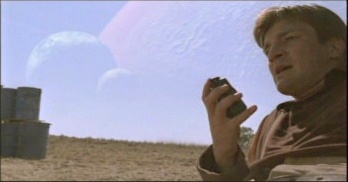
Notice that Mal seems to be on a world orbiting that big planet, and that one of the worlds in sky also seems to be a terraformed satellite.
JOSS, WHERE'S MY CHECK???!!!
NOTIFY: Y | REPLY | REPLY WITH QUOTE | PERMALINK | TOP | HOME
Quote:No. All of the planets would not have to be orbiting at the same distance. That's a myth brought on by egocentric thinking. The orbit of the earth is not the only orbit that a planet could have earth-like conditions. There is a range of orbits, from the orbit of venus to out beyond the orbit of Mars. Both Venus and Mars could have had earth-like environments on them at one time. So concievably the sun could have as many as three earth-like planets, possibly four. Just because we see only one today is more because we don't live long enough to see the full history of our solar system.
Originally posted by Galfridus:
Also, how would the notion of a "core" and a "periphery" work into such a system. All of the planets would have to be orbiting at about the same distance, and unless they were all orbiting at precisely the same speeds, the distances between them would be constantly changing.
Guess I have something to ask Mr. Whedon if I ever meet him. :)
A larger sun could have a larger range of orbits. In fact, a blue giant could have a range billions of miles wide, supporting dozens or possibly hundreds of earth-like planets. the furthest planets would be on the other side of the star, as many as 10 - 20 billion (or more) miles away, hence the "core" and the "periphery." Because the orbits would be so large, their positions relative to one another might change slowly, so that within a human life time, these core and periphery planets would be constant.
And yeah, the gas giant thing adds a whole other dimension. You could have 4 or 5 or possibly 16 or 20 "planets" orbiting a single gas giant. In essence, you have all these planets sharing the same earth-like orbit. Which (once again) concievably increases the number of possible earth-like planets a system like that could support.
And binary star systems could support habitable planets. The orbits don't have to be erratic. There are stable binary systems.
-----------
In the Dark Ages, Romano-Celtic Britannia was over-run by Viking-like cultures collectively called the Anglo-Saxons. They were led by warlords called Drytinns, and the greatest warriors among them were the Thegns.
NOTIFY: Y | REPLY | REPLY WITH QUOTE | PERMALINK | TOP | HOME

Quote "every man there, go back inside, or we will blow a new crater in this little moon" wash, the train job.
NOTIFY: N | REPLY | REPLY WITH QUOTE | PERMALINK | TOP | HOME
I know a star's life zone can have more than one planet in it. Our sun has three. Maybe a big sun could have 20 or so. But hundreds? I don't buy it. And, as that photo indicates, many worlds on Firefly would seem to be satellites of gas giants or brown dwarfs.
JOSS, WHERE'S MY CHECK???!!!
NOTIFY: Y | REPLY | REPLY WITH QUOTE | PERMALINK | TOP | HOME
Habitable planets would have a very difficult time forming naturally around any O or M class star such as blue giant. However, if they could be helped along by some form of terraforming there certainly could be a huge number of habitable planets orbiting a star that size, based on geometry alone. I don't know where you came up with this number 20 and why you think it's a limiting factor, but there's no law of physics that says there can't be more.
As for your gas giant theory, I'm not disagreeing with you. That sounds perfectly reasonable to me.
One question I have: why do we never see the gas giants in space?
These kinds of planets are not easy to hide. Jupiter is 11 times the diameter of the Earth, and there's no reason that a gas giant couldn't be larger, but Jupiter itself is hard to miss. In NASA photos of Jupiters moons, Jupiter often dominates the background scenery, sometimes Jupiter is the background scenery.
If these planets really are gas giant moons, I would like to see these gas giants in the background when the Serenity enters and leaves a world.
-----------
In the Dark Ages, Romano-Celtic Britannia was over-run by Viking-like cultures collectively called the Anglo-Saxons. They were led by warlords called Drytinns, and the greatest warriors among them were the Thegns.
NOTIFY: Y | REPLY | REPLY WITH QUOTE | PERMALINK | TOP | HOME
Quote:
Zicsoft wrote:
I know a star's life zone can have more than one planet in it. Our sun has three. Maybe a big sun could have 20 or so. But hundreds? I don't buy it. And, as that photo indicates, many worlds on Firefly would seem to be satellites of gas giants or brown dwarfs.
"The universe is not only stranger than we imagine, it is stranger than we can imagine."
Now, if the refugees from the dying earth suddenly discovered a system with such vast potential, what would they do?
Remember, Earth is a major unlikely event and we evolved (or were created) to fit it.
Jeff
Who figures a poly star system with other advantages as well.
NOTIFY: Y | REPLY | REPLY WITH QUOTE | PERMALINK | TOP | HOME
Quote:I guess this is where the whole science debate in science fiction could come in. Many, many inhabitable worlds in the same system is basically impossible. Doesn't mean I can't have fun watching it tho.
Originally posted by Zicsoft:
yes, the Firefly stories all take place in a single solar system with a suprisingly large number of inhabitable worlds

NOTIFY: N | REPLY | REPLY WITH QUOTE | PERMALINK | TOP | HOME
Quote:BUT, any habitable planets orbiting a gas giant that big is in significant jeopardy from incoming meteors and comets. Theory is that Earth made it to the state it has because Jupiter absorbs many of the incoming objects into our system because of its gravity well. I image planets orbiting a HUGE gas giant would be orbiting targets for nearly everything entering they system near the planet.
Originally posted by Thegn:
And yeah, the gas giant thing adds a whole other dimension. You could have 4 or 5 or possibly 16 or 20 "planets" orbiting a single gas giant. In essence, you have all these planets sharing the same earth-like orbit. Which (once again) concievably increases the number of possible earth-like planets a system like that could support.
NOTIFY: N | REPLY | REPLY WITH QUOTE | PERMALINK | TOP | HOME
No one said you wouldn't take your chances. That doesn't mean it couldn't happen, though. All I said was that there's no law of physics preventing it. I didn't say it would be safe.
-----------
In the Dark Ages, Romano-Celtic Britannia was over-run by Viking-like cultures collectively called the Anglo-Saxons. They were led by warlords called Drytinns, and the greatest warriors among them were the Thegns.
NOTIFY: Y | REPLY | REPLY WITH QUOTE | PERMALINK | TOP | HOME

Actually, it wouldn't be unstable.... from a physics standpoint. Yeah, and distances would change.
Politically... probably.
But some could be moons of a gas giant, others could be moons of smaller planets than that... the "central" planets could be moons around a gas giant, and the "peripheral" planets could have a variable distance from core of civilization depending on the season.
NOTIFY: Y | REPLY | REPLY WITH QUOTE | PERMALINK | TOP | HOME
Quote:
Originally posted by UFO:
BUT, any habitable planets orbiting a gas giant that big is in significant jeopardy from incoming meteors and comets. Theory is that Earth made it to the state it has because Jupiter absorbs many of the incoming objects into our system because of its gravity well. I image planets orbiting a HUGE gas giant would be orbiting targets for nearly everything entering they system near the planet.
So the moons would have a measurable probability of being hit by a comet every 10 million to 100 million years or so... people take their chances.
Also, we may be more surrounded by comets and other loosely attracted bodies than most solar systems. Because we basically know NOTHING about the local environments of other stars. The fact that we have as many comets as we do could be a regional abnormality of space.
NOTIFY: Y | REPLY | REPLY WITH QUOTE | PERMALINK | TOP | HOME

I've been lurking in this thread for a while and thinking about it, and earlier today I got started writing a response and then quit because it was getting so long. I was sort of drifting into a bunch of the science of how our solar system was formed, from the supply of atoms of heavy elements, to the way the long reach of gravity and the emptiness of space relate to consolidate the mass in a given orbital range into a single place because planets tend to sweep their path clear, to the supply of little comets and asteroids and their attraction to big masses, to the changes in matter density with distance from the center of the system and how this causes gravity to make planets of different sizes and densities and atmospheres (or no planets), to the way orbits fall into a rough plane instead of being distributed more spherically... I was actually trying to sort this all out as I went along, not lecture, but it started coming out that way!
BTW, a blue sun would be bad for life; its color is different because its EM emissions are different. It would be heavy in nasty radiation like UV and gamma, and short on the infra-red which photosynthesis depends on. And the colors we see on screen aren't all screwed up.
Anyway, the short version is that there's just no way such a thing would really happen. Even if you could find a place where, say a dozen or more supernovas had recently happened very close to each other and thus released such unimaginibly high amounts and densities of heavy atoms into the same place, and even if this mass somehow started forming a solar system mostly like ours only with extra solid planets (nevermind where all the extra energy and light elements went), the planets would then proceed to smash each other up anyway, which means that a system that still HAS all those planets is so young that the planets are being constantly pummeled by comets and asteroids and small lost moons and such, and the planets themselves are still ridiculously hot and toxic... not that the premise with which this run-on sentence began is really believable either.
So, unless and until something is specified in the show, you can choose whether to figure the setting uses technology that might someday turn out to be impossible to build (FTL travel) or is in a solar system whose existence violates known laws of motion. I prefer to believe in the one that, although perhaps far-fetched, might become possible after we've discovered more unknown physics, rather than the one that's already known not to work out with even rudimentary physics that's been well established for a while.
NOTIFY: Y | REPLY | REPLY WITH QUOTE | PERMALINK | TOP | HOME
You're right about the blue giant thing. But it's not too far-fetched that, since we are assuming terraforming technology, atmospheres may be constructed to provide extra protection from the higher radiation. As for the photosynthesis thing, that could explain why we only see desert landscapes. (Although, I'm sure it doesn't. :D)
And it doesn't have to be a blue giant. I used that as an example of the size that stars can be, not their life supporting capacity. In fact, there is another more drastic problem with the blue giant hypothesis. And that is that few stars of that temperature live long enough to form planets. Long before the primordial gases that might someday become a new earth begin to settle, that star would have blown itself to pieces. 
You could just drop down a size or two, to a white star, like a A or F, which might still give you the habitable zone large enough to support many habitable worlds with tolerable radiations ranges, especially if many of them are satellites of larger planets, given certain technologies.
And there's also another point that should be mentioned and that is that the habitable zones of stars are based on the premise that these are the orbits at which life is most likely to form on its own. If one does assume certain technologies, then the habitable zone might increase significantly.
However, there's also another problem, which I thought of, but didn't mention, and that is that it might not even be possible for a gas giant to form in a stars habitable zone. One of the reasons that the gas giants in our solar system are in orbits several au from the sun is because the closer to the sun you get, the stronger the solar wind gets. The solar wind moves out radially from the sun, so it diminishes as one over the distance squared, and therefore is exponentially greater the closer you get to the sun. There's a question as to whether a mass of gases could stay localized long enough to form a gas giant within that range.
If you considers more then just geometry, the story starts to get fuzzy. I'm not entirely sure that any laws of physics need to be violated, but you might need to insults some laws of statistics. If such a system did exist, it would seem that it would need to be almost mechanically laid out as to be improbable at best. But I'm not ready to say it's impossible, just yet. Although, it is intriguing.
-----------
In the Dark Ages, Romano-Celtic Britannia was over-run by Viking-like cultures collectively called the Anglo-Saxons. They were led by warlords called Drytinns, and the greatest warriors among them were the Thegns.
NOTIFY: Y | REPLY | REPLY WITH QUOTE | PERMALINK | TOP | HOME

Quote:
Originally posted by UFO:
BUT, any habitable planets orbiting a gas giant that big is in significant jeopardy from incoming meteors and comets. Theory is that Earth made it to the state it has because Jupiter absorbs many of the incoming objects into our system because of its gravity well. I image planets orbiting a HUGE gas giant would be orbiting targets for nearly everything entering they system near the planet.
And people voluntarily live in California, right on fault lines right now...
NOTIFY: N | REPLY | REPLY WITH QUOTE | PERMALINK | TOP | HOME
Quote:
Originally posted by UFO:
BUT, any habitable planets orbiting a gas giant that big is in significant jeopardy from incoming meteors and comets. Theory is that Earth made it to the state it has because Jupiter absorbs many of the incoming objects into our system because of its gravity well. I image planets orbiting a HUGE gas giant would be orbiting targets for nearly everything entering they system near the planet.
I have just two words for you. Orbital Railguns.
Also useful in engaging any ship that might be passing by.
:)
-------------------------------------------------
May the road rise to meet you.
May the wind be always at your back.
May you be in heaven an hour before
The Devil knows you’re dead.
NOTIFY: N | REPLY | REPLY WITH QUOTE | PERMALINK | TOP | HOME

For one thing there are more then one solarsystem!!!
In both the first show ,and the last show it was said to that they had to go to other systems!!!
NOTIFY: Y | REPLY | REPLY WITH QUOTE | PERMALINK | TOP | HOME
Quote:
Any habitable planets orbiting a gas giant that big is in significant jeopardy from incoming meteors and comets. Theory is that Earth made it to the state it has because Jupiter absorbs many of the incoming objects into our system because of its gravity well. I image planets orbiting a HUGE gas giant would be orbiting targets for nearly everything entering they system near the planet.
I'm certainly not disagreeing with you. That might be one of the reasons only poor people want to live on those outer planets in Firefly. I would love it if that could be the subject of a future episode.
NOTIFY: N | REPLY | REPLY WITH QUOTE | PERMALINK | TOP | HOME
When the narration says, "After the Earth was used up, we found a new solar system and hundreds of new Earths to be terraformed and colonized," they might mean they found a planet that could support life in a solar system that is part of a globular cluster. In a globular cluster, there are between 10,000 and 1,000,000 stars spread over a volume of several 10s to 200 light years in diameter. If we could travel to a cluster of 10,000 stars, we might find hundreds of Earth-like planets. These planets could be terraformed with the terraforming technology we apparently have in the future.
Terraforming Earth-like planets seems more plausible to me than terraforming moons of gas giants. Hence, I'm leaning toward interstellar travel to stars that are relatively close together on Firefly. Still, that doesn't explain the huge gas giant we see at the beginning of "The Train Job".
NOTIFY: N | REPLY | REPLY WITH QUOTE | PERMALINK | TOP | HOME
I don't see any reason why those hundreds of planets can't be spread over several star systems. The narrator may be talking about the number of planets colonized by the earth, not the number of planets readily accessible to the crew of the Serenity. And interstellar travel does not necessarily require faster then light speeds. A vessel that is capable of 0.5 - 0.8 the speed of light would be suitable for feasible interstellar flight as long as the stars were close. Of course individual star systems would still be very isolated, perhaps in much the way Europe was isolated from the Americas, after the Discovery.
On Globular Clusters:
A globular cluster would be a very poor place for planets to form. The stars may be far too densely packed. I doubt, planets would ever begin to form. If you somehow transplanted a planet (hypothetically speaking) the tidal forces between the starts would rip it out of orbit or tear it to crumbs. Some astronomers like to say that the number of stars makes it unlikely that enough heavy elements would be present to form planets, but I'm not a big proponent of the "lack of material" theories. They are essentially cop-out theories, because in the end, we don't know how much heavy material there is in the universe, and there's no way to find out. But if there's any place where such a theory is valid, it's a globular cluster. And recent observations have confirmed that globular clusters seem to be lacking in planets.
One could hypothesis the existence of planets on the outermost stars of a globular cluster, but that might not give you what you're looking for.
Now Open Clusters are a different story. They would be more likely to have life supporting stars and planets
On teraforming planets instead of moons:
It really doesn't matter, whether it's a moon or a planet. It's the size and orbit of a planet, given a habitable star that is important. Whether that "planet" is directly orbiting the star or a larger planet really has nothing to do with the plausibility of teraforming it.
-----------
In the Dark Ages, Romano-Celtic Britannia was over-run by Viking-like cultures collectively called the Anglo-Saxons. They were led by warlords called Drytinns, and the greatest warriors among them were the Thegns.
NOTIFY: Y | REPLY | REPLY WITH QUOTE | PERMALINK | TOP | HOME
How far do you have to go from here to find the nearest of these clusters? Too far for STL, I'd bet. And even if the stars are really close together, it's still going to be years between them at less than c... which is just too impractical. There'd be no trade; the most there MIGHT even be at a stretch is some sparse migration of permanent one-way movers.
In the narration, he says that those who lost the war drifted to the outer edges of the system. If you figure he's talking about a solar system, there's just no way. Beyond Saturn, the sun is hardly distinguishable from other stars; at Pluto's range, not at all. There's a REASON why those planets have such low temperatures. You don't have to be very scientific to figure out that farther away from the heat source equals colder. It HAS to be multiple different solar systems. So this quote just has to be either dismissed as an unrecoverable mistake or interpretted some other way, like maybe that "the system" refers to the region of space that humans occupy.
NOTIFY: Y | REPLY | REPLY WITH QUOTE | PERMALINK | TOP | HOME
This is why the idea of a double star seems the most plausible solution. The stars would be close enough that interstellar flight may not be impractical yet increases the number of habitable planets in the system.
The outer edges of solar system could just as likely be an analogy for a certain group of moons further from the star then an inner group. No matter how it's interpreted, you're right that it can't mean the actual outer edges of the solar system in question, at least in reality, but it also doesn’t necessarily have to mean entire other star system either.
-----------
In the Dark Ages, Romano-Celtic Britannia was over-run by Viking-like cultures collectively called the Anglo-Saxons. They were led by warlords called Drytinns, and the greatest warriors among them were the Thegns.
NOTIFY: Y | REPLY | REPLY WITH QUOTE | PERMALINK | TOP | HOME
Quote:Unfortunately, we'd still be talking about flight times of weeks or months. How many times in a lifetime does one traveller do that? How much should wee see them age if there's that much inactive travel time between episodes and the show goes on for a few seasons? What cargo is worth that?
This is why the idea of a double star seems the most plausible solution. The stars would be close enough that interstellar flight may not be impractical yet increases the number of habitable planets in the system.
NOTIFY: Y | REPLY | REPLY WITH QUOTE | PERMALINK | TOP | HOME
Quote:Firstly, back 300 or so years ago, travel between China/India, Europe and the Americas, could take months, yet trade was very vibrant. In fact, most travel between those regions was done for trading purposes. It wasn’t unusually for some people to spend years on a sailing vessel to get somewhere. So weeks and months of travel time is well within the plausible range. Don’t underestimate the levels that mankind is willing to go for the almighty dollar.
Originally posted by Delvo:
Unfortunately, we'd still be talking about flight times of weeks or months. How many times in a lifetime does one traveller do that? How much should wee see them age if there's that much inactive travel time between episodes and the show goes on for a few seasons? What cargo is worth that?
Secondly, On time dilation:
First, what makes you think that Joss Whedon or any other Firefly writer as the first clue what that is?
Second, even if they did, the effects of time dilation would only be evident from a frame reference stationary relative to the Serenity. Most of the episodes have been told mostly from the same frame reference as the crew of the Serenity. So time dilation wouldn’t necessarily be noticeable at all. And time dilation is really only very evident beyond about 0.7-0.8c. Below that time dilation is more-or-less negligible. At 0.8c time dilation is only about 2 days for every day on the ship. It would be interesting though if Joss would incorporate time-dilation into Firefly, but I don’t think it’s going to happen. I think we’ve already over-thought this show long way back in this thread.
-----------
In the Dark Ages, Romano-Celtic Britannia was over-run by Viking-like cultures collectively called the Anglo-Saxons. They were led by warlords called Drytinns, and the greatest warriors among them were the Thegns.
NOTIFY: Y | REPLY | REPLY WITH QUOTE | PERMALINK | TOP | HOME
Ya, I knew that voyages by ship took a long time, especially back then... but that doesn't make for very good TV! (And with the aging comment, I wasn't saying anything about time dilation, I was just pointing out how much of one's life such long voyages take.)
NOTIFY: Y | REPLY | REPLY WITH QUOTE | PERMALINK | TOP | HOME
A solar system can only support only so many planets, and gas"Giants"( and thats the Corect way of describleing it)not only is there rotational factors to considder, but there are planitary factors to consider.
If Earth was one Degree closer to the sun would be talking about another hundred degree, in climet.
This means that if you had only one ordit base oppone the earth orbit you would only be able to support two or three,if lucky four but not Likely!!!
So it's bull that there is only"One Solar" system, that supports more then that number and forget about "hundreds", there are more then one solar system, thats for sure watch the show!!!
NOTIFY: Y | REPLY | REPLY WITH QUOTE | PERMALINK | TOP | HOME
I think they may have addressed this issue tonight. In the new intro, by Mal instead of Book, they changed it to say that Humans had found a new galaxy, rather than the old intro that said a new solar system.
Just my dos pesos,
Rex!
NOTIFY: Y | REPLY | REPLY WITH QUOTE | PERMALINK | TOP | HOME
Somehow that doesn't answer anything from a stand point of plausiblity. The nearest galaxy would take billions of years to reach and then you would still have the same problems there as you do in this one.
If you want to consider it scientifically plausible, you can't take either introduction as literal.
-----------
In the Dark Ages, Romano-Celtic Britannia was over-run by Viking-like cultures collectively called the Anglo-Saxons. They were led by warlords called Drytinns, and the greatest warriors among them were the Thegns.
NOTIFY: Y | REPLY | REPLY WITH QUOTE | PERMALINK | TOP | HOME
Um, Thegn, you're looking at it wrong: the huge distance travelled doesn't just make the whole thing about not having FTL travel implausible, it proves that they must have FTL travel.
NOTIFY: Y | REPLY | REPLY WITH QUOTE | PERMALINK | TOP | HOME
I don't think I'm looking at it wrong, necessarily. I understand what it implies. The problem is that what it implies is NOT scientifically plausible. But I guess it's a small matter.
-----------
In the Dark Ages, Romano-Celtic Britannia was over-run by Viking-like cultures collectively called the Anglo-Saxons. They were led by warlords called Drytinns, and the greatest warriors among them were the Thegns.
NOTIFY: Y | REPLY | REPLY WITH QUOTE | PERMALINK | TOP | HOME
Let's look at it this way...
We know that the show is 500 years in the future, so realistically, if it's a new solar system we're talking about then they must have FTL flight in order to get the Earth's population out there in under five hundred years... And that leaves out the time it takes to start all these colonies and the time until we leave Earth from now.
Possibility one - Earth was used up a LONG time ago and the human race took cryo stasis ships from Earth to this new system/galaxy and they ignore the time spent in transit as no-one experianced it. Firefly could be set a million years in the future but with the collective age of humanity essentially only advanced 100 years.
There is no way, even in a Trinary system, you could pack in hundreds of planets... So how about this... A Blue Giant orbited by a few dozen Red Dwarves? That would give you a couple of dozen systems, all within easy reach, of each other, each with a habitable zone capable of holding three or four worlds that could technically be classed as moons... You could maybe squeeze fifty or sixty worlds in that way... Make it a small black hole instead of a Blue Giant and you could have a sphere of hundreds of Red Dwarves or larger orbiting, each with four or five planets... There you have humanity's new home.
Implausible but possible.
Mark
"Oops" Shannon Foraker, Ashes of Victory
NOTIFY: Y | REPLY | REPLY WITH QUOTE | PERMALINK | TOP | HOME
Um...don't we already know from the new opening that it's a galaxy, not a single star system? Have I missed something?
Is there any reason why it couldn't just be other locations in the Milky Way galaxy?
Forgive this oh-so-ignorant person.
NOTIFY: Y | REPLY | REPLY WITH QUOTE | PERMALINK | TOP | HOME
Being in England, I haven't seen the new opening yet, although I am downloading all the episodes a soon as I can...
Still, I think all this comment is over Serenity's drive system. We know that she has a standard radion accelerator core, but I think everyone would like to know how she goes FTL. The drive, the top speed ect. Everything said so far (Up to Jaynestown for me) has indicated that it's a single system and we haven't seen any signs of ships going into warp or whatever they do... If Joss could clear up the details I think everyone would be happier.
He just needs to hang with David Weber for a few days. Dave would sort him out.
Mark
NOTIFY: Y | REPLY | REPLY WITH QUOTE | PERMALINK | TOP | HOME
Here's a quote from http://beyondheroes2.tripod.com/stars.htm :
"An excellent example is the nearby solar-like stars Alpha Centauri A and B. They orbit each other at an average distance of 23 AU, however the eccentricities of each orbit bring them to as close to 11 AU and as far as 35 AU. Numerical simulations by Paul Weigert at University of Toronto have shown that each star has a 'safe zone' about 3 AU in radius in which planets could safely survive for billions of years. Objects placed further out from each star than about 3 AU are dynamically ejected in a matter of millions of years or less. Alpha Cen A is about 1.5 times as luminous as our Sun, and Alpha Cen B is about .45 times as luminous as our Sun, and if you do the simple physics, one can see that a 'habitable zone' exists around BOTH stars within the 3 AU dynamic 'safe zone.' Indeed, it could be possible that BOTH Alpha Cen A and B have planets conducive to life. Theoretical models age them anywhere from 3-8 Gyr... plenty of time for life to develop if the planets have the right conditions..."
In addition, a report at http://adsbit.harvard.edu/cgi-bin/nph-iarticle_query?1994A%26A...292..
115A theorizes that the Alpha/Proxima Centauri system is gravitically linked to others, including:
Gliese 140.1
Gliese 676
ADS 10288 (Gliese 649.1)
and six single stars.
Not sure how far these other stars are from Alpha Centauri, though.
According to http://www.solstation.com/stars/alp-cent3.htm :
In a binary system, a planet must not be located too far away from its "home" star or its orbit will be unstable. If that distance exceeds about one fifth of the closest approach of the other star, then the gravitational pull of that second star can disrupt the orbit of the planet. Recent numerical integrations, however, suggest that stable planetary orbits exist: within three AUs (four AUs for retrograde orbits) of either Alpha Centauri A or B in the plane of the binary's orbit; only as far as 0.23 AU for 90-degree inclined orbits; and beyond 70 AUs for planets circling both stars (Weigert and Holman, 1997). Hence, under optimal conditions, either Alpha Centauri A and B could hold four inner rocky planets like the Solar System: Mercury (0.4 AU), Venus (0.7 AU), Earth (1 AU) and Mars (1.5 AUs).
So...
It could be that the "core planets" are those orbiting one or the other of the stars, and the rim planets orbit both at 70+ AUs.
Early: You ever been raped, Kaylee?
Kaylee: You know, it's funny you should mention that... ever heard of the Fox network?
NOTIFY: Y | REPLY | REPLY WITH QUOTE | PERMALINK | TOP | HOME

A few random points...
- Several times they refer to some of the worlds as "moons", a statement supported by the sky background in the beginning of Train Job.
- The Hands of Blue guys say they've travelled 86 million miles like it's some kind of large distance.
- The voyage from Persephone to Jiangyin (time between Shindig and Safe) was "nearly a month". The voyage from somewhere to Greenleaf via the roundabout route they were taking took a week (Out of Gas). The voyage from Triumph to Beaumont was also a week (Our Mrs Reynolds). So clearly travel times, and time passage between episodes, can be awhile.
- Their terraforming technology is apparently very advanced, since Mal describes them as being able to alter gravity as well as atmosphere.
If we assume for a moment that this near-magical terraforming tech would allow them to transform a moon of Saturn, say, into a desert-like world like we see in the show, then habitation zones and whatnot become somewhat moot.
Granted, such terraforming technology is far beyond anything envisioned by today's science, and flies in the face of more than a few laws of physics. But then again, so does FTL and wormhole travel. I find the one no less plausible than the other, personally.
NOTIFY: Y | REPLY | REPLY WITH QUOTE | PERMALINK | TOP | HOME
The main criterion for a habitable zone is temperature. If the planet's too hot, all the water boils away. If it's too cold, it all freezes. Terraforming only transforms the surface conditions and atmosphere; it does not render that region of space hotter or colder. Thus the question of habitable zones is far from moot, unless these planets all have global climate control. I'd think that the reference to planets having Earthlike gravity means that they actually looked for planets with appropriate gravitation, rather than altering what was already there.
Early: You ever been raped, Kaylee?
Kaylee: You know, it's funny you should mention that... ever heard of the Fox network?
NOTIFY: Y | REPLY | REPLY WITH QUOTE | PERMALINK | TOP | HOME
All depends on how you interpret it. I read that as meaning they have some control over the gravity, not just good choices. And if they can control gravity, why not temperature. But it's all a matter of how you want to look at it.
NOTIFY: Y | REPLY | REPLY WITH QUOTE | PERMALINK | TOP | HOME
This is all well and good, but let's not forget it is science FICTION and episodic television.
Serenity, and all the the other space ships we've seen, including crippled derelicts, all appear to have artificial gravity, a huge advance over our current state of physics. This is as good a representation of the fiction part as it is of the limited budgets of episodic television.
Sometimes TV (and movie) writers have to do stuff that is scientifically implausible or suspect because other things would just take too long or be too boring or, most importantly, be too expensive, so you throw in a little magic and call it dramatic license...
Fetishizing Serenity would be a mistake; Firefly is not about the ship.
The reason we watch Firefly is not because of the tech any more than we watch Buffy or Angel for commentary on the true nature of good and evil. It is, more than anything else, because of those terrific characters and the way they interact on the ship and with others they meet along the way.
[Blue]Was it monkeys?[/blue]
NOTIFY: Y | REPLY | REPLY WITH QUOTE | PERMALINK | TOP | HOME

Geez, I wish I'd seen this thread before I started posting all manner of off-topic tech stuff on the "What makes Firefly so different" thread! So, here's one of my posts from there, which, I think, speaks to (but by no means settles!) some of the points raised by y'all:
>
Quote:
[Jeffns wrote] I lean towards a single, large solar system for the background of the 'Verse. Who's to say that whatever techniques of terraforming were used on all the worlds, moons, large asteroids, planetesimals, etc, it wouldn't have the effect of increasing the gravity to something approaching Earth normal?
Trouble with that, Jeffns, is that I don't see evidence in the rest of the 'verse of that kind of God-like tech. Try to boost the gravity of even a small planet-like body, and you'd have to stabilize megatons of rock 'n such against the immense geological (*don't* give me a hard time about that word!) forces involved in changing the grav at the surface (like, say, by burrowing a small singularity into its core...remember, it has to be zero-maintenance [think it over], so giga-machines are pretty much out). The body would have a tendency to buckle. Not to mention that without enough mass to sustain some kind of tectonic process, atmo gasses would tend toward chemical equilibrium, and not get recycled through vulcanism and such (I think this would be so even with enough plant and animal biomes to recycle oxy and carbon diox. The CO2 would tend to get bound up in carbonates, methinks).
And remember again that the orbital dynamics of a system with THAT many bodies (*especially* one in which their gravitational characteristics had been mucked about with willy-nilly) would be outlandishly complex and, ultimately, catastrophically chaotic.
Quote:
Also, if the number of worlds seems too large to be in orbit around just one sun, just think about how many bodies exist here in our own Solar System. There are more planets, moons, etc in our system than have ever been visited, listed or mentioned in the episodes thus shown.
Well, in our own system, 4 out of 8 planets (I'm counting Pluto/Charon as a Kuiper Belt Object...and, yes,that's a WHOLE other thread!) are gas giants, so they're right out. Yup, they've got plenty of moons...but then there's the problem of the sun being too far away. Yah, maybe you could orbit artificial suns, or implode the gas giants to make mini suns (if they're massive enough...which most ain't [not even Old Jove]). But you're still talking about a whopping load of radiation on close-orbiting "planets." Again, these measures have to be zero maintenance, or your investment's for naught. Rocky planets closer in aren't as much of a problem ('less you count such as Mercury, where you'd have to orbit huge sun shades...and keep 'em there, or your colony's like ants under a magnifying glass [actually, with Mercury, you'd also have to spin it up, since it's tidally locked; always shows the same face to the sun...killer winds, and the small problem of your atmo constantly snowing onto the dark side!]). Your best course would be to stick to the relatively habitable zone (Venus-Earth-Mars), which eliminates all but three (four, if you count Luna) of the many bodies in this particular system. Again, looks like our FF 'verse is a collection of star systems.
edited to add Many thanks BTW, for the info on Alpha Centauri. Will prove MOST useful for a noveloid I'm writing! As for binaries, you are up against formidable problems in orbital mechanics, as has been said. My money is really on a globular, or more likely open cluster (say like the Magellanic Clouds or somesuch). Would still (just) qualify as a "galaxy" as per the new and improved Mal-narrated intro, and, given FTL travel, not OUTLANDISHLY far (like, say, Andromeda)
Quote:
And only in a small (compared to the rest of the Universe) volume like a solar system would the Alliance have a hope of exercising any kind of control over the peoples. So, I think Serenity has incredibly efficient and powerful engines, but they are sublight.
NOTIFY: Y | REPLY | REPLY WITH QUOTE | PERMALINK | TOP | HOME
Supposing you had gravity control, able to affect a small body, giving it sufficient gravity to hold onto an atmosphere. There is a problem in this in that you now this more massive body starts disturbing the orbital characteristics of other bodies out there.
UNLESS: The trick used in Alcubierra's original warp drive paper was to collapse space-time in front of the ship and expand it behind the vessel. Leaving the inside of the warp bubble "flat" as well as the outside. But the edge or "wall" of the bubble would be higly curved. (Very highly curved in the case of FTL travel) with a band around the middle of the bubble that reverses the curvature in the zone closest to the bubble walls.
To avoid potentially dangerous perturbations of other planetary/satellite orbits, wrap a warp bubble (for lack of a better term) around the body, such that space time inside the bubble is differently curved from outside. Instead of a smooth gradual curve like you find naturally, make a sharp (or rather less smooth) curve around the body.
Which means, if you have warp drive, you might also be able to affect the gravity, and hence atmospheric holding ability of any sized object. Warp drive makes terriforming easier.
NOTIFY: Y | REPLY | REPLY WITH QUOTE | PERMALINK | TOP | HOME
"This is all well and good, but let's not forget it is science FICTION and episodic television."
I know, I know... I just can't help myself. I am the kind of person that wants to actually live the fantasy. I love hearing the stories of Serenity, (and Enterprise, and the C57D etc.) But more than that, I would love to actually live them, go out into the black, see what is out there.
I can't now. I am not so lost in my imagination that I can't see how it differs from reality. And yet, I want to see it made reality, as much as possible. Made fact instead of fiction.
But having said that, I do have to salute Joss et.al. for not making the story SCIENCE fiction, but good fiction with a small science angle. If you have not got a good story in the first place, good characters, and plots, all the fancy special effects in the world won't save you.
"Couldn't let us make a profit. That wouldn't be civilized."
NOTIFY: Y | REPLY | REPLY WITH QUOTE | PERMALINK | TOP | HOME
"writing! As for binaries, you are up against formidable problems in orbital mechanics, as has been said. My money is really on a globular, or more likely open cluster (say like the Magellanic Clouds or somesuch). Would still (just) qualify as a "galaxy" as per the new and improved Mal-narrated intro, and, given FTL travel, not OUTLANDISHLY far (like, say, Andromeda)"
Global clusters have sever gravitational problems of their own. Which tend to strip planets from their suns. For long term solutions, they are not nearly as feasible as one would thing.
The orbital dynamics of binaries is a lot less of a problem, mostly because they are so predictable. It all depends on the separation of the two stars, as has been pointed out elsewhere.
Again, I think that Mal and Book were being more poetical than practical, and also that Serenity is FTL. You are right, in that boundless optimism runs up against a hard limit very quickly if limited to a single star system. But the "galaxy" of new earths does not have to be in either of the Magellenic clouds or a cluster. It is estimated the Milky Way itself is approximately 100,000 light years across at its widest. (30kiloparsec) And approximately 200 Billion stars. Thats a lot of real estate, right here in our own back yard.
"Couldn't let us make a profit. That wouldn't be civilized."
NOTIFY: Y | REPLY | REPLY WITH QUOTE | PERMALINK | TOP | HOME

Stupid history major question alert:
Don't globules eventually give birth to new stars?
End stupid history major question alert.
Sarah
NOTIFY: N | REPLY | REPLY WITH QUOTE | PERMALINK | TOP | HOME
Doing this from memory, so if I got this wrong, well, sorry.
Short answer: No.
Long answer: Global clusters are largely older, smaller stars found bunched up in the galactic halo. There was some concern a while back when the age of the oldest stars, as found in global clusters did not match the age of the galaxy as determined by other means using the Hubble. Hipparcos was launched by the ESA (European Space Agency) which then found that our baselines were too short by about 10%. (Using very accurate parallax measurements of cephid variables) Working through all the math, things turned out to agree within the known margins of error.
Stars are formed in nebulas of different kinds. The Big nebula in Orion is a major star forming region. Basically standard theory is that clumps of these gasious nebulas collapse gravitationally to form stars, planets, and other fun stuff. This mostly happens in the spiral arms of our galaxy. (At least at this stage of life in our galaxy.)
I think that there is a tendency to take every utterance of a science fiction character as gospel, especially in the area of science. People don't do that now, why expect them to do it in the future? People use metaphors, analogies, poetry and hyperbole. They may abbreviate for various reasons. And they may lie, or simply get it wrong. With FTL travel, whether all the worlds are in a single solar system (which 80 worlds seems a bit high, even with gas giant moons) or spread throughout several solars systems, it really does not matter from the story's point of view.
"Could let us make a profit. Wouldn't be civilized"
NOTIFY: Y | REPLY | REPLY WITH QUOTE | PERMALINK | TOP | HOME
Drakon;
Gotta say, it's a joy to read your posts. If I didn't have to dash out the door (pesky career!), I'd have more specific things to say (and may do so later this eve). But wanted to say that I echo your sentiments about why we devote so much good brain glucose to these fictional conundrums (conundra?). Only game in town till NASA stops going round in circles (or someone finally up and wins the X-prize and gives those bureaucrats a good kick in the arse!). Till then, the only "black" I'll be taken out to is the void between my ears!
Keep flyin'!
Department of Redundancy Department
NOTIFY: Y | REPLY | REPLY WITH QUOTE | PERMALINK | TOP | HOME
Quote:
Originally posted by Drakon:
But having said that, I do have to salute Joss et.al. for not making the story SCIENCE fiction, but good fiction with a small science angle. If you have not got a good story in the first place, good characters, and plots, all the fancy special effects in the world won't save you.
Listen, I'm just glad that Serenity didn't make that rumbling/whooshing sound all the Star Wars/Trek ships make. Just the fact that Joss tried to give us an accurate picture of a soundless void made me happy --- everyone knows spaceships really sound like fiddles...
NOTIFY: Y | REPLY | REPLY WITH QUOTE | PERMALINK | TOP | HOME
http://ebay3.ipixmedia.com/abc/M28/_EBAY_a237149f6bd37aa0a3a49ab728c82
6c1/i-2.JPG
This is the front cover of a trifold map included in the press kit for the show. You'll notice that it says "NGC 3242" on it. Googling "NGC 3242" quickly shows that it's the "Ghost of Jupiter" planetary nebula, approximately 1,400 light-years from Earth.
Early: You ever been raped, Kaylee?
Kaylee: You know, it's funny you should mention that... ever heard of the Fox network?
NOTIFY: Y | REPLY | REPLY WITH QUOTE | PERMALINK | TOP | HOME
Noocyte:
Thanks for your kind words, but please, my head is fat enough as it is 
Agree wholeheartedly about NASA, but remember MASA is a product of our own democratically elected government. I am afraid that we who want "out to the black" are a minority, and other spending concerns have priority. It is something that we are going to have to do ourselves without relying on government's help. Fortunately, all research that NASA does falls into the public domain, so their efforts are freely available.
Right now we need a propulsion system. And really that is it. We have enough technical knowhow to build everything else. (Power plant is a function of propulsion, and possibly the largest single power draw.) Life support, navigation, hull, everything else has been pretty well worked out.
Not so sure "Ghost of Jupiter" nebula is a likely candidate in and of itself for a lot of habitable planets. A planetary nebula is formed by a star "sluffing off" its outer layers of gas, either just prior to, or during a nova. Anything within about 10 light years of a nova stands a good chance of being sterilized. Perhaps, this is simply the largest or main feature of this region of space.
Hmmm, 1400 light years away, and the year is 2517? That is almost 3 light years per year we'd have to cover just to get there. We better start cracking.
NOTIFY: Y | REPLY | REPLY WITH QUOTE | PERMALINK | TOP | HOME
Y'know, it's entirely possible that we developed FTL drive, but it's so hideously expensive that the only ones ever developed were used for the ships that transported us to our new home. After that, it's all sublight.
Also, re: the Ghost of Jupiter, it's possible that the "terraforming" referred to in the intro is more than just taking an existing planet and making it habitable, but creating planets from scratch out of existing materials.
Early: You ever been raped, Kaylee?
Kaylee: You know, it's funny you should mention that... ever heard of the Fox network?
NOTIFY: Y | REPLY | REPLY WITH QUOTE | PERMALINK | TOP | HOME
Quote:
This is the front cover of a trifold map included in the press kit for the show. You'll notice that it says "NGC 3242" on it. Googling "NGC 3242" quickly shows that it's the "Ghost of Jupiter" planetary nebula, approximately 1,400 light-years from Earth.
Does the map actually have any info about the layout of the planets inside it? I know that won't answer the "stellar system or galaxy" question by itself, but it might shed some interesting light.
NOTIFY: Y | REPLY | REPLY WITH QUOTE | PERMALINK | TOP | HOME
Quote:
Originally posted by Haplo721:
Y'know, it's entirely possible that we developed FTL drive, but it's so hideously expensive that the only ones ever developed were used for the ships that transported us to our new home. After that, it's all sublight.
This could make sense. The use of FTL within a solar system would be tricky; the distances are not far enough away to justify it's use and there could be serious repercussions if you did -- doesn't the mass of something at light speed approach infinity?
Quote:
Also, re: the Ghost of Jupiter, it's possible that the "terraforming" referred to in the intro is more than just taking an existing planet and making it habitable, but creating planets from scratch out of existing materials.
If we were sure the sun wasn't going nova, going to a nebula could also make sense; you'd use those elements, gaseous and otherwise, floating in space to build planets, perhaps ala Star Trek Genesis Project type methods...
NOTIFY: Y | REPLY | REPLY WITH QUOTE | PERMALINK | TOP | HOME
Well, a planetary nebula is formed WHEN a star goes nova, so I suppose we figured "If it's blown once already, it'll be a while before it does again."
I've contacted 2 different people who have the press kit. Both are willing to scan the map, blueprints, and other materials, but one has no scanner and the other has a le-se one. Both are going to ask friends to use theirs.
Early: You ever been raped, Kaylee?
Kaylee: You know, it's funny you should mention that... ever heard of the Fox network?
NOTIFY: Y | REPLY | REPLY WITH QUOTE | PERMALINK | TOP | HOME
BTW: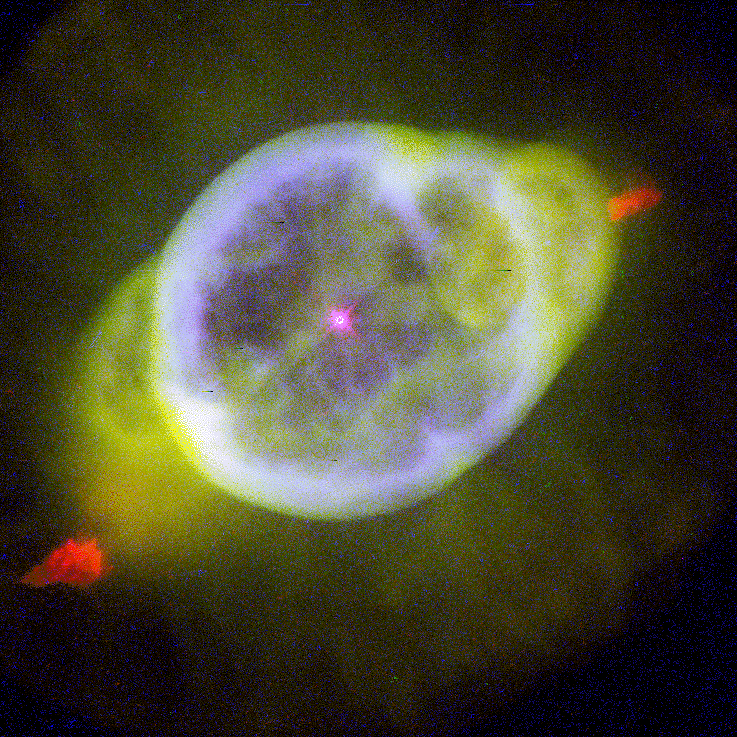
That's the nebula in question.
It's 1,400 light-years away, and 0.6 light-years across.
Early: You ever been raped, Kaylee?
Kaylee: You know, it's funny you should mention that... ever heard of the Fox network?
NOTIFY: Y | REPLY | REPLY WITH QUOTE | PERMALINK | TOP | HOME
Haplo721 wrote:Friday, February 21, 2003 07:47 Y'know, it's entirely possible that we developed FTL drive, but it's so hideously expensive that the only ones ever developed were used for the ships that transported us to our new home. After that, it's all sublight.
Also, re: the Ghost of Jupiter, it's possible that the "terraforming" referred to in the intro is more than just taking an existing planet and making it habitable, but creating planets from scratch out of existing materials.
Ya know. Two very good points. Heck, only nit I got against it is that expensive in terms of energy requirements, rather than money. Which is probably what you meant anyway.
"Couldn't let us make a profit. Wouldn't be civilized."
NOTIFY: Y | REPLY | REPLY WITH QUOTE | PERMALINK | TOP | HOME
"doesn't the mass of something at light speed approach infinity?"
I was kinda hoping not to be asked this, as this is one of the more technical and "counter-intuitive" (i.e. confusing) things about General Relativity.
Space and time cannot be seen or measured directly. And because of that, there is no way to measure any kind of absolute velocity. If you want to figure out where you are, or how fast you are going, you have to have a reference point. And that reference point may be sitting still or moving, with relation to, or "relative" to, any number of other objects.
Each object traveling on its own, not being affected by outside forces, is travelling inertially. This inertial travel establishes a "frame" by which we can measure velocity, acceleration and mass. But if you change the velocity, you change the frame, and this messes with your measurement of mass.
We are all familiar with how length contracts in the direction of motion, how time slows down, and how mass increases as an object travels closer to the speed of light. What is usually ignored, is that a person on such a ship would not notice anything different. It is only with respect to an outside observer, one not traveling at the same velocity as the ship that such issues come into play. From the outside, as you look at the ship speeding past, it may look like a very heavy pancake, whose clocks are running slow(er than yours). But to a guy on that ship, it looks completely normal. As a matter of fact, if he looks at you, he sees your clock has slowed down, you are remarkably thinner, and more massive.
Now this has dealt with inertial mass. And Relativity says that inertial mass and gravitational mass are the same. (Gravitational mass being the cause or source of the gravitational field) Relativity says that Mass and Energy are equavilent, but that Energy is another of those frame dependent measurements. It depends on how fast your reference point is travelling.
Ya with me so far?
In other words, the curvature of space and time causes the effects we call gravity. This curvature is dependent on the total amount of mass and energy in the area. The measure of both mass and energy are dependent on what "intertial frame" you are using, how fast your reference point is going. One can swap frames by running through the formulas.
There is one thing that makes this not that big a deal. In order to displace a planet, or other body, you have to do work, which is exert a force over a period of time. The force of gravity is an inverse square law, it gets 4 times as weak if the distance is 2 times as far. So it works out that a slow moving light object has as much effect as a fast moving heavy one, because of this little fact. The faster object does not spend as much time close to the planet to deflect it as much.
If this is as clear as mud, I can try again. You can take that as a threat if you like, I can be quite boring on the subject.
"Couldn't let us make a profit. Wouldn't be civilized"
NOTIFY: Y | REPLY | REPLY WITH QUOTE | PERMALINK | TOP | HOME
Not quite. You get such a nebula prior to a nova as well. Look at Eta Carina, which hasn't yet, but looks damn pretty puffing out a sky the way it does.
But in this case, if the central star is already a white dwarf, it looks pretty safe
"Couldn't let us make a profit. Wouldn't be civilized"
NOTIFY: Y | REPLY | REPLY WITH QUOTE | PERMALINK | TOP | HOME