

What is science?
POSTED BY: canttakesky
UPDATED: Sunday, August 30, 2026 21:01
VIEWED: 22789
PAGE 1 of 1
From time to time, here in RWED, we have debates about science. Inevitably, these debates end up accusing the other side of not knowing what science is, or betraying scientific integrity in some way.
So, what IS science? What is non-negotiable about what makes science, science? What is pseudo-science? When someone claims to be a scientist, what can he/she do that REALLY gets your goat and makes you want to scream, "You don't know what science is, you idiot!"?
NOTIFY: Y | REPLY | REPLY WITH QUOTE | PERMALINK | TOP | HOME

The most commonly used definition would probably be:
systematic knowledge of the physical or material world gained through observation and controlled experimentation.
Pseudo-science is when someone uses a scientific word (such as "theory") in an improper way to make themselves sound like they are operating from fact when they aren't. It could also be when an observation or experiment isn't properly controlled, or it's done backwards, and the conclusions can't be trusted. It could be claiming causation where the cause can't be proven to give a predictable effect under controlled circumstance. A "scientist" claiming that, for example, the existence of Quantum Theory proves that there's a magical field creating the universe that we can control with our minds... that sort of thing makes me want to scream that they are not a scientist.
Ritual is what happens when we run out of rational.
NOTIFY: N | REPLY | REPLY WITH QUOTE | PERMALINK | TOP | HOME

My best definition of 'Science' would be discovery based off of observation and empirical evidence that can be measured and tested against itself and other factors/discoveries/etc... Outside of that, it could have scientific aspirations but is still really guesswork.
EDIT: I agree with Pheonixrose's definition, that's more or less what I was trying to say and is written better.
NOTIFY: Y | REPLY | REPLY WITH QUOTE | PERMALINK | TOP | HOME

Science today is not the same as it was in 1850, so the old definition doesn't work for me.
It has two serious problems:
1) Something can be demonstrated through experimentation which turns out not to be true. A correlation may be recognized as the result, but may not imply either the causality nor the mechanism of action.
2) Something can be a scientifically provable fact while there is absolutely no way to do so, such as Quantum Mechanics.
The way this science is derived at is by the application of sometimes simple, sometimes very advanced applied logic. You can logically deduce that something *must* be so given certain laws of the universe, such as the statistical law that governs evolution.
I have gone through step by step and shown, what I'm not about to do here, because I'm busy, but I can show that absolutely everything we observe can be derived as an unavoidable outcome of the uncertainty principle. Even uncertainty itself seems logically unavoidable.
OTOH, there are sometimes experiments done, such as one I've been meaning to dig up on an anti-psychotic drug, which they studies, according to the scientific method, lowered dopamine levels, but in reality, the drug simply killed brain cells, and had no real direct effect on dopamine levels. This may be science, by the old school, but it has to fall into a special category of "bad science."
This is a chart from UC Berkeley. It gives a decent stab at the complexity of new science.
Sure, there's a grey area, but for me, the dividing line is if it can logically walk from one point to another using the existing laws of science to arrive at an unavoidable conclusion that cannot be reached by another mechanism, then it is probably a decent scientific proof, even if it cannot be tested.
We can't create a star or an atom, so we can't really experiment to prove how these things happen. But we can still understand them, do to the laws of science, and the judicious application of logic.
If something fails to meet these criteria, it might still be science, but its not undisputed. For instance, I can easy arrive at all of the data currently known to the field of cosmology using any of a number of static state models for the universe, as well as a number of inflationary models which still conflict with big bang. Big bang theory is clearly science, but it's not a scientific proof, it's still a theory, because the conclusions reached can be gotten at by other means. Likewise, the theory of global warming can also be reached by other methods than the greenhouse effect. So, again, it's a scientific theory, but it's not proof.
Many unprovable things cannot be gotten to by another mechanism, and represent as far as I'm concerned a scientific proof: Chaos Theory, String Theory, Darwin's theory of Evolution*. These might be considered as unscientific as Quantum mechanics by the scientists of the last century, but today, we deal with things we cannot test, yet we can still know, as certainly, or more so, as we would from laboratory tests.
* The theory of evolution by natural selection is solid even if the incidence of random mutation as a perpetuating factor is not certain. The quantity of genetic code that was clearly scripted, written, locked, unlocked, shuffled through lysogenics and jumping genes, hopped into and out of parasites and symbionts, ultimately does not alter this one inescapable fact: The genes of the survivors, however they are created, will dominate over those who do not.*
*extra caveats for genetic drift, generation loss, dominance and sleepers, etc. It's a science, it evolves, but the evolution of the theory itself is not about to discredit the theory.
NOTIFY: Y | REPLY | REPLY WITH QUOTE | PERMALINK | TOP | HOME
Put more simply: Science is wrong. If it's not wrong, it's not science. Belief systems are right. They know the answers, and try to arrive at the conclusions, a predetermined destination. Science does not know where it's going, and it's able to allow itself to be radically overturned by a shift in the balance of evidence.
NOTIFY: Y | REPLY | REPLY WITH QUOTE | PERMALINK | TOP | HOME
Quote:So in your view, is the term "scientific fact" an oxymoron?
Originally posted by dreamtrove:
Science is wrong.
-------
Everything I say is just my opinion, not fact.
NOTIFY: Y | REPLY | REPLY WITH QUOTE | PERMALINK | TOP | HOME
Sure, but then so is a fact.
I mean, 19 Jews were killed on Kristallnacht. Is that really what happened? What if it was 21? It's a fact to the best of my knowledge. I've found over my life that virtually everything I've ever learned has been overturned. Science *needs* to be overturned, if it's going to evolve, and approach the unreachable truth. I could rehash the holocaust forever, but the basic lessons and implications show little change (enough to make it worth doing, how to avoid that happening, etc.) but changes in science can have radical implications. What if greenhouse theory is wrong? Then we're cutting carbon emissions for no reason, while ignoring the real cause of the problem, provided there is a problem.
Some things in science are definitions. If an atom has 14 protons we call it silicon. But even some hard and fast rules can be broken. Conventional models of chemistry do not predict Xenon Tetrafluoride.
The moon orbits the earth, or the moon and the earth orbit a point in between. Or a point 3000 miles from the center of the earth, so still inside the earth. Or the moons, plural, orbit a point inside the earth. But all is getting closer to the truth without really necessarily utterly discarding the general principle.
Sometimes things unravel entirely
The moon is the same size as the sun. The moon occupies the same arc in the sky as the sun. The sun is much further away than the moon, so, the sun is radically larger than the moon. The sun and the moon still appear to be the same size. Is this coincidence?
The sun is 27 million times the size of the moon. Earlier reports that they were the same size were in error.
NOTIFY: Y | REPLY | REPLY WITH QUOTE | PERMALINK | TOP | HOME

So to put it another way: Science adjusts its views based on what's observed. Faith is the denial of observation so that belief can be preserved.
"I really am ruggedly handsome, aren't I?"
NOTIFY: Y | REPLY | REPLY WITH QUOTE | PERMALINK | TOP | HOME

I probably have a mentality very like dreamtrove in regards to science.
When I read a study, I usually first think "how is this wrong." If spotting what is wrong is not easily coming, I look and see if the data supports the conclusion in a logical manner, and if so, I give the hypothesis some degree of interest and potential weight.
The biggest problem I see when something is probably wrong if I can see a clear bias either in the researcher or in the structure of the experiment, which is when I call foul.
NOTIFY: Y | REPLY | REPLY WITH QUOTE | PERMALINK | TOP | HOME
Quote:How do you determine what is a "clear bias"?
Originally posted by Bytemite:
... I can see a clear bias either in the researcher or in the structure of the experiment, which is when I call foul.
-------
Everything I say is just my opinion, not fact.
NOTIFY: Y | REPLY | REPLY WITH QUOTE | PERMALINK | TOP | HOME
A clear bias on the part of the researcher is indicated when rather than trying to explore a question about some subject or field, an assumption is made about the nature of the subject or field that the experiment is designed around.
This can either result in the experiment subconsciously being constructed to validate that assumption/belief, such as through sampling bias in a psychology study - which is where I most often see this. But another result of this that can be observed is if the data is inconclusive, null hypothesis in statistics, no R correlation, yet there will be an interpretation made in the conclusion that the hypothesis is not null that supports the initial assumption.
Rue posted a good example of this a while back that I argued about for a while. But if you can see a bias, you can also figure out pretty quickly WHY they're doing the experiment, even with very limited information available.
Such experiments can still have useful information, but you have to weigh it against whether the bias has affected the data results too much.
NOTIFY: Y | REPLY | REPLY WITH QUOTE | PERMALINK | TOP | HOME
Quote:
Originally posted by dmaanlileiltt:
So to put it another way: Science adjusts its views based on what's observed. Faith is the denial of observation so that belief can be preserved.
"I really am ruggedly handsome, aren't I?"
Not surprised to see faith thrown into a science thread without any relevance, also not surprised it was brought in a negative manner.
NOTIFY: Y | REPLY | REPLY WITH QUOTE | PERMALINK | TOP | HOME

Actually, most of the best scientific discoveries ever don't start with "Eureka!", but rather "What the fuck?!".
Sometimes science doesn't go as planned - it's what you do THEN which defines you as a scientist, I think.
-F
NOTIFY: N | REPLY | REPLY WITH QUOTE | PERMALINK | TOP | HOME

I would highly recommend that anyone interested in what science is and how it originated should read the book UNCOMMON SENSE by Alan Cromer. He argues that science is a logical and objective thinking method that was developed exclusively by the ancient Greeks because of the unique geographical, social and religious circumstances of their time. Other ancient civilizations tried to mimic the Greeks but added very little to scientific knowledge. Only in recent times have the conditions required for scientific thought reemerged and led to great minds like Copernicus and Galileo.
Science is simply a way of thinking that controls the natural instinct of humans to believe in gods, magic and other nonsense. It is a learned thing and that's why so few are capable of scientific thought. Most people go though life trying to avoid using their brains, while a scientists brain never rests. Scientific thought is brain exercise in the hope that your unique experience will lead to something no one has thought of or done before.
http://www.amazon.com/Uncommon-Sense-Heretical-Nature-Science/dp/01950
96363/ref=sr_1_4?s=books&ie=UTF8&qid=1296958435&sr=1-4
NOTIFY: Y | REPLY | REPLY WITH QUOTE | PERMALINK | TOP | HOME
Quote:Assumptions are made in every subject or field when an experiment is designed. Assumptions underlie all hypotheses. How do you distinguish valid assumptions from biased assumptions?
Originally posted by Bytemite:
A clear bias on the part of the researcher is indicated when rather than trying to explore a question about some subject or field, an assumption is made about the nature of the subject or field that the experiment is designed around.
Quote:If the flaw in methodology is subconscious, it means they didn't intend to do it. It seems to me that scientists have unconscious biases as human beings. So how would you distinguish one person with unconscious biases from another?
This can either result in the experiment subconsciously being constructed to validate that assumption/belief, such as through sampling bias in a psychology study - which is where I most often see this.
I understand about critiquing papers. You would point out, "There is a sampling bias in this study" or "Conclusions are not supported by the data." It seems that one should be able to level these critiques about objective bias of the studies without making assumptions about personal bias or motives of the authors.
I guess what I don't understand is the conditions under which you would "call foul" or identify "clear bias" in a researcher.
-------
Everything I say is just my opinion, not fact.
NOTIFY: Y | REPLY | REPLY WITH QUOTE | PERMALINK | TOP | HOME
Quote:
Originally posted by dmaanlileiltt:
So to put it another way: Science adjusts its views based on what's observed. Faith is the denial of observation so that belief can be preserved.
"I really am ruggedly handsome, aren't I?"
Dmaan, you nailed it
Quote:
Originally posted by Fremdfirma:
Actually, most of the best scientific discoveries ever don't start with "Eureka!", but rather "What the fuck?!".
Sometimes science doesn't go as planned - it's what you do THEN which defines you as a scientist, I think.
-F
Frem, you also nailed it
Byte,
I also look backwards from the conclusion, and ask myself if there was any reason that the study group might have a vested interest in having reached it; and I prefer studies that are based on solid previous work, and not conjecture, and usually they work in small incremental steps. If they are major breakthroughs, they'll be much less suspect if the group clearly had no possible interest in the finding, and it has all the trappings of Frem's WTF?
Happy,
I posted a long rant, but it didn't post. Basically, it's my fault. I may doubt my faith at points, but I don't have serious doubts. If it was true for thousands of years, it's liable to remain true. I don't see faith and science at all incompatible. Look at Japan, S. Korea or Iran.
Kirk, I haven't read the book, but Athens was Persian, and that was what made it different, also, the Greeks openly admitted to taking large swaths of their science from Egypt. Greece, like Phoenicia, had the advantage of naval power. That's why they were able to gather so much info. That, and a nifty written language.
NOTIFY: Y | REPLY | REPLY WITH QUOTE | PERMALINK | TOP | HOME
DT addressed it first. The trick is to go back through the line of inquiry, sometimes to the researcher that inspired the current researcher. Assumptions do exist, but it's only ones that have been previously tested to hold up under given conditions which I consider fair use for an experiment.
Or, in the very least, it can stem from Frem's wtf and an effort from multiple people testing the underlying conditions of the wtf to understand it better. That's also a valid generation point for an assumption.
When you read a paper's citations, there should be a whole bunch of previous papers, that you can trace an idea back to a paper with a conclusion where the base idea/assumption for the experiment arose.
NOTIFY: Y | REPLY | REPLY WITH QUOTE | PERMALINK | TOP | HOME
Quote:
Originally posted by dreamtrove:
Kirk, I haven't read the book, but Athens was Persian, and that was what made it different, also, the Greeks openly admitted to taking large swaths of their science from Egypt. Greece, like Phoenicia, had the advantage of naval power. That's why they were able to gather so much info. That, and a nifty written language.
The Greeks may have collected the sum knowledge of the World at the time from other civilizations, but it wasn't science. Those civilizations had collected that knowledge primarily to try and predict the future and know the will of their gods. Collecting astronomical data for astrology isn't science though the information derived is useful to science sometimes.
NOTIFY: Y | REPLY | REPLY WITH QUOTE | PERMALINK | TOP | HOME
Quote:That clarifies where you're coming from. Thanks. I understand now.
Originally posted by Bytemite:
When you read a paper's citations, there should be a whole bunch of previous papers, that you can trace an idea back to a paper with a conclusion where the base idea/assumption for the experiment arose.
-------
Everything I say is just my opinion, not fact.
NOTIFY: Y | REPLY | REPLY WITH QUOTE | PERMALINK | TOP | HOME
Egyptians were quite scientific in some regards, like medicine. Everyone had gods. Not sure.
CTS
Sometimes there will be an outside theory like Quantum Mechanics which is based on nothing but logic, but it is extremely rare, and will come out of nowhere, have no tie in to anything which came before and will take many decades to take hold.
NOTIFY: Y | REPLY | REPLY WITH QUOTE | PERMALINK | TOP | HOME
All right, my turn.
Science is a systematic method of discovery. The method consists of making quantifiable observations, forming hypothetical explanations, testing these hypotheses in experiments, and accumulating experimental results into an overarching model. Models are used to predict future data with varying levels of accuracy. Models that have 100% predictive accuracy to date are called "laws." The rest of the models are called anywhere from theories to conjectures. All models are subject to change, improvement, correction, and the periodic total revamping.
Observation, hypothesis, experiment, theory. The end goal is this: to think of all possible explanations for any observation and test every single factor to arrive at the most predictive model possible.
What science is not. Science is not knowledge. Science is not technology. Science is the METHOD by which we get knowledge or technology. But it should not be confused with the facts or inventions themselves. Science is not the product; it is the tool used to make the product.
Quality of the scientific method. Not all science is equal. On the high quality end, a good series of experiments will have controlled for every possible alternative explanation (called confounders) for the results that the experimenter can think of. They have thought of and controlled for so many things that the reader can feel quite confident that the hypothesis is either rejected or supported.
On the low quality end, the experimenter has thought of and controlled for no alternative explanations at all. The experiment does not rule out alternative explanations, so the reader has very little confidence that the hypothesis has been supported or rejected.
When a researcher conducts a poorly controlled study that should generate very little confidence, but yet claims a high amount of confidence in its conclusions, it is pseudo-science. The more disparity that exists between the confidence deserved and the confidence claimed, the more pseudo-scientific it is.
No one discussed pseudo-science better than Richard Feynman in "Cargo Cult Science.
http://www.lhup.edu/~DSIMANEK/cargocul.htm
or
http://faperta.ugm.ac.id/mikro/donny_w/metpen/CargoCultofScience.pdf
I don't talk about cause-and-effect, because the real world never has only any one "cause." Cause is something scientists chase after, but never catch. I prefer to use the word "mechanism" for the series of factors and conditions that lead up to a certain outcome.
In science, I don't talk about "facts" because the word implies some piece of knowledge that is unchanging and uncorrectable. I prefer to use the word "observation" which puts "facts" in context of time, space, and conditions.
When someone talks about "scientific facts" or "scientific impossibility" (based in the unnegotiable nature of "scientific facts"), my ass twitches. Science is a BLIND method of discovery; it cares not WHAT we discover. You use the method, and you land where you land whether you believe it or not, whether it is consistent with previous findings or not. Explain the landings if you want, but don't dismiss them categorically.
When someone talks about subjective agendas/biases of researchers, my ass twitches. The beauty of science is in its objectivity, its BLIND objectivity. It is a method that allows anyone to look at and interpret quantifiable data collected by anyone else. It is not a method for making conjectures about the personal motivations of people you don't agree with.
I'll end with an excerpt from Feynman's Cargo Cult Science. This is the kind of science I love.
Quote:
For example, there have been many experiments running rats through all
kinds of mazes, and so on--with little clear result. But in 1937 a man named Young did a very interesting one. He had a long corridor with doors all along one side where the rats came in, and doors along the other side where tNOTIFY: Y | REPLY | REPLY WITH QUOTE | PERMALINK | TOP | HOME
Robert Heinlein once wrote, " If you can't measure it, it isn't science." a definition by exclusion that can fit in a telegram, and my favorite. I think that that subject has been covered already.
Science is also repeatable, and can be confirmed by testing and repetition by other people in other places. I drop a rock, it falls, I say, " Eureka! That proves gravity!" You drop a rock off your garage roof, you say, " Aha! that confirms gravity!" Galileo drops a rock off the tower of Pisa, says " Aha! A't'sa prove gravity." Somebody drops a rock, measures how fast it accelerates, publishes the speed, 1000's of people everywhere drop rocks and measure the speed, they all come pretty close to each other, everybody starts to agree that the acceleration of gravity is 32 feet per second per second. Other guys drop pieces of wood, lead balls, rubber balls, feathers, get similar or different results, explain and argue about why, try it inside vacuum jars and discover that feathers and lead balls fall at the same speed in vacuum. So if you subtract wind resistance, gravity works consistently, pretty much. Eventually 'most everybody agrees.
Climate change is prediction, somewhere between, " If I drop this rock, it will fall up." and "If I drop this rock, it will fall at 31 feet per second per second. " And not everybody who deserves to have an opinion is in agreement yet.
NOTIFY: Y | REPLY | REPLY WITH QUOTE | PERMALINK | TOP | HOME
Quote:These are indeed 2 cardinal characteristics of science, but they are not enough. If I were to define science by a number of characteristics, I would list them thus:
Originally posted by NewOldBrownCoat:
Robert Heinlein once wrote, " If you can't measure it, it isn't science."...
Science is also repeatable, and can be confirmed by testing and repetition by other people in other places.
1. Quantifiable, concrete definitions
2. Objectively measurable (measurable by anyone)
3. Repeatable
4. Exhaustive
5. Tentative, uncertain
6. Skeptical
7. Correctable
8. Blind
-------
Everything I say is just my opinion, not fact.
NOTIFY: Y | REPLY | REPLY WITH QUOTE | PERMALINK | TOP | HOME

Hello,
Science is a reliable, reproduce-able vehicle of discovery.
--Anthony
Assured by friends that the signal-to-noise ratio has improved on this forum, I have disabled web filtering.
NOTIFY: Y | REPLY | REPLY WITH QUOTE | PERMALINK | TOP | HOME
Quote:
Originally posted by AnthonyT:
Hello,
Science is a reliable, reproduce-able vehicle of discovery.
--Anthony
Assured by friends that the signal-to-noise ratio has improved on this forum, I have disabled web filtering.
I'm not so sure. I think that we WANT science to be reliable, but it has shown itself to be reliable only untill someone comes along and debunks it. This has happened over and over again. Those that have the knowledge and use science tell the people what is true, the people accept "scientist's" word as truth, go on with their lives only to be told that everything they were told is wrong(anyone that helps their children with homework will understand).
Rogue waves come to mind..Sailors came back with stories of huge monster waves..only to be laughed at and told waves of that size were not physically possible. That their models said so.
How many times have you seen the impossible or improbable, become plausible or definite overnight?
My point is... science is not that reliable, and we put too much faith in the scientific understanding of the day...
I won't even touch global warming....
NOTIFY: N | REPLY | REPLY WITH QUOTE | PERMALINK | TOP | HOME
Quote:Kaneman, you just made my day! Thank you.
Originally posted by kaneman:
How many times have you seen the impossible or improbable, become plausible or definite overnight?
-------
Everything I say is just my opinion, not fact.
NOTIFY: Y | REPLY | REPLY WITH QUOTE | PERMALINK | TOP | HOME
Hello,
Science is an utterly reliable vehicle of discovery.
If the driver refuses to pursue the destination, how can you blame the vehicle?
It is mankind who, again and again, chooses to stop the vehicle and fails to pursue discovery. It is mankind who says, "I know all that I need to know. I know all that is."
It is foolhardy to blame the car that fails to move when no one is willing to get behind the wheel.
Science has never, ever laughed at any person or any idea. Men do that. They do it with or without science.
You describe a failing of man.
--Anthony
Assured by friends that the signal-to-noise ratio has improved on this forum, I have disabled web filtering.
NOTIFY: Y | REPLY | REPLY WITH QUOTE | PERMALINK | TOP | HOME
Quote:
Originally posted by AnthonyT:
Hello,
Science is an utterly reliable vehicle of discovery.
If the driver refuses to pursue the destination, how can you blame the vehicle?
It is mankind who, again and again, chooses to stop the vehicle and fails to pursue discovery. It is mankind who says, "I know all that I need to know. I know all that is."
It is foolhardy to blame the car that fails to move when no one is willing to get behind the wheel.
Science has never, ever laughed at any person or any idea. Men do that. They do it with or without science.
You describe a failing of man.
--Anthony
Assured by friends that the signal-to-noise ratio has improved on this forum, I have disabled web filtering.
It may be reliable over long stretches of time as the truth is slowly unfolded, but in a life span it is rather pathetic....
NOTIFY: N | REPLY | REPLY WITH QUOTE | PERMALINK | TOP | HOME
Hello,
That's like saying an automobile is pathetic five-minutes into its journey, but an hour later, after it has traveled 50 miles, it's more impressive.
Science is a vehicle of discovery. It is not a destination. I have never seen a better vehicle for discovery.
You continue to confuse the failures of men with the failures of science. It is men who periodically stop and say, "This is all that is."
Science never does, any more than a car says, "This is the only road on Earth," or a plane says, "This is the only stretch of sky worth flying."
--Anthony
Assured by friends that the signal-to-noise ratio has improved on this forum, I have disabled web filtering.
NOTIFY: Y | REPLY | REPLY WITH QUOTE | PERMALINK | TOP | HOME
Quote:That's a very good point. It is man who says, "That is impossible!" Not science.
Originally posted by AnthonyT:
You describe a failing of man.
But I probably wouldn't use "reliable" to describe science. There is so much uncertainty in science and so many unknown variables that it is very difficult and painstaking to actually get reliable observations. There are a lot of observations that are NOT reliable, but are nonetheless true and real.
-------
Everything I say is just my opinion, not fact.
NOTIFY: Y | REPLY | REPLY WITH QUOTE | PERMALINK | TOP | HOME
Quote:
Originally posted by AnthonyT:
Hello,
That's like saying an automobile is pathetic five-minutes into its journey, but an hour later, after it has traveled 50 miles, it's more impressive.
Science is a vehicle of discovery. It is not a destination. I have never seen a better vehicle for discovery.
You continue to confuse the failures of men with the failures of science. It is men who periodically stop and say, "This is all that is."
Science never does, any more than a car says, "This is the only road on Earth," or a plane says, "This is the only stretch of sky worth flying."
--Anthony
^This.
Peer review is where the modern definition of science falls on it's collective face. Too many times has a radical new theory or discovery been trotted out and rejected by the establishment.
The greatest scientific minds failed. It took two bicycle builders from Ohio to show us how to fly.
The more I get to know people the more I like my dogs.
...and he that has no sword, let him sell his garment, and buy one. Luke 22:36
NOTIFY: Y | REPLY | REPLY WITH QUOTE | PERMALINK | TOP | HOME
Quote:
Originally posted by Hardware:
Peer review is where the modern definition of science falls on it's collective face. Too many times has a radical new theory or discovery been trotted out and rejected by the establishment.
Not really, there's scepticism in science, but that's it's strength not it's failing. If there really is anything to a new and radical theory it'll gain traction, like for instance how Einstein's theories of relativity overthrew Newton. Most of the time when a new radical theory is trotted out and rejected by the establishment, it's for good reason.
Of course you'll then get those that really want to believe they've created anti-gravity or perpetual motion in their garage with a car battery and a bicycle pump, start babbling how the scientific "establishment" is conspiratorially trying to stop their genius from changing the whole world. That's not a real problem with Science though, it's a problem with the accusers grasp of reality.
Quote:
Originally posted by Hardware:
The greatest scientific minds failed. It took two bicycle builders from Ohio to show us how to fly.
The Wright Brothers didn't invent flight, nor heavier than air flight. The Wright Brothers get most of the press, at least partly because the people who did it before them weren't as canny with marketing, and partly because they weren't American.
Besides, in what way did the "Greatest scientific minds" fail exactly?
--------------------------------------------------
If you play a Microsoft CD backwards you can hear demonic voices. The scary part is that if you play it forwards it installs Windows.
NOTIFY: Y | REPLY | REPLY WITH QUOTE | PERMALINK | TOP | HOME
Quote:Agreed.
Originally posted by citizen:
Not really, there's scepticism in science, but that's it's strength not it's failing.
It is important to note, though, the distinction between skepticism and pathological skepticism.
Skepticism is where one demands a higher standard of evidence before arriving at a conclusion.
Pathological skepticism is where no amount or quality of evidence can persuade one to even consider a certain conclusion, usually because of one's adherence to a competing worldview/model. You can see this kind of skepticism in religion, or certain kinds of creationism, for example.
But scientists are not immune to pathological skepticism. It is not the fault of science; those who practice science are only human.
-------
Everything I say is just my opinion, not fact.
NOTIFY: Y | REPLY | REPLY WITH QUOTE | PERMALINK | TOP | HOME
Quote:
Originally posted by canttakesky:Quote:Agreed.
Originally posted by citizen:
Not really, there's scepticism in science, but that's it's strength not it's failing.
It is important to note, though, the distinction between skepticism and pathological skepticism.
Skepticism is where one demands a higher standard of evidence before arriving at a conclusion.
Pathological skepticism is where no amount or quality of evidence can persuade one to even consider a certain conclusion, usually because of one's adherence to a competing worldview/model. You can see this kind of skepticism in religion, or certain kinds of creationism, for example.
But scientists are not immune to pathological skepticism. It is not the fault of science; those who practice science are only human.
-------
Everything I say is just my opinion, not fact.
Yeah, but that's why peer review is open to everyone, not just some mythical cabal of the "scientific establishment". It's that that allows "radical" new ideas to gain traction if there's something to them. Invariably if they don't gain traction it's because there's not anything to them, then you have the claims of the conspiratorial cabalistic "establishment" trotted out.
Having said that, there are some things in science that are just so well supported there's not much point in giving things that claim to overthrow them much time. I'd put perpetual motion firmly in that category, because for it to work you have to prove the laws of thermodynamics are wrong, and to prove the laws of thermodynamics are wrong you pretty much have to prove all scientific evidence ever collected isn't only wrong, but never existed in the first place, that science doesn't really exist, and that everything from Aristotle to Hawking has been a delusion dreamed by a blue frog named Gerald.
I.e. the mountain of evidence against perpetual motion is so steep, dismissing it out of hand at this stage isn't pathological scepticism.
--------------------------------------------------
If you play a Microsoft CD backwards you can hear demonic voices. The scary part is that if you play it forwards it installs Windows.
NOTIFY: Y | REPLY | REPLY WITH QUOTE | PERMALINK | TOP | HOME
Science, much like everything else, is like a penis. Chicks suffer from science envy and the dude scientist have a hard time thinking things through and making good decisions when their science gets too big.
Scientists who's science kinda small (like those flaccid global warming types) are typically over defensive and prone to overcompensating with LARGE numbers.
Some scientist are bi-curious, flirting with religion of all things. Most scientist view these as sluts. You can be a scientist or religious, but not both, unless you know how to keep a secret.
NOTIFY: Y | REPLY | REPLY WITH QUOTE | PERMALINK | TOP | HOME

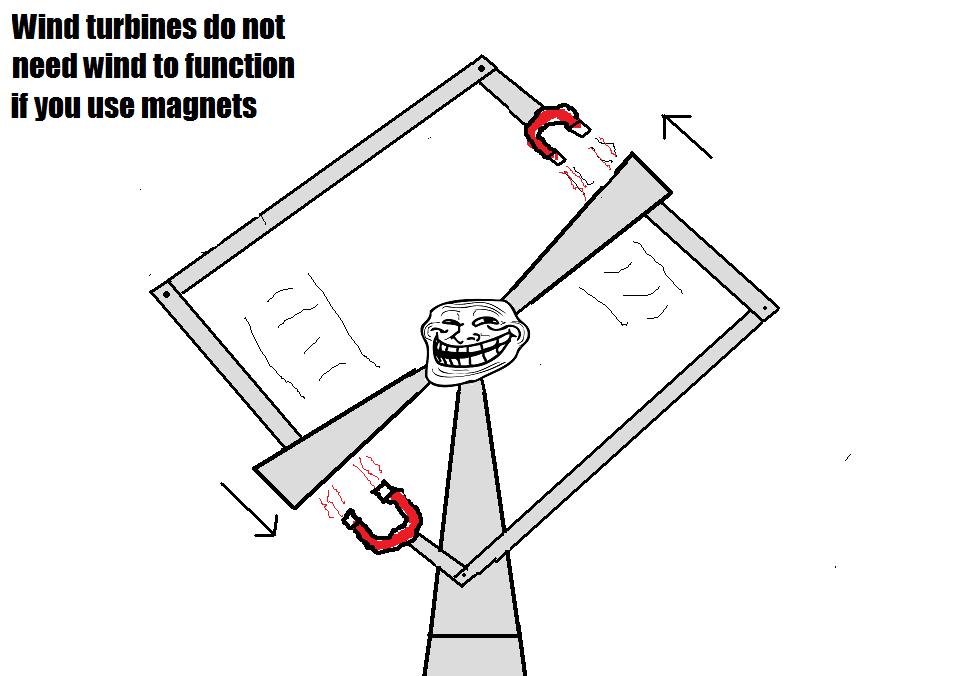
Magnets. How do they work?
lol
"Hope is a good thing, maybe the best of things, and no good thing ever dies"
NOTIFY: Y | REPLY | REPLY WITH QUOTE | PERMALINK | TOP | HOME
Quote:Would you say the same for cold fusion? Or homeopathy? Or anti-gravity?
Originally posted by citizen:
I.e. the mountain of evidence against perpetual motion is so steep, dismissing it out of hand at this stage isn't pathological scepticism.
-------
Everything I say is just my opinion, not fact.
NOTIFY: Y | REPLY | REPLY WITH QUOTE | PERMALINK | TOP | HOME
Quote:
Originally posted by canttakesky:Quote:Would you say the same for cold fusion? Or homeopathy? Or anti-gravity?
Originally posted by citizen:
I.e. the mountain of evidence against perpetual motion is so steep, dismissing it out of hand at this stage isn't pathological scepticism.
Cold Fusion, no, Cold Fusion is perfectly possible, since it's merely fusing atoms at lower temperatures. In fact we know it happens, whether we can do it or not is a different matter.
Anti-Gravity is something I'd be dubious of more or less out of hand at the moment, mainly because the people doing it are nearly exclusively people who should be on prodigious amounts of medication. If there was a source of good quality that provided a paper on the subject I'd listen, but this is such a well trod subject by crazy talkers I'd admit that if just Joe anybody voiced it I'd switch off.
Homoeopathy. Well if a Homoepathist(?) ever tried to actually prove word one of their claims I might just listen out of novelty if nothing else. However there is, frankly, a mountain of evidence showing that it doesn't work, or works no better than a placebo which is precisely the same thing, and absolutely none to say it has any quantifiable effect. What's more most of the time Homoeopathy seems to find the very idea they should prove their claims as insulting and some concept dragged up by a "big pharma conspiracy".
I doubt Homoeopathy will ever be an issue, because I don't think they'll ever even try to provide scientific evidence, they haven't so far.
--------------------------------------------------
If you play a Microsoft CD backwards you can hear demonic voices. The scary part is that if you play it forwards it installs Windows.
NOTIFY: Y | REPLY | REPLY WITH QUOTE | PERMALINK | TOP | HOME
Quote:ROFL. You one funny man.
Originally posted by TheHappySockpuppet:
Some scientist are bi-curious, flirting with religion of all things. Most scientist view these as sluts.
-------
Everything I say is just my opinion, not fact.
NOTIFY: Y | REPLY | REPLY WITH QUOTE | PERMALINK | TOP | HOME
This is how F@*Kin' Magnets work.


NOTIFY: Y | REPLY | REPLY WITH QUOTE | PERMALINK | TOP | HOME
Quote:
Originally posted by canttakesky:
So, what IS science?
Science is the study of "why" and "how".
Engineering is the application of "why" and "how".
I note for the record that religon is the sudy of the application of "why" and "how".
H
"Hero. I have come to respect you." "I am forced to agree with Hero here."- Chrisisall, 2009.
"I would rather not ignore your contributions." Niki2, 2010.
NOTIFY: Y | REPLY | REPLY WITH QUOTE | PERMALINK | TOP | HOME
Quote:
Science is the study of "why" and "how".
Engineering is the application of "why" and "how".
I note for the record that religon is the sudy of the application of "why" and "how".
Therefore God is a robot.
http://tvtropes.org/pmwiki/pmwiki.php/Main/SufficientlyAdvancedAlien
NOTIFY: Y | REPLY | REPLY WITH QUOTE | PERMALINK | TOP | HOME
Quote:
God is a robot.
That explains a lot.
NOTIFY: Y | REPLY | REPLY WITH QUOTE | PERMALINK | TOP | HOME
Quote:Two questions, out of curiosity:
Originally posted by citizen:
I.e. the mountain of evidence against perpetual motion is so steep, dismissing it out of hand at this stage isn't pathological scepticism.
1. Since there is a mountain of evidence against perpetual motion, could you perhaps submit just one example from this mountain? What kind of evidence have you seen that is "against" perpetual motion?
2. If someone said the revolution of a planet around a star is "perpetual," how would you argue that this was not an example of "perpetual motion"?
-------
Everything I say is just my opinion, not fact.
NOTIFY: Y | REPLY | REPLY WITH QUOTE | PERMALINK | TOP | HOME
Quote:
Originally posted by citizen:
The Wright Brothers didn't invent flight, nor heavier than air flight. The Wright Brothers get most of the press, at least partly because the people who did it before them weren't as canny with marketing, and partly because they weren't American.
Sour grapes much? The Wright brothers invented controlled powered flight. Their methods have been improved upon, but the majority of aviation today uses a design recognizable as one the Wrights flew.
As far as foreigners competing and being out-marketed by the Wrights, their primary competitor was Glenn Curtiss. The Wright company eventually went into powerplants. Curtiss' company thrived up through WW2. When it merged with another competitor.
Most of the aircraft flown by the combatants in WW1 were produced by foreign companies. I don't see how American aircraft companies out marketed anyone.
And regarding science falling on its face. Here's a list of some radical concepts in science that were resoundingly denied when they debuted.
Arrhenius (ion chemistry)
Alfven, Hans (galaxy-scale plasma dynamics)
Baird, John L. (television camera)
Bakker, Robert (fast, warm-blooded dinosaurs)
Bardeen & Brattain (transistor)
Bretz J Harlen (ice age geology)
Chandrasekhar, Subrahmanyan (black holes in 1930)
Chladni, Ernst (meteorites in 1800)
Crick & Watson (DNA)
Doppler (optical Doppler effect)
Folk, Robert L. (existence and importance of nanobacteria)
Galvani (bioelectricity)
Harvey, William (circulation of blood, 1628)
Krebs (ATP energy, Krebs cycle)
Galileo (supported the Copernican viewpoint)
Gauss, Karl F. (nonEuclidean geometery)
Binning/Roher/Gimzewski (scanning-tunneling microscope)
Goddard, Robert (rocket-powered space ships)
Goethe (Land color theory)
Gold, Thomas (deep non-biological petroleum deposits)
Gold, Thomas (deep mine bacteria)
Lister, J (sterilizing)
T Maiman (Laser)
Margulis, Lynn (endosymbiotic organelles)
Mayer, Julius R. (The Law of Conservation of Energy)
Marshall, B (ulcers caused by bacteria, helicobacter pylori)
McClintlock, Barbara (mobile genetic elements, "jumping genes", transposons)
Newlands, J. (pre-Mendeleev periodic table)
Nott, J. C. (mosquitos xmit Yellow Fever)
Nottebohm, F. (neurogenesis: brains can grow neurons)
Ohm, George S. (Ohm's Law)
Ovshinsky, Stanford R. (amorphous semiconductor devices)
Pasteur, Louis (germ theory of disease)
Prusiner, Stanley (existence of prions, 1982)
Rous, Peyton (viruses cause cancer)
Semmelweis, I. (surgeons wash hands, puerperal fever )
Steen-McIntyre, Virginia (southwest US indians villiage , 300,000BC)
Tesla, Nikola (Earth electrical resonance, "Schumann" resonance)
Tesla, Nikola (brushless AC motor)
J H van't Hoff (molecules are 3D)
Warren, Warren S (flaw in MRI theory)
Wegener, Alfred (continental drift)
Wright, Wilbur & Orville (flying machines)
Zwicky, Fritz (existence of dark matter, 1933)
Zweig, George (quark theory)
Quote:
"Concepts which have proved useful for ordering things easily assume so great an authority over us, that we forget their terrestrial origin and accept them as unalterable facts. They then become labeled as 'conceptual necessities,' etc. The road of scientific progress is frequently blocked for long periods by such errors." - Einstein
The more I get to know people the more I like my dogs.
...and he that has no sword, let him sell his garment, and buy one. Luke 22:36
NOTIFY: Y | REPLY | REPLY WITH QUOTE | PERMALINK | TOP | HOME
Quote:
Originally posted by canttakesky:
1. Since there is a mountain of evidence against perpetual motion, could you perhaps submit just one example from this mountain? What kind of evidence have you seen that is "against" perpetual motion?
2. If someone said the revolution of a planet around a star is "perpetual," how would you argue that this was not an example of "perpetual motion"?
Thank you.
Yes, it is one of many examples of perpetual motion. We also have a moon that orbits the earth, and creates tides. We have a convection oven of Geothermal inside the magma core, and inside that we have an absolutely tremendous electromagnetic field being generated by the magnetic core. Additionally, we have a transpiration/evaporation cycle which has been running on this planet for perhaps billions of years. When you go onto a cosmological scale, there are systems which appear to run forever, and some seem to increase in energy.
IMHO, the second law of thermodynamics itself is incorrect: The universe has been steadily been progressing towards a more ordered more highly differentiated state from a low energy state as far back as we can see.
The Newtonian universe only applies to small machines operating in a vacuum, because as far as what Newton could harness did fit this model more or less.
But everything does *not* operate in a vacuum. There are forces which generate energy in the universe, that are infinitely greater than ourselves, and that seem to only increase in energy over time, and on some models of the universe, those which I feel actually accurately describe the data that we have, this appears to increase indefinitely into the future.
I think it really took the advent of science fiction to be able to look into the world of science and see not just what *was* but what *could be*, and the major steps of HW Wells and Jules Verne, indispensable in this regard, and what I consider the real first step... Mary Shelley's Frankenstein, showed us just how far, possibly, science could take us.
The golden age gave us an endless amount of insight into things which would never have occurred to the mundane mind, showing us that, yes, it would actually be possible to set up a sailing ship which would cross the trade winds of the pacific by mechanical means alone, back and forth, forever. You could set up a rail system that traveled the countryside, stopping at each station, and moving on to the next, running on no internal power source to the train or the tracks, and I have tested this model and it does work, and I am not going to post it here just to win an argument over the internet, because I actually want to build it.
But beyond that, is my iPad not a perpetual motion machine? As long as the sun, or some light source, pours out energy which my solar collector can pick up, and as long as the circuitry shows no wear, I see no reason why it can't work forever.
Have you read about the molecular computer? This design was printed in Science News, and the machine relies on electron transfer on a nanotech level, and the machine does not wear, or use power, it recycles its own electrons to supply back to its own power supply, which runs forever.
Or the nanomotor?
These machines run forever without even any wear, and they do so because on a quantum mechanical level, the picowear that would normally seem to occur, or would be expected, simply does not happen, because the molecules which make up the switches and gears of a nanomachine repair themselves to perfection with every turn, as if by magic.
What scientists suspect is that the quantum mechanical subatomic particles are stablizing themselves internally by drawing from the energy of space time, which is infinite according to the current available data, and equally importantly, appears to be spontaneous created on the spot for the purpose.
When we step outside of the Newtonian world of kinetics, black boxes and heat engines, and into a world which stretches from string theory to cosmology, the nature of matter, energy and motion app
NOTIFY: Y | REPLY | REPLY WITH QUOTE | PERMALINK | TOP | HOME
Hardware
Nice list. Thanks.
Quote:
the majority of aviation today uses a design recognizable as one the Wrights flew.
One caveat, simply because he's my homeboy: The airplane model which was used ultimately was Curtiss'. Glenn Curtiss made some comment about "you could fly a bicycle in Kitty Hawk" (Those of us who have been there understand, IIRC, one of us lives there, so no offense ;) but you know what he means, it's a windy place, and there are some major cliffs.)
Now, maybe that's sour grapes on his part, since they beat him into the air, but he does have a point that they were cheating, they deliberately went to Kitty Hawk to exaggerate their chances, and the machine which they flew, on the re-enactment of their flight, actually didn't work. There's a fair amount I've seen that argues that it's not in fact a feasible design, outside of the wind itself, but people here who are pilots, please feel free to dispute that.
I was actually at the re-enactment of Glenn Curtiss' launch, and I have to say the reconstruction was perfect in materials and design down to the last detail, and the pilot who was to fly it was terrified. He actually said a final farewell to his whole family before getting in the plane. But that said, the plane took off beautifully, with no wind, from a flat surface, and he flew many miles around before coming back to land seamlessly where he had started.
So, not to deny the contributions made by the Wright Brothers to sustainable flight, I suspect old Glenn had a point: They were unable to fly their plane in their native Dayton, Ohio, because it wasn't really a stable flying machine.
Just picking up from the wikipedia entry on the Wright Brothers here
Curtiss' June Bug sustained flight, July 4, 1908, a month before the first demonstration flight of the wright brothers, but I cannot find that they ever had a windless or sustained flight. May 25, 1910, Orville Wright was able to demonstrate a flat take off and land, though it doesn't specify the length, and or that it was wind-independent.
Many of the inventions and innovations of science are like this, and someone gets the glory, but really everyone contributed to the result.
Oh, and yes, Curtiss was an American, and he's from right here in Hammondsport, where he flew the plane, and where they re-enacted the first flight and the first water-to-water flight, which was really a better idea, IMHO, since 90% of all crashes stem from land takeoff and landing errors.
NOTIFY: Y | REPLY | REPLY WITH QUOTE | PERMALINK | TOP | HOME
Quote:
Originally posted by citizen:
Anti-Gravity is something I'd be dubious of more or less out of hand at the moment, mainly because the people doing it are nearly exclusively people who should be on prodigious amounts of medication. If there was a source of good quality that provided a paper on the subject I'd listen, but this is such a well trod subject by crazy talkers I'd admit that if just Joe anybody voiced it I'd switch off.
Then why not dig up Townsend Browns work and Project WINTERHAVEN, now declassified ?
Hell, Brown had a functional prototype goin at one time.
-F
NOTIFY: N | REPLY | REPLY WITH QUOTE | PERMALINK | TOP | HOME
Quote:
Originally posted by canttakesky:Quote:Two questions, out of curiosity:
Originally posted by citizen:
I.e. the mountain of evidence against perpetual motion is so steep, dismissing it out of hand at this stage isn't pathological scepticism.
1. Since there is a mountain of evidence against perpetual motion, could you perhaps submit just one example from this mountain? What kind of evidence have you seen that is "against" perpetual motion?
The laws of thermodynamics are the most well supported concepts in physics, you're really demanding I submit evidence for them here? That's the pathological scepticism you were talking about ;).
Every thermodynamics experiment on the subject proves Thermodynamics, the second law of thermodynamics is proven when a broken vase doesn't magically reform without external energy input. But still, not that it's at all necessary at this stage:
www.physik.uni-augsburg.de/~campismi/campisiSHPMP2.pdf
Quote:
2. If someone said the revolution of a planet around a star is "perpetual," how would you argue that this was not an example of "perpetual motion"?
I'd suggest that "someone" doesn't understand what is meant by perpetual motion. Perpetual motion is where a closed system creates more energy than it has applied to it. A planet orbiting a star isn't a closed system, Q.E.D.
Further orbiting bodies pull energy out of the system, on a long enough time frame orbits change and collapse of their own accord.
You really missed the closest thing to a gotcha I'm afraid though. Thought Experiment:
You place an object in a perfect vacuum, with zero gravitational forces acting on it, and set it spinning. Does it ever stop? No. Is it a perpetual motion machine? No, because as we can plainly see it's merely acting under the dictates of First Law of Motion, acting under all the external forces that have been applied to it. Besides there's no where in the universe with zero gravitational forces nor a perfect vacuum.
NOTIFY: Y | REPLY | REPLY WITH QUOTE | PERMALINK | TOP | HOME
Quote:
Originally posted by Hardware:
Sour grapes much?
Note really, just noting how the myth of the Wrights inventing flight is so pervasive.
Quote:
Originally posted by Hardware:
The Wright brothers invented controlled powered flight.
Ah, so you agree with me. They didn't invent powered flight, or heavier than air-flight, they invented the aileron which I'd agree with, since previous designs used somewhat inefficient wing warping, or just no control altogether.
Of course I never said they didn't make the first powered controlled manned heavier than air-flight. I said they didn't invent powered heavier than air flight. And they didn't.
Quote:
Originally posted by Hardware:
Most of the aircraft flown by the combatants in WW1 were produced by foreign companies. I don't see how American aircraft companies out marketed anyone.
You word this like it's a rebuttal to something I said, but since I never claimed American companies out marketed anyone that would seem strange. I said the wrights marketed themselves as the first to produce flight, which has been the enduring myth, and isn't true.
Quote:
Originally posted by Hardware:
And regarding science falling on its face. Here's a list of some radical concepts in science that were resoundingly denied when they debuted.
...snip...
And yet all those things are now accepted by the "scientific establishment", proving that science is sceptical but that "radical new ideas" will gain traction if there's something to them. Or in other words, your list only goes to show that science works more or less pretty well and exactly how it's supposed to, that my original statements you're arguing against are correct and that the only thing falling on it's face is your argument :p.
NOTIFY: Y | REPLY | REPLY WITH QUOTE | PERMALINK | TOP | HOME
Quote:I see. So you are defining perpetual motion in such a manner as to be contrary to the Second Law of Thermodynamics.
Originally posted by citizen:
I'd suggest that "someone" doesn't understand what is meant by perpetual motion. Perpetual motion is where a closed system creates more energy than it has applied to it.
This is what Wiki says:
Quote:
Perpetual motion describes hypothetical machines that operate or produce useful work indefinitely and, more generally, hypothetical machines that produce more work or energy than they consume, whether they might operate indefinitely or not.
I would have gone with just the first part: "hypothetical machines that operate or produce useful work indefinitely"--whether they produce more work or energy or not. But that is just me.
What would you say if someone said nuclear reactions (say, the sun) are an example of perpetual motion, as you defined it: producing more energy than it has applied to it?
-------
Everything I say is just my opinion, not fact.
NOTIFY: Y | REPLY | REPLY WITH QUOTE | PERMALINK | TOP | HOME
Well, just last night every major broadcast aired that a new study may link diet soda to strokes, however what they did not tell you was that there was no control for family history of strokes/heart attacks or weight.
Even worse is this whole idea, which was doomed to failure before it began, that most dieseases and behaviors have a genetic basis(Come on admit it you have bought into that since it was first sold and this is why dispite years and billions of dollars VERY few cures have come out of genetic mapping or biomed). We fail to see humanity in a simple naturistic manner, not in the way liberals see it. See, any baby born with the ability to see, that is then left in the dark for five years will lose the ability to see.
Only 7% of women with breast cancer have the "genetic marker" for tit cancer, and the % of women that have the marker and get cancer are slightly higher than those without.
I guess I am trying to say is scientific discovery is only as good as the manner in which it is conveyed to the rest of humanity. When we are constantly told how things "are", as if it were the word of god, and the reality is far different science becomes UNRELIABLE....think..the health benefits of eggs. Ask yourself this....Are they bad for you?
Now, I am going to go snort a bit of coke....Psst, it is good for you.
NOTIFY: N | REPLY | REPLY WITH QUOTE | PERMALINK | TOP | HOME
Quote:
Originally posted by citizen:
And yet all those things are now accepted by the "scientific establishment", proving that science is sceptical but that "radical new ideas" will gain traction if there's something to them. Or in other words, your list only goes to show that science works more or less pretty well and exactly how it's supposed to, that my original statements you're arguing against are correct and that the only thing falling on it's face is your argument :p.
My original idea as stated was that science rejects ideas that fly in the face of the establishment. You leapt to the defense of science. I provided proof to support my assertion. You are now trying to lay claim to the very thing you said did not happen.
Stop moving the goalposts. Oh, wait. You're doing exactly what the science establishment does.
Science is measurable and repeatable. Science establishment reproduces bad ideas rejecting new ideas with measurable repeatable results.
The more I get to know people the more I like my dogs.
...and he that has no sword, let him sell his garment, and buy one. Luke 22:36
NOTIFY: Y | REPLY | REPLY WITH QUOTE | PERMALINK | TOP | HOME
Quote:
Originally posted by canttakesky:Quote:I see. So you are defining perpetual motion in such a manner as to be contrary to the Second Law of Thermodynamics.
Originally posted by citizen:
I'd suggest that "someone" doesn't understand what is meant by perpetual motion. Perpetual motion is where a closed system creates more energy than it has applied to it.
This is what Wiki says:Quote:
Perpetual motion describes hypothetical machines that operate or produce useful work indefinitely and, more generally, hypothetical machines that produce more work or energy than they consume, whether they might operate indefinitely or not.
I would have gone with just the first part: "hypothetical machines that operate or produce useful work indefinitely"--whether they produce more work or energy or not. But that is just me.
Either way the definition I used is spot on, a machine that once set going doesn't stop even if no further force is applied to it. If you're extracting energy from the system (i.e. useful work) for the machine to carry on running it would have to be generating more energy that was put into it in the first place. If you think about it the longer definition is still implied by the shorter one you picked out.
Quote:
Originally posted by canttakesky:
What would you say if someone said nuclear reactions (say, the sun) are an example of perpetual motion, as you defined it: producing more energy than it has applied to it?
I'd say E=MC2. Those reactions are burning fuel, in the case of most types of Fusion Hydrogen, and releasing energy that is bottled up within the matter itself. In essence the Sun isn't producing more energy than it has had applied to it, it is converting one type of energy into another, and not at perfect efficiency either. Hence why one day the sun will "die".
Quote:
Originally posted by Hardware:
My original idea as stated was that science rejects ideas that fly in the face of the establishment. You leapt to the defense of science.
No, I said if a new idea has merit it will gain traction and be accepted. For your original assertion to hold any weight all those "radical new ideas" would have to still be dismissed by this secretive "scientific establishment" cabal you've fantasised into being.
Quote:
Originally posted by Hardware:
I provided proof to support my assertion.
And I pointed out that your "proof" supports my statements, and completely dismisses yours. You claim the scientific establishment won't accept anything that doesn't agree with current theory. I said that there was inertia against complete changes, but that if the new idea had merit it would eventually gain traction. If you can't see how a list of things that were originally rejected but then gained acceptance because they had merit fits what I have been saying all along, and disproves what you said, then I don't see any point talking to you further on this.
Quote:
Originally posted by Hardware:
You are now trying to lay claim to the very thing you said did not happen.
Either you didn't read my post, didn't understand it, or are making shit up. I said nothing of the sort.
Quote:
Originally posted by Hardware:
Stop moving the goalposts. Oh, wait. You're doing exactly what the science establishment does.
I'm not moving any goalposts, my position hasn't wavered a bit. It's you that claimed the "scientific establishment" won't accept new ideas; then decided to wave your arms around and start casting aspersions on people in a vain attempt to cover up the fact that all the new ideas you claimed weren't accepted by the insular scientific establishment, were in fact accepted by the self same "scientific establishment". I can't help it if logic isn't your strong point.
Quote:
Originally posted by Hardware:
Science isNOTIFY: Y | REPLY | REPLY WITH QUOTE | PERMALINK | TOP | HOME
Quote:Well, no.
Originally posted by CITIZEN:
Either way the definition I used is spot on, a machine that once set going doesn't stop even if no further force is applied to it.
Let's revisit the 2 definitions:
1. Perpetual motion describes hypothetical entities that operate or produce useful work indefinitely.
2. Perpetual motion is where a closed system creates more energy than it has applied to it.
In the case of a revolving planet, one person might say that was perpetual motion (#1) while you would say that doesn't meet your definition because it isn't a closed system that violates the 2nd Law of Thermodynamics (#2).
So the two definitions are not one and the same. They operate on different assumptions (e.g. closed vs open system). The second CAN be, but is not necessarily, implied by the first.
-------
Everything I say is just my opinion, not fact.
NOTIFY: Y | REPLY | REPLY WITH QUOTE | PERMALINK | TOP | HOME
Darn, I didn't want to get into this.
Wikipedia says this:
Quote:
The second law of thermodynamics is an expression of the tendency that over time, differences in temperature, pressure, and chemical potential equilibrate in an isolated physical system. From the state of thermodynamic equilibrium, the law deduced the principle of the increase of entropy and explains the phenomenon of irreversibility in nature. The second law declares the impossibility of machines that generate usable energy from the abundant internal energy of nature by processes called perpetual motion of the second kind.
Sounds to me like the definition of a perpetual motion machine requires it to violate the second law of thermodynamics. The concept of a perpetual motion machine (or entity) also seems to require it to be a closed system.
Not to say it couldn't be done, or that the second law is immutable (under certain conditions? Or that there's not a better law out there). But it'd definitely be a trick.
From the article on perpetual motion:
Quote:
While the laws of physics are incomplete and stating that physical things are absolutely impossible is un-scientific, "impossible" is used in common parlance to describe those things which absolutely cannot occur within the context of our current formulation of physical laws.
Also:
Quote:
Any proposed perpetual motion design offers a potentially instructive challenge to physicists: one is almost completely certain that it can't work, so one must explain how it fails to work.
It's entirely possible that dismissals of perpetual motion machines are a case of scientific moving the goalposts. However, some of it is also probably quackery, and so it's fair to be a little skeptical.
If someone could pull it off? Paradigm shift.
NOTIFY: Y | REPLY | REPLY WITH QUOTE | PERMALINK | TOP | HOME
Quote:
Originally posted by canttakesky:Quote:Well, no. In the case of a revolving planet, one person might say that was perpetual motion while you would say that doesn't meet your definition because it doesn't violate the 2nd Law of Thermodynamics.
Originally posted by CITIZEN:
Either way the definition I used is spot on, a machine that once set going doesn't stop even if no further force is applied to it.
So the two definitions are not one and the same. The second definition can be, but is not necessarily, implied by the first.
No, they couldn't, since you can't derive useful work from the orbit of a planet, which was a part of your butchered quote. An orbiting planet doesn't fulfil any criteria for a perpetual motion machine, since it's movement is due to an external force, and as I've already pointed out, a planet won't keep orbiting indefinitely, just a very long time. For instance the moon is slowly moving away from the Earth, due to energy loses from the very forces that keep it orbiting.
I'm not going to carry on with these silly semantics. The definition you keep pushing for is wrong, and harping on with this planet analogy merely shows a lack of understanding of orbital mechanics. Planets aren't perpetual motion machines, under any definition one cares to make up to attempt to redefine the term.
NOTIFY: Y | REPLY | REPLY WITH QUOTE | PERMALINK | TOP | HOME
Quote:
Originally posted by canttakesky:Quote:Well, no.
Originally posted by CITIZEN:
Either way the definition I used is spot on, a machine that once set going doesn't stop even if no further force is applied to it.
Let's revisit the 2 definitions:
1. Perpetual motion describes hypothetical entities that operate or produce useful work indefinitely.
2. Perpetual motion is where a closed system creates more energy than it has applied to it.
In the case of a revolving planet, one person might say that was perpetual motion (#1) while you would say that doesn't meet your definition because it isn't a closed system that violates the 2nd Law of Thermodynamics (#2).
So the two definitions are not one and the same. They operate on different assumptions (e.g. closed vs open system). The second CAN be, but is not necessarily, implied by the first.
-------
Everything I say is just my opinion, not fact.
I note, for the record, you neatly ignored the salient point of my post:
Quote:
If you're extracting energy from the system (i.e. useful work) for the machine to carry on running it would have to be generating more energy that was put into it in the first place.
Or it would have to have an energy supply from outside, which means it's not a perpetual motion machine, it's just an engine.
So by your definition, a generator hooked up to an oil refinery would be a perpetual motion machine. Which frankly makes your definition rather silly.
NOTIFY: Y | REPLY | REPLY WITH QUOTE | PERMALINK | TOP | HOME
Byte,
Perpetual motion within the confines of a closed system has been done with nanotechnology. One could argue that it's drawing energy from the fabric of space-time, but that's as much as saying that the concept closed system doesn't exist.
Ergo, the 2nd law, like the physics of its time, is simply out of date, and it all should be viewed as an approximation of systems on a human scale, like a steam engine. Since we know far more now than they did then, we know that the fact that there is no closed system can be exploited ad infinitem, so the restriction and rules thus applied become meaningless.
Quote:
In 1908 U.S. inventor, businessman and engine builder Glenn Curtiss flew an aileron-controlled aircraft. However Curtiss had previously been a member of the Aerial Experiment Association, headed by Alexander Graham Bell. The Association had previously developed ailerons for their aircraft.[3] The AEA members were later dismayed when Curtiss dropped out of their organization, patented their innovation and reportedly sold the patent to the United States Government.
This does not actually disprove the idea that Curtiss invented the aileron, which is claimed on several other entries, and the inclusion of Bell's name is meaningless, since Bell didn't really invent anything, the telephone was invented by Gray and Barton. But Curtiss was on a team that developed it, but it's entirely possible he invented it himself on that team.
That said, many similar innovations had proceeded it. As I said, many people had input into the final idea. I feel pretty confident with the idea that Curtiss created the completed entity that we call the airplane, but he did it our of pieces from all over. Gliders way preceded this.
NOTIFY: Y | REPLY | REPLY WITH QUOTE | PERMALINK | TOP | HOME
Quote:
Perpetual motion within the confines of a closed system has been done with nanotechnology. One could argue that it's drawing energy from the fabric of space-time, but that's as much as saying that the concept closed system doesn't exist.
Interesting, this makes immediate logical sense.
NOTIFY: Y | REPLY | REPLY WITH QUOTE | PERMALINK | TOP | HOME
Quote:Brilliant. Much better than bickering about semantics.
Originally posted by dreamtrove:
.... but that's as much as saying that the concept closed system doesn't exist.
-------
Everything I say is just my opinion, not fact.
NOTIFY: Y | REPLY | REPLY WITH QUOTE | PERMALINK | TOP | HOME
Thanks
NOTIFY: Y | REPLY | REPLY WITH QUOTE | PERMALINK | TOP | HOME
Quote:Oh no, I'm not pushing for it.
Originally posted by CITIZEN:
The definition you keep pushing for is wrong,
Let me spell out the points I AM pushing.
1. If you define X as an impossibility, X is going to be impossible, by definition. This is simply confirmation bias at its worst (or best?).
2. To me, it is more *useful* to consider a broader definition, then explore the various circumstances under which X can or cannot work. This is the spirit of science, testing and experimentation.
3. Science is not knowledge that X is impossible. It is a method by which we construct a predictive model. No models are perfect, therefore the best any model can do is say that X is highly improbable under the conditions of the model. Science IS uncertainty.
4. The 2nd Law of Thermodynamics is a pretty damn good model, but it is NOT religious dogma or the inspired Holy Scriptures of the God of Omni-Science. It has limitations and assumptions; it is subject to correction, change, improvement.
5. What I am pushing for is a different attitude about what science is: exploratory, uncertain, carefully qualifying assumptions, open to correction.
-------
Hell, the only reason the Government hates crime at all is that it despises competition. - Frem
NOTIFY: Y | REPLY | REPLY WITH QUOTE | PERMALINK | TOP | HOME
Quote:
Originally posted by canttakesky:
4. The 2nd Law of Thermodynamics is a pretty damn good model, but it is NOT religious dogma or the inspired Holy Scriptures of the God of Omni-Science. It has limitations and assumptions; it is subject to correction, change, improvement.
Which limitations and assumptions are you talking about preceisly?
The laws of Thermodynamics aren't actually a model. A model is a theory, the laws of Thermodynamics are scientific laws, not theories, which means they are descriptions of observed effects. The only way to overturn a scientific law is to prove that the experimental evidence is wrong, that the observed effect didn't, in fact happen. Theories get overturned all the time, because they're describing why a particular observed effect took place, so if a new theory better describes the observation, it's adopted. Since laws state "this happened" in order to overturn them you have to prove the evidence collected was wrong.
Since Thermodynamics are a fundemental set of laws to physics, you have to prove that pretty much every experiment ever done by every physicist was wrong, that physics doesn't in fact exist and then prove that the scientific method doesn't work. Which kinda Sure all that is "possible", in the vague way that it's also "possible" that I'm going to Quantum Tunnel into a new state, that just happens to be a limbo dancing super-intelligent shade of the colour blue called Rasputin-Charmichael the third. I'll keep you posted on that one, hasn't happened yet though.
As for "perpetual motion", regardless of which definition you choose to use, the word is "perpetual", never ending. If it's doing useful work it'll need a "perpetual", i.e. never ending, power source. Whether internal or external, whether closed or open or otherwise, if you can come up one example of a concievably infinte power source, I'll take a rusty nail and carve "fancy that" into the side of my cock, before telling Stephen Hawking he's wasted his life and that Physics is all bullshit. Deal?
Quote:
Originally posted by canttakesky:
5. What I am pushing for is a different attitude about what science is: exploratory, uncertain, carefully qualifying assumptions, open to correction.
And nothing I've said actually contradicts that. In fact that's pretty much exactly what I've been saying all along, others rephrasing of my words not withstanding. What gets old though CTS, and hopefully you won't take this the wrong way, but while you clearly understand the scientific method really well, you seem to instantly distrust anything mainstream to the point of "pathelogical scepticism", while accepting anything from the fringes with almost pathelogical open-mindedness. For instance in this thread you asked me to back up the most well supported set of physical laws we have, while congratualating Dreamtrove on his statments, and ignoring completely his babbling about vaccuum energy, and impossible nanotech magic machines.
For the record, it's easier to construct a "closed system" than it is to construct a "perpetual motion" machine.
NOTIFY: Y | REPLY | REPLY WITH QUOTE | PERMALINK | TOP | HOME
Yes, I have been drinking excessively, but that doesn't change the fact that Citizen is 100% correct. I can't tell you how painful that is for me to admit. The laws of Physics are the pillars of all science, those that call them into question without evidence are claiming knowledge superior to Newton and Einstein without showing any evidence. Those that believe such drivel are victims of the lure of the pseudo-science idiots that pollute our society today.
NOTIFY: Y | REPLY | REPLY WITH QUOTE | PERMALINK | TOP | HOME
CTS
You won. Why are you still arguing?
NOTIFY: Y | REPLY | REPLY WITH QUOTE | PERMALINK | TOP | HOME
Quantum Mechanics showed Einstein up. There are some who think Newton's Laws and his derived gravitation force between two objects are a smidgen off and need correction, and they're entirely respectable physicists who think that Dark Matter and Dark Energy are weak explanations for observed discrepancies in measurements - weak explanations that no one has yet been able to provide evidence for.
Even laws are not immune to our ever-improving understanding of the universe. Laws are meant to be broken.
NOTIFY: Y | REPLY | REPLY WITH QUOTE | PERMALINK | TOP | HOME
Quote:
Originally posted by CITIZEN:
Which limitations and assumptions are you talking about preceisly?
From Wikipedia:
Quote:
All laws of thermodynamics but the first are statistical and simply describe the tendencies of macroscopic systems. They are only strictly valid in the thermodynamic limit when a system has many states. For microscopic systems with few particles the assumptions of thermodynamics become meaningless.
The same concepts from a different source: http://ecee.colorado.edu/~bart/book/book/chapter1/ch1_4.htm
Quote:
Thermodynamics describes the behavior of systems containing a large number of particles. These systems are characterized by their temperature, volume, number and the type of particles. The state of the system is then further described by its total energy and a variety of other parameters including the entropy. Such a characterization of a system is much simpler than trying to keep track of each particle individually, hence its usefulness. In addition, such a characterization is general in nature so that it can be applied to mechanical, electrical and chemical systems.
The term thermodynamics is somewhat misleading as one deals primarily with systems in thermal equilibrium. These systems have constant temperature, volume and number of particles and their macroscopic parameters do not change over time, so that the dynamics are limited to the microscopic dynamics of the particles within the system.
From http://chemed.chem.purdue.edu/genchem/topicreview/bp/ch21/chemical.php
Quote:
One of the basic assumptions of thermodynamics is the idea that we can arbitrarily divide the universe into a system and its surroundings.
And so on and so forth.
-------
Hell, the only reason the Government hates crime at all is that it despises competition. - Frem
NOTIFY: Y | REPLY | REPLY WITH QUOTE | PERMALINK | TOP | HOME
Quote:I am not calling them into question. I fully accept the laws of physics.
Originally posted by Kirkules:
The laws of Physics are the pillars of all science, those that call them into question without evidence are claiming knowledge superior to Newton and Einstein without showing any evidence.
I am saying, EVERYTHING in science, including laws, axioms, and postulates, have an inherent uncertainty that makes it possible for self-correction. In other words, nothing in science is absolute.
In contrast, religion is all about dogmas being absolute and certain.
In a thread called "What is science?" I am attempting to make a distinction between "science" used with absolute certainty like a religion and science used as a self-questioning method of exploration.
-------
Hell, the only reason the Government hates crime at all is that it despises competition. - Frem
NOTIFY: Y | REPLY | REPLY WITH QUOTE | PERMALINK | TOP | HOME
Quote:
Originally posted by canttakesky:
...Quote:
One of the basic assumptions of thermodynamics is the idea that we can arbitrarily divide the universe into a system and its surroundings.
And so on and so forth.
I pulled this out specifically because it's fairly to the point. The assumption of the laws of Thermodynamics is the same assumptions of science itself, that the universe is real, and exists and can be studied and systematised. It would seem a moot point to say it has assumptions when they're of that nature, it would be like mentioning each time we talk that we're assuming this conversation is actually happening and this isn't a delusion.
I'm aware that Thermodynamics doesn't apply everywhere, but then it wasn't meant to. It applies to perpetual motion machines though.
Quote:
Originally posted by canttakesky:
I am saying, EVERYTHING in science, including laws, axioms, and postulates, have an inherent uncertainty that makes it possible for self-correction. In other words, nothing in science is absolute.
Yes of course, but you are taking that too far in a way. Just because we don't know everything, just because our current theories aren't perfect, doesn't mean that we know nothing or that anything is possible.
NOTIFY: Y | REPLY | REPLY WITH QUOTE | PERMALINK | TOP | HOME
Quote:
Originally posted by Bytemite:
Quantum Mechanics showed Einstein up. There are some who think Newton's Laws and his derived gravitation force between two objects are a smidgen off and need correction, and they're entirely respectable physicists who think that Dark Matter and Dark Energy are weak explanations for observed discrepancies in measurements - weak explanations that no one has yet been able to provide evidence for.
Even laws are not immune to our ever-improving understanding of the universe. Laws are meant to be broken.
All your examples are theories, not laws; as I've pointed out two very different things.
Given that Quantum Mechanics can't describe the Macro universe, and so we're still describing the universe as Einsteinian, it's hard to tell how QM has shown GR and SR up though. Since the current predictions of QM are disproved by experimental evidence when applied to things much larger than an electron, it would be just as correct, and just as wrong, to say Einstein showed up Quantum Mechanics. The fact is neither work in the others playground.
Secondly, Newton's Law of gravity was off, and was adjusted, because better tools of observation have shown that his observations were out by an order of magnitude. His law of gravity, however, wasn't shown to be wrong, it was shown to needing adjustment. That's the only way you can dismiss a scientific law, by showing all the evidence it describes and that supports it is wrong. It's a big task for any law, and for some, say Thermodynamics, they're so integral and well supported you'd have to throw science out along with them.
It's not to say that they're not open to investigation, but it is to say that if you think they don't work you better spend a number of years ensuring firstly that you aren't misunderstanding something, and secondly putting together a very long paper backed with more evidence than has been collected by all physicists across the last few centuries to date, because that's the bear minimum you'll need. Anyone who posts on an Internet forum claiming that Thermodynamics is wrong, doesn't understand thermodynamics, it's pretty much as simple as that; because if they did understand it, and still thought it didn't work, they'd be way too busy pulling enough evidence together to prove it to eat and sleep, let alone post on Internet forums.
NOTIFY: Y | REPLY | REPLY WITH QUOTE | PERMALINK | TOP | HOME
Quote:
Originally posted by CITIZEN:
Just because we don't know everything, just because our current theories aren't perfect, doesn't mean that we know nothing or that anything is possible.
You are saying that I am taking the first part too far into the second part.
1. We don't know everything ---> we know nothing.
2. Current theories aren't perfect ----> anything is possible.
What I actually believe is:
1. We don't know everything ----> We know plenty of things, just not with absolute certainty.
2. Current theories aren't perfect ----> Theories are subject to change upon preponderance of new evidence.
3. Science is about exploring possibilities. ----> Scientists have to be OPEN to anything being possible in order for science to work. (They have faith that the scientific method is very, very good at sorting out crazy possibilities from real possibilities, so they are not afraid of being open to all possibilities.)
4. Fortunately, science demands a high standard of evidence before declaring what is "possibly" true into what is "probably" true.
So, no. Not just no, but no-HELL-no. I do not believe "We know nothing" or that "Anything is possible." And I never said any such thing.
I never asked you to provide evidence for the 2nd Law of Thermodynamics either. I asked you to provide just one piece of evidence (from the mountain you claimed exists) that perpetual motion is impossible. Your answer was you defined it as a violation of the 2nd Law of Thermodynamics. The reason I asked was because there is no empirical evidence that anything is "impossible," (that is not how the scientific method works since you cannot test impossibility in experimentation) so I was curious why you would say such a thing.
I never accepted DT's nanotech perpetual motion assertion. What I found brilliant was his underscoring of both assumptions behind the laws of thermodynamics: 1) it is a statistical model based on the known and observed behavior of macroscopic systems, and does not apply in microscopic ones; 2) the boundaries of a "closed" system are arbitary. If you WERE to find events where these assumptions come into question or don't apply, then there exists a hypothetical possibility that the 2nd Law doesn't apply and perpetual motion would not violate it. You would then form a hypothesis and test it per the scientific method.
I wish you would not tell me how awful my ideas are based on what you think my ideas are, because you are usually wrong about what I believe. I would rather that you asked me, "CTS, do you actually believe that we know nothing? Or did you just accept DT's nanotech perpetual motion idea without any evidence? Or do you really believe that there is a real possibility there are people with unicorn horns in their foreheads who can make a wish any time they want just by holding their horns?"
And I would tell you, "No, I don't believe those things. But thank you for asking instead of just assuming."
-------
Hell, the only reason the Government hates crime at all is that it despises competition. - Frem
NOTIFY: Y | REPLY | REPLY WITH QUOTE | PERMALINK | TOP | HOME
Quote:
Originally posted by canttakesky:
And I would tell you, "No, I don't believe those things. But thank you for asking instead of just assuming."
Nice victim card. I'm sorry you don't like being treated the way you treat others.
Quote:
Originally posted by canttakesky:
You are saying that I am taking the first part too far into the second part.
I'm basing my statements on how you behave, not what you claim to believe. As I mentioned earlier, I know you understand the scientific method very well, I've also noticed that the way you apply that knowledge is highly dependent on the source of information. I actually made no statements about what you believed,just the way you acted.
Quote:
I never asked you to provide evidence for the 2nd Law of Thermodynamics either. I asked you to provide just one piece of evidence (from the mountain you claimed exists) that perpetual motion is impossible. Your answer was you defined it as a violation of the 2nd Law of Thermodynamics.
Interesting spin on it. The post you responded to said:
Quote:
Having said that, there are some things in science that are just so well supported there's not much point in giving things that claim to overthrow them much time. I'd put perpetual motion firmly in that category, because for it to work you have to prove the laws of thermodynamics are wrong, and to prove the laws of thermodynamics are wrong you pretty much have to prove all scientific evidence ever collected isn't only wrong, but never existed in the first place, that science doesn't really exist, and that everything from Aristotle to Hawking has been a delusion dreamed by a blue frog named Gerald.
I.e. the mountain of evidence against perpetual motion is so steep, dismissing it out of hand at this stage isn't pathological scepticism.
I note for the record when you quoted my post, you, as usual, whittled it down to just one sentence, and ignored the salient point. Neatly excising my statements about thermodynamics, I'd assumed at first that you did that to reduce redundancy, I see now you did it so you could lie about what I said. Taken in context, rather than the out of context edited state you presented it in, it's clear why I would think you're asking me to prove thermodynamics; because in the full context of what I was saying, that was exactly what you were asking. I'm sorry if I responded based on what I said, rather than what you wanted people to believe I said, but I wish you'd stop telling me what I said because you are usually wrong about it. I would rather you presented my statements honestly, and then maybe your attempts at playing the victim would hold more weight, if nothing else.
As usual when someone tries to discuss science with you, it ends up in pointless idiotic semantics and sophistry.
NOTIFY: Y | REPLY | REPLY WITH QUOTE | PERMALINK | TOP | HOME
Quote:It ends up with my pointing out that the person you are arguing with is made of straw, and not the real me.
Originally posted by CITIZEN:
As usual when someone tries to discuss science with you, it ends up in pointless idiotic semantics and sophistry.
-------
Hell, the only reason the Government hates crime at all is that it despises competition. - Frem
NOTIFY: Y | REPLY | REPLY WITH QUOTE | PERMALINK | TOP | HOME
Quote:
Originally posted by canttakesky:Quote:It ends up with my pointing out that the person you are arguing with is made of straw, and not the real me.
Originally posted by CITIZEN:
As usual when someone tries to discuss science with you, it ends up in pointless idiotic semantics and sophistry.
Yeah, you're right, it also ends up with you lying about what other people say.
NOTIFY: Y | REPLY | REPLY WITH QUOTE | PERMALINK | TOP | HOME
Quote:Nope. No lie.
Originally posted by citizen:
Yeah, you're right, it also ends up with you lying about what other people say.
My initial curiosity of "why you would say such a thing" was based on an incomplete understanding of how you defined perpetual motion. When you clarified that the impossibility was built into the definition, that misunderstanding was cleared up.
I never lied about your position or accused you of holding a position that wasn't explicitly stated.
-------
Hell, the only reason the Government hates crime at all is that it despises competition. - Frem
NOTIFY: Y | REPLY | REPLY WITH QUOTE | PERMALINK | TOP | HOME
Quote:
Originally posted by canttakesky:
I never lied about your position or accused you of holding a position that wasn't explicitly stated.
You've misrepresented my statements numerous times, and contrary to your assertion here, you also made a number of statements directly implying I'm some extremist dolt that sees science as an unchanging religion; despite nearly every post I've made reiterating the exact opposite. Through out you've misrepresented what I've said, and edited it down to portray it as something else. You throw the victim card around very readily, about how I'm strawmanning your statements, but the fact is I've had to spend half my time on this thread restating what I've already said to try and combat your redefining of my position.
At this point, after you've started hurling accusations around, I don't care if you did it on purpose or through some innocent misunderstanding, I don't see why I should give you more leeway or understanding than you're willing to dish out.
NOTIFY: Y | REPLY | REPLY WITH QUOTE | PERMALINK | TOP | HOME
Bump.
-------
Hell, the only reason the Government hates crime at all is that it despises competition. - Frem
NOTIFY: Y | REPLY | REPLY WITH QUOTE | PERMALINK | TOP | HOME
Meh, at one time it was scientific law, unassailable "fact" that the earth was flat.
At one time, it was scientific law, unassailable "fact" that the sun revolved around the earth.
And then some bloody heretic, some loony, a downright veritable kook, suggests that this might not be true - only to face flaming, scorn and persecution from the scientific community as they dig in and defend at all costs what their established understanding happens to be.
The more things change....
Tell me, did the earth BECOME round, did the earth suddenly change course to revolve around the sun, or perhaps did our understanding and comprehension of the world around us change ?
Because of some heretic who DARED QUESTION IT.
NOT because of the "this-is-the-way-it-is-so-sit-down-and-shut-up" conservative, hidebound traditionalist who'd rather flame and blame than accept the horrible thought that we might NOT know all their is to the world around us, that our understanding of the universe might be flawed, imperfect, incomplete.
Hell, take the "law" of gravity, it's a working theory that isn't even *complete* till you add ON THIS PLANET, and under certain circumstances, like the work of Townsend Brown, and certain spatial phenomenae, so far as my understanding of it, might not even apply universally even so.
But of course, one could always think that the established body of knowledge is all there is, and refuse to countenance any change - at which point learning stops, and when that happens, something within a person dies, it does.
Damn near every advancement we ever had, socially, medically, scientifically - started as an act of heresy, and I think if the human race has any saving grace whatsoever, it is that very ability, the driving NEED to question what *IS*, even in the face of other humans scorn and persecution - because without that one thing, I think we'd still be painting on the cave walls.
So here's to Heresy!
-Frem
I do not serve the Blind God.
NOTIFY: N | REPLY | REPLY WITH QUOTE | PERMALINK | TOP | HOME
Quote:Raising my cup to you, Fremmy.
Originally posted by Fremdfirma:
Damn near every advancement we ever had, socially, medically, scientifically - started as an act of heresy, and I think if the human race has any saving grace whatsoever, it is that very ability, the driving NEED to question what *IS*, even in the face of other humans scorn and persecution - because without that one thing, I think we'd still be painting on the cave walls.
So here's to Heresy!
And all's I's sayin' is this driving NEED to question what IS? THAT is science.
Which is why I love it so.
-------
Hell, the only reason the Government hates crime at all is that it despises competition. - Frem
NOTIFY: Y | REPLY | REPLY WITH QUOTE | PERMALINK | TOP | HOME
Quote:
Originally posted by Fremdfirma:
Meh, at one time it was scientific law, unassailable "fact" that the earth was flat.
There was never a scientific law that said the Earth was flat. Even if there had been consensus within "science" that the Earth was flat, that would have been a THEORY and not a LAW.
Quote:
Originally posted by Fremdfirma:
At one time, it was scientific law, unassailable "fact" that the sun revolved around the earth.
There was never a scientific law that the sun orbited the Earth. It's true that Geocentricism was (sort of) a scientific theory at one time, but it was a THEORY and not a LAW.
Quote:
Originally posted by Fremdfirma:
Hell, take the "law" of gravity, it's a working theory that isn't even *complete* till you add ON THIS PLANET, and under certain circumstances, like the work of Townsend Brown, and certain spatial phenomenae, so far as my understanding of it, might not even apply universally even so.
Hmm. This is, confused. Point one, very basic mistake you're obviously making: I don't know why but for some reason many people seem to think that a theory will, at some point, graduate to being a law. This isn't so, Laws and theories are two entirely different things. There is a law of Gravity, which works very well, even including THIS PLANET; there's also half a dozen theories of Gravity, but none of them are quite right. Law != Theory, theories and laws aren't the same thing.
A law describes an observed effect. Saying "the sun rises in the morning and sets on the other side of the sky in the evening" would be a scientific law. Describing why that event occurs would be a theory.
NOTIFY: Y | REPLY | REPLY WITH QUOTE | PERMALINK | TOP | HOME
Quote:They never used that nomenclature of "scientific law," but the certainty of a scientific law was there. "Earth is flat" was based on universal, empirical observations across the entire planet over millenia. Its predictive value of well, finding flat Earth no matter where you go, was extremely reliable. There was no doubt a consensus amongst scholars of the time.
Originally posted by CITIZEN:
There was never a scientific law that said the Earth was flat. Even if there had been consensus within "science" that the Earth was flat, that would have been a THEORY and not a LAW....
A law describes an observed effect. Saying "the sun rises in the morning and sets on the other side of the sky in the evening" would be a scientific law. Describing why that event occurs would be a theory.
As you say, describing the Earth as flat would be the equivalent of a scientific law. Describing WHY the Earth was flat would be a theory.
Quote:Well, in your own words, describing the observation that the sun orbits the Earth would be a law. Describing WHY the sun orbited the Earth would be a theory.
There was never a scientific law that the sun orbited the Earth. It's true that Geocentricism was (sort of) a scientific theory at one time, but it was a THEORY and not a LAW.
Here is a good article on laws vs. theories that reflects my thoughts on the topic very well. I can't say it better than this guy and highly recommend reading the entire article. I've taken the liberty of underscoring certain passages.
http://science.kennesaw.edu/~rmatson/3380theory.html
Quote:
As used in science, I think that it is important to realize that, in spite of the differences (see below), these terms share some things in common. Both are based on tested hypotheses; both are supported by a large body of empirical data; both help unify a particular field; both are widely accepted by the vast majority (if not all) scientists within a discipline. Furthermore, both scientific laws and scientific theories could be shown to be wrong at some time if there are data to suggest so.
Some scientists will tell you that the difference between them is that a law describes what nature does under certain conditions, and will predict what will happen as long as those conditions are met. A theory explains how nature works. Others delineate law and theory based on mathematics -- Laws are often times mathematically defined (once again, a description of how nature behaves) whereas theories are often non-mathematical. Looking at things this was helps to explain, in part, why physics and chemistry have lots of "laws" whereas biology has few laws (and more theories). In biology, it is very difficult to describe all the complexities of life with "simple" (relatively speaking!) mathematical terms.
Regardless of which definitions one uses to distinguish between a law and a theory, scientists would agree that a theory is NOT a "transitory law, a law in waiting". There is NO hierarchy being implied by scientists who use these words. That is, a law is neither "better than" nor "above" a theory. From this view, laws and theories "do" different things and have different roles to play in science. Furthermore, notice that with any of the above definitions of law, neither scientists nor nature "conform" to the law. In science, a law is not something that is dictated to scientists or nature; it is not something that a scientist or nature has to do under threat of some penalty if they don't conform.
-------
Hell, the only reason the Government hates crime at all is that it despises competition. - Frem
NOTIFY: Y | REPLY | REPLY WITH QUOTE | PERMALINK | TOP | HOME
Quote:
Originally posted by canttakesky:
They never used that nomenclature of "scientific law," but the certainty of a scientific law was there.
No, not that that is a particularly relevant objection. Further the "certainty" isn't what makes it a scientific law, what makes it a scientific law is whether or not it's a description of an observed effect.
Quote:
Originally posted by canttakesky:
"Earth is flat" was based on universal, empirical observations across the entire planet over millenia.
Scientific theories are based on empirical observation. Laws are descriptions of empirical observation. That's the difference.
Quote:
Originally posted by canttakesky:
Its predictive value of well, finding flat Earth no matter where you go, was extremely reliable. There was no doubt a consensus amongst scholars of the time.
There might well have been, but it was never really a scientific theory, and it sure as hell was never ever a scientific law.
Quote:
Originally posted by canttakesky:
As you say, describing the Earth as flat would be the equivalent of a scientific law.
Well, it didn't take long for "me" to start putting words in "your" mouth again did it? Where, pray tell, did I say any such thing? If there had been any "Law" it would be "we can't see any curvature here", not "the Earth is flat". Your whole supposition is nothing more than sophistry, equivocation at best.
Quote:
Originally posted by canttakesky:
Describing WHY the Earth was flat would be a theory.
No, describing why the Earth APPEARS flat to their observations would be the theory. The law, at best would be "the Earth looks flat". The Theory would be "it looks flat because it is flat". You could also say "it appears flat because it's a very big sphere". See how two explanations can be used without changing the underlying observation at all?
Subtle difference perhaps, but still one that produces a vastly different meaning.
Quote:
Well, in your own words, describing the observation that the sun orbits the Earth would be a law. Describing WHY the sun orbited the Earth would be a theory.
And again "I" put words in "your" mouth, huh. No my own words, said "the sun appears to move across the sky". Saying it appears so because the Sun circles the Earth is STILL a theory.
Don't believe me that geocentricism was a theory?
Quote:
The geocentric theory is the belief that the Earth is the center of the universe and that all other objects orbit around it. This outdated and disproved theory is often attributed to Ptolemy.
http://www.universetoday.com/71978/geocentric-theory/
Quote:
In astronomy, the geocentric model (also known as "geocentrism", or the Ptolemaic view of the whole universe), is the superseded theory, that the Earth is the center of the universe, and that all other objects orbit around it.
http://en.wikipedia.org/wiki/Geocentric_model
Quote:
Originally posted by canttakesky:
Here is a good article on laws vs. theories that reflects my thoughts on the topic very well. I can't say it better than this guy and highly recommend reading the entire article. I've taken the liberty of underscoring certain passages.
And I'll take your underscoring, and quote myself, to take the wind out of any possible "misunderstanding" you may have about my position:
Quote:
Furthermore, both scientific laws and scientific theories could be shown to be wrong at some time if there are data to suggest so.
Quote:
Originally posted by Citizen:
The only way to overturn a scientific law is to prove that the experimental evidence is wrong, that the observed effect didn't, in fact happen.
Clearly noting that it's possible to overturn a Law, just that it's very hard. I also
NOTIFY: Y | REPLY | REPLY WITH QUOTE | PERMALINK | TOP | HOME
Quote:Quote:
Originally posted by canttakesky:
As you say, describing the Earth as flat would be the equivalent of a scientific law.
Well, it didn't take long for "me" to start putting words in "your" mouth again did it? Where, pray tell, did I say any such thing?
"A law describes an observed effect. Saying 'the sun rises in the morning and sets on the other side of the sky in the evening' would be a scientific law. Describing why that event occurs would be a theory."
Quote:I thought you didn't like to argue semantics.
The law, at best would be "the Earth looks flat".
The Earth "looks" flat. "Describing the Earth as flat." Whatever. The concept of a flattish, flat-looking Earth is a description of an observed effect (in your own words), and therefore should qualify by your definition, as a law and not a theory. An explanation of WHY the Earth appears flat (such as it was a platter lying on the back of a chain of turtles), that would be a theory, in your own words.
-------
Hell, the only reason the Government hates crime at all is that it despises competition. - Frem
NOTIFY: Y | REPLY | REPLY WITH QUOTE | PERMALINK | TOP | HOME
Quote:
Originally posted by canttakesky:Quote:Quote:
Originally posted by canttakesky:
As you say, describing the Earth as flat would be the equivalent of a scientific law.
Well, it didn't take long for "me" to start putting words in "your" mouth again did it? Where, pray tell, did I say any such thing?
"A law describes an observed effect. Saying 'the sun rises in the morning and sets on the other side of the sky in the evening' would be a scientific law. Describing why that event occurs would be a theory."
Read the quote again. I asked where I said that the "Earth is flat is a scientific law", and you quote me saying "the sun rises in the morning". Your quote doesn't support your claim, I'd say try again, but I'm done playing shadow for your strawman.
Quote:
I thought you didn't like to argue semantics.
I thought you didn't lie about what people say. But here you are, claiming I said things I didn't say.
Quote:
The Earth "looks" flat. "Describing the Earth as flat." Whatever. The concept of a flattish, flat-looking Earth is a description of an observed effect (in your own words), and therefore should qualify by your definition, as a law and not a theory. An explanation of WHY the Earth appears flat (such as it was a platter lying on the back of a chain of turtles), that would be a theory, in your own words.
It's not semantics to say two sentences that say two entirely different things are different sentences. It is dishonest to claim I'm saying things I haven't said, and have actually flatly told you I wasn't saying, though.
No, not in my words. Very much not in MY own words. THEY are YOUR words, that you're attempting to attribute to me. Well, I tried to set you straight about what I was saying, but you've ignored me. I'm playing Ferdinand in a production of the Tempest, so I'm going to learn my lines, because I'm clearly just wasting my time here.
Outside of this I actually quite like you, so I'll catch you later, have a nice Saturday, peace.
NOTIFY: Y | REPLY | REPLY WITH QUOTE | PERMALINK | TOP | HOME
Quote:Are you serious?
Originally posted by citizen:
Read the quote again. I asked where I said that the "Earth is flat is a scientific law", and you quote me saying "the sun rises in the morning".
-------
Hell, the only reason the Government hates crime at all is that it despises competition. - Frem
NOTIFY: Y | REPLY | REPLY WITH QUOTE | PERMALINK | TOP | HOME

LHCb looks forward to the 2030s
https://cerncourier.com/a/lhcb-looks-forward-to-the-2030s/
No, the James Webb Space Telescope Hasn’t Broken Cosmology
https://www.wired.com/story/no-the-james-webb-space-telescope-hasnt-br
oken-cosmology/
NOTIFY: N | REPLY | REPLY WITH QUOTE | PERMALINK | TOP | HOME
Quantum Physics and Cosmology and Nano tech and Artificial Intelligence and Psychology go into the realm of fringe
for some they are the more interesting subject because of the fringe nature
Who are the best Science nations doing discovers, writing papers, winning pirizes, per head of population it is now Switzerland, Monaco, Denmark, Japan, Norway, Falkland Islands, Singapore, Iceland, Macau, Hong Kong, Liechtenstein, Estonia, Portugal, Australia...and even the Vatican City
a population of French speakers at the French Southern and Antarctic Lands rank very high on science but now doubt supported by the French government
The USA has many discovers and so did Russia during the USSR and Soviet era but per head of population they now rank lower on the sciences.
Science is an evolution of the rational process, a modern systematized and organized knowledge about the various natural phenomena this can be obtained by careful mathematical experimentation, machines built to test theory, models created and keen observation.
The linguistics of the English term the word "science" came from the Latin word for knowledge scientia. An old language of Rome, the Latin term from a classical language belonging to the Italic branch of the Indo-European languages that word 'science' comes from a Latin word 'scientia' and originally meant 'knowledge' but used used more particularly to stand for 'systematic knowledge' In Asia they considered themselves the center in 'China' they had a term for Science which they still use 'Section' 'Learn or the Arts Studying' they don't really have an alphabet as we do in the West, in China and Japan instead a traditional picto Logogram indicative Pictograph morphemes symbol ideogram 'letters' with thousands upon thousands of characters ...this philosophy of 'Section' 'Learn or Study' two characters combined into an idea has philosophically spread from China through Asia, Japan, the Koreas, Vietnam a very similar but maybe somewhat different view on science. Biology becomes Live or 'Life' combined with Thing or Things and Learning Study, Chemistry becomes Chemical or Transformation and combined with a symbol for Science studies, and in Asia using Hazi or Kanji the term for Physics becomes a combination of Things / Item and Reasoning and combined with Science Study...because of how linguistics works some one of another culture might have a different view on the definition of 'science' with 'Words' across Asia there might be slight differences on meaning, a character from Japan which looks the same as a Chinese character may have a somewhat different linguistic meaning than its original character from China, the same for Cantonese or Vietnamese or Korean which use ChuHan or Han-ja, just as Spanish or English or French or German or Spanish have many words with a Latin or Greek root but with a slightly different linguistic meaning, languages and cultures might have a slightly different definition of sciences.
The process of science a very mathematical, the methodological naturalism aimed at new findings, accuracy obtained in the exact measurement of physical quantities and systematic way of building up knowledge, consists of observing the world by watching, listening, observing, and recording while applying reasoning and rational thinking, acting as a scientist controlled experimentation allows us to see whether the small thing we change makes any difference.
The process of the sciences, Botany also called plant science, Geography evolves to geology is the study of Earth — its interior and the exterior surface. Other evolutions or Plant science, an evolution from mystic Alchemy to Chemistry, Balloons and Aeronautics and Aircraft, Material science and Ship building, Animal Biology, an evolution in Mathematics and then Astronomy and Celestial mechanics, Planetary Science, Orbital mechanics, the smaller stuff that made the Atom studied at Cern and Fermilab, Computer science,
NOTIFY: N | REPLY | REPLY WITH QUOTE | PERMALINK | TOP | HOME
Universities Reeling from Trump Cuts Fear for a ‘Lost Generation’ of Scientists
https://www.scientificamerican.com/article/trump-cuts-threaten-univers
ities-could-lead-to-lost-generation-of-scientists/
Trump cuts threaten a measurement lab critical for advanced chips and medical devices
https://www.npr.org/2025/03/26/nx-s1-5340687/trump-cuts-nist-atomic-sp
ectra-lab-advanced-chips-medical-devices
NOTIFY: N | REPLY | REPLY WITH QUOTE | PERMALINK | TOP | HOME
Lysenkoism
The Most HATED Scientist of the Soviet Union
Trump is Mr Science Man?
and Science Given the Boot?
Opinion: Trump wants to disable NASA satellites measuring C02. Congress must not let him.
https://www.eastbaytimes.com/2025/08/28/opinion-trump-wants-to-disable
-nasa-satellites-measuring-c02-congress-must-not-let-him/
Why a NASA satellite that scientists and farmers rely on may be destroyed on purpose
https://www.npr.org/2025/08/04/nx-s1-5453731/nasa-carbon-dioxide-satel
lite-mission-threatened
NOTIFY: N | REPLY | REPLY WITH QUOTE | PERMALINK | TOP | HOME
NASA Works with Boeing, Other Collaborators Toward More Efficient Global Flights
https://www.nasa.gov/aeronautics/nasa-works-with-boeing/
Free Beer and Hot Wings Unexpected Duel With A Flat Earther
https://1057thehawk.com/ixp/1226/p/free-beer-hot-wings-flat-earth/
NOTIFY: N | REPLY | REPLY WITH QUOTE | PERMALINK | TOP | HOME
Trump funding cuts threaten US energy innovation, National Academies warns
https://www.eenews.net/articles/trump-funding-cuts-threaten-us-energy-
innovation-national-academies-warns/
‘Science saves lives’: Protesters march against research cuts in Madison
https://badgerherald.com/news/madison/2025/03/07/science-saves-lives-p
rotesters-march-against-research-cuts-in-madison/
Cancer survivors, veterans, scientists urge rally attendees to defend research funding
NOTIFY: N | REPLY | REPLY WITH QUOTE | PERMALINK | TOP | HOME
The World’s First Scientists? Mohism: Ancient China’s Engineers of Love and Peace
Amimisu
NOTIFY: N | REPLY | REPLY WITH QUOTE | PERMALINK | TOP | HOME
Nasa space telescope launches after surviving Trump budget cuts
https://www.theguardian.com/science/2026/aug/29/nasa-telescope-launch-
nancy-grace-roman
NOTIFY: N | REPLY | REPLY WITH QUOTE | PERMALINK | TOP | HOME